


Hi, I’m Hannah! Welcome to Nonlinear News, where I write for smart, ambitious people choosing the nonlinear path.
Today’s newsletter is a guest post from Sneha Rampalli, founder of Money Whispers, a community built around more honest conversations about women and money. Sneha left Google last year and now coaches women through career transitions. She also hosts Off the Table, a filmed dinner series about women’s real relationships with money.
I connected with Sneha through Substack a few months ago. Her work stood out to me because she tackles two questions that tend to pull in opposite directions during a career transition, and that a lot of us agonize over in our careers:
Will I find the next thing fulfilling? And will it financially support my life?
A lot of career advice tells you to follow your curiosity without mentioning your bank account; most financial advice tells you to protect your paycheck without asking what it might be costing you mentally and emotionally to stay.
So I asked Sneha to share how she approached both, together.
This is for anyone thinking about stepping off the linear path—whether you’re considering a startup offer with a lower salary and uncertain equity, a fractional or freelance career, a sabbatical, or any other move away from a predictable W-2. It won’t tell you whether to leave (only you can decide that), but it will give you three better questions to answer before you do.

A year ago, I left Google.
Every time I’ve picked up my phone in the last month, it feels like I have a new message asking me (I’m paraphrasing here): “How has your first year since quitting your job been, Sneha?”
Underneath that is usually another question: How did you know it was the right decision to leave?
The short answer is that I didn’t.
I left Google after five years, working on teams I had once dreamed of joining: Google Maps, Sidewalk Labs, and then Google Earth.
I still remember taking long walks around the Mountain View campus as an intern in 2018, daydreaming about what it would be like to work on the Geo for Good team. When I finally got there seven years later, I felt an amalgamation of emotions saying goodbye to the dream I once had.
Google had felt like the perfect combination: working on cool products, earning enough to be a financially independent woman, and being surrounded by some of the most intelligent people I’ve ever met, many of whom I feel lucky enough to call friends.
But making the decision to leave took three years of constant back and forth.
That is what makes golden handcuffs so effective. Your job doesn’t have to be terrible. It can give you interesting work, good people, excellent benefits, and a salary that makes leaving feel increasingly irrational.
One 26-year-old woman described the feeling to me this way recently:
“What is another promotion going to do? I get more money, it feels good for a day or two, and then the feeling fades. I get shuffled around to a new team to do work I don’t care about. But this is what pays for my life, and I’m not even sure what I want to do next. I just know I’m interested in autonomy and purpose.”
Maybe the next step for you is a startup with a lower base salary and equity you’re not sure how to value. Maybe you’re thinking about going fractional or freelance. Maybe you need a sabbatical after burning out. Or maybe you finally want to take a chance on working for yourself instead of someone else.
Whatever it is, working out the numbers can feel secondary to the bigger question: Can I actually trust myself to make this decision?
Everyone tells you to calculate your runway. But what about the opportunity cost of leaving your high-paying job? How does that runway actually sit with you? How do you decide what comes next?
Leaving your job is one of the few pivotal moments in life that is both deeply financial and deeply psychological. You can’t separate the calculations from your own relationship with money and financial ambiguity.
You can’t avoid the messy middle of figuring out what comes next. But you can go into it with better questions.
These are the three that helped me.
1. Are you making this decision from clarity or exhaustion?
Exhaustion and clarity can induce similar feelings but produce completely different outcomes.
Exhaustion can make you stay too long because you’re too tired to move. It can also make you leave impulsively because you’ve finally hit a wall.
That’s why I always say: before you touch your Excel spreadsheet, check what state you’re making the decision from.
If you took a real break, would you still want to leave? If your manager or team changed, would you feel differently? Are you moving toward something you want, or do you mostly need your current situation to stop?
As I’ve talked to people about leaving their jobs, I’ve noticed that many already know they need to calculate their runway. But it’s almost as if they need permission to take the next step.
The longer they delay the decision, the more they slowly lose their self-efficacy. They want to do something, but they aren’t acting on it.
You need to be bored first
People frequently think the antidote to exhaustion is optimism, but when you’re in that fog, anything optimistic can sound like toxic positivity.
The missing step between exhaustion and optimism is actually boredom.
I know “being bored” may sound oversimplified, maybe even a little insulting, especially if you’re someone who has time-blocked every 15min slot from Monday through Friday and you “don’t have time”. For someone wired to be hyperproductive, myself included, doing nothing on purpose is a discipline.
Your brain will reach for your phone before you’ve consciously decided to. That resistance is signaling how starved for idle time you actually are.
So I reiterate: go on a walk without headphones. Sit somewhere without your phone. Let your brain have space for emptiness.
I’m not saying you’re guaranteed to see a change within the first day, week, or even month, but diffuse thinking eventually allows you to gravitate toward what you want when you finally have the mental capacity to do so.
I’m a big believer that boredom reinstates creativity. Eventually, you feel restless. You want to do something. And guess what? Once your brain has that space, it feels a lot less daunting to ask questions about your bank account and credit card statements.
Before you make the decision, try writing down two lists:
What am I trying to move away from?
What am I trying to move toward?
If you have ten answers to the first question and none to the second, you may need recovery before you need a resignation letter.
2. What will it actually cost you to leave…and to stay?
Once you have enough capacity to look at the decision clearly, we can start talking numbers.
And I mean actual numbers, not a vague sense that you have “some savings” and a vague fear that it “won’t be enough.”
This is when you calculate what I call your Financial Oxygen Mask.
Your financial oxygen mask is the amount of time your savings can support you before earning income becomes urgent. It doesn’t tell you whether you should leave, but how long you can “breathe” while you figure out what comes next.
Calculating your Financial Oxygen Mask
Pull the last three months of bank and credit card statements from every account.
Add up everything: fixed expenses like rent, subscriptions, insurance, and loan payments, plus variable expenses like groceries, dining, transportation, therapy, and entertainment.
Average those three months. That number is what your life actually costs.
One month might contain an anomaly: a flight, a birthday dinner, or a car registration, so looking at three months allows you to see the pattern.
You can also calculate two versions:
Your minimum baseline: what you need to cover your obligations and live acceptably.
Your comfortable baseline: what it costs to maintain roughly your current lifestyle.
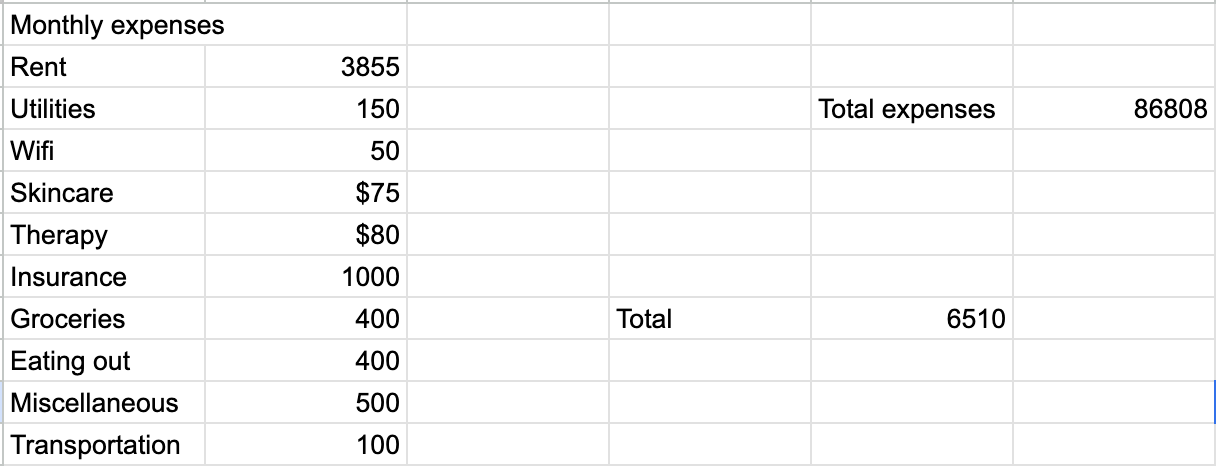
When I ran my numbers, I calculated that I needed $86,400 per year after taxes (or $7,200 per month) to live comfortably without adding anything to savings or investments. Here’s my real calculation:
How much of your savings is actually accessible?
Accessible means money you can get right now without a penalty: checking, savings, high-yield savings, and severance, if you have it.
Not your 401(k) or unvested equity. And not necessarily a taxable brokerage account you would rather not touch.
Technically, money in a taxable brokerage account (index funds, ETFs, or individual stocks) is accessible because you can sell it. But accessible and willing to access are two different things.
You might have $30,000 in index funds you’ve been building for years and decide you would rather extend your timeline or find income before touching them. That is a completely valid choice.
Be honest with yourself about which money you would actually draw from. Your real runway is built on money you would use, not money that technically exists.
Now divide
Financial oxygen mask = savings you are willing to use ÷ monthly baseline
That gives you the number of months you can support yourself before you absolutely have to make another move.
When I left Google, I ran this calculation and discovered that my runway was longer than my anxiety had been convincing me it was.
A few things may adjust your number (both up and down):
COBRA health insurance can cost significantly more than what you paid through your employer’s plan.
Pre-tax benefits and phone, transit, or gym stipends may disappear on your last day.
Your commuting costs, work lunches, and wardrobe maintenance may also go down.
If you’re starting a business, you may need to account for equipment, software, taxes, or other new expenses.
Run the numbers with those adjustments before making any decisions.
You can also model a few different realities:
No income during the transition
Some freelance or part-time income
A few months without income, followed by a conservative income estimate
Your oxygen mask is not a guaranteed prediction but a way to understand your range of possible outcomes.
Here’s one way to interpret the number:
Under three months: Income and health insurance are urgent decisions. Unless your circumstances require you to leave immediately, build a plan first.
Three to six months: You have some breathing room, but start income conversations now.
Six to twelve months: You have the runway to be intentional, especially if you set financial checkpoints.
More than twelve months: You have time to be selective about what comes next.
These aren’t universal rules. Someone with severance, access to a partner’s insurance, family support, or a job that is affecting their health will make a different decision from someone without those resources.
Your runway number isn’t just a financial fact but a psychological one too.
If you have eight months of runway but are acting as if you have two weeks, something is driving that urgency that isn’t the actual number.
You need to know your baseline because you won’t know how to get to your destination if you don’t know where you’re starting.
If you have trouble looking at this alone, Accredited Financial Counselors are a great resource, especially if you want specialized help with debt or cash-flow management. Taylor Nelsen, AFC® and Bethel Habte, AFC® are two I recommend. (This is not an ad, just my own endorsement!)
Don’t forget the opportunity cost of leaving
There’s another number worth adding to the runway calculation that most people skip: opportunity cost.
Every month you aren’t contributing to your 401(k), you may miss your own contribution, your employer match, and the future compounding growth on both.
Under the Google terms that applied to me, the match was either 100% of contributions up to $3,000 or 50% of contributions up to the IRS elective-deferral limit, whichever was greater.
Two months before I left, I maxed out my contributions so I could capture the 2025 match before my final day.
Make sure you check the terms that apply to you in your benefits portal.
The same logic applies to unvested equity. If you have RSUs or stock options on a vesting schedule, leaving before your next cliff or vesting date can mean leaving a meaningful amount of money on the table.
Before setting your final day, answer:
When is my next vesting date?
Have I hit my cliff?
How much equity would I be giving up?
What is my post-termination exercise window if I have stock options?
Is a bonus or employer contribution tied to a specific date?
A two-week difference in timing can mean a meaningful amount of money.
Then calculate the opportunity cost of staying
Opportunity cost runs in the opposite direction too. It may be harder to calculate, but it’s equally important to consider.
Every month you stay in a job you’ve outgrown, you are also making a financial choice. You are accepting the salary and benefits in exchange for delaying whatever you might otherwise build, learn, or pursue.
I want to give a moment to acknowledge that golden handcuffs make this especially difficult to internalize because the cost of leaving appears clearly on your Excel spreadsheet, but the cost of staying rarely does.
Sometimes staying changes the way you spend, too. Consumption fills the gap: the Sunday-scaries dinner out, the skincare haul, or the Euro-summer vacation you booked because you needed something to look forward to.
You may also begin underinvesting in yourself. You don’t join the rec soccer league, go on dates, meet new people, or build cool shit because you don’t have the energy to believe a different outcome is possible.
Staying may still be the right choice. But it should be a choice, rather than something that just happens to you because your paycheck made every alternative feel irresponsible or unimaginable.
3. What do you want your financial oxygen mask to make possible?
Now that you know your numbers, how do you make sure life doesn’t just happen to you?
You figure out what you value.
I used Brené Brown’s Dare to Lead values list to identify the values reflected in my life at the time and the ones I wanted to reflect a year later.
One year ago, my values were:
Financial stability
Compassion
Self-discipline
Gratitude
Harmony
What I wanted one year later:
Compassion
Connection
Learning
Perseverance
Integrity
Beyond compassion, I had a pretty big gap between the way I was living and what I wanted to be doing.
That was misalignment every damn day.
What was holding me back was the constant prioritization of financial stability. As someone who is vigilant about her money and took a LOT of pride in being financially responsible, I had to revisit my own money story.
The irony is that years of prioritizing financial stability were exactly what gave me the runway to ask these questions in the first place.
Letting go of that identity was scary, so I kept checking the facts against what my brain was telling me.
Life is expensive in New York. I checked my bank account weekly to compare the numbers with the emotions that came from no longer receiving a biweekly paycheck.
I also acknowledged the safety nets I had: a degree, a home that would take me in if I ever needed it, and confidence that I could find another job if I really needed one. Those resources shaped the risk I could take, and it would be dishonest not to include them.
I wasn’t trying to convince myself that nothing could go wrong. I wanted to train my brain to think beyond order and certainty, and to trust that I could make it through hard things.
Hence perseverance as the new value :)
If you’re a perfectionist who believes you need to do everything and be everywhere all at once, this will be a tough activity, but that’s exactly the point.
Narrow the list down to five words that reflect your life today vs. five you want to reflect your life a year from now.
Then ask:
Where is the biggest gap?
What is holding me inside that gap?
What would living in closer alignment actually look like?
What do I want my financial oxygen mask to give me the time to try?
The values are only useful if you translate them into action. If you choose connection, maybe that means two meaningful conversations each week. If you choose learning, maybe it means finishing a course or shipping a small project. If you choose autonomy, maybe it means controlling a specific part of your schedule.
Your runway gives you time and your values give that time a direction.
Reminder: your entire life is not this one life change
Once I completed the values exercise, the reframe that helped me let go of my financial-stability identity was realizing that this next decision didn’t have to determine my entire life.
I had been thinking about my career as one continuous spectrum, which made every decision feel permanent.
Instead, I started chunking my life into phases.
One phase can prioritize building, another can prioritize earning, and another might focus on connection, learning, caregiving, or stability.
Some call it a nonlinear career whereas I call it just life.
Leaving Google wasn’t about proving that I would never want or need a conventional job again but understanding what my body and mind needed before jumping ship for my next thing.
Sometimes, we look at our decisions with permanence, but I kept reminding myself that I wasn’t choosing the shape of my entire life. I was just choosing its next phase.
This decision is as much about money as it is about self-efficacy
I recently spoke with someone who told me:
“I’ve wanted to leave my job for a while, but I kept staying because there was always something on the horizon that made me think it would get better. Somehow, I’ve now been stuck in the same cycle for three years. I’m scared about the job market, especially because I want to try something new and don’t know how my skills transfer. I don’t have a strong gauge of my runway. I’m just so burnt out.”
I told her:
“When you continuously say you’re going to do something and then don’t do it, you stop trusting yourself. The inaction begins to take over like an insidious little monster.”
Her eyes bulged with relief.
“You are speaking my language,” she said. “That is exactly what I’m feeling.”
There’s something visceral and inescapable about losing trust in yourself.
The financial fear of leaving your job is huge. The psychological shift of no longer receiving a biweekly paycheck also takes time to get used to.
But what may be even more impactful than the lost paycheck is a hit to your self-efficacy: your belief in your ability to accomplish a particular task.
We think staying in a job we’ve outgrown is only emotionally expensive. But it can also become financially expensive in ways that will never appear on a spreadsheet.
You start believing this is your ceiling.
Right before I left Google, a mentor told me:
“It’s not about making the right decision. It’s about making a decision and making it the right one.”
We think trusting ourselves means predicting the future and knowing the outcome in advance. But we forget that humans have an uncanny ability to handle hard things.
We always have.
If you’re considering leaving, start here:
Give yourself enough space to distinguish exhaustion from clarity.
Calculate your financial oxygen mask.
Check the benefits, vesting dates, and other costs that could affect your exit.
Decide what you want your runway to make possible.
Set a date to make the decision (or revisit it if you decided you need more time).
Your financial oxygen mask tells you how long you can breathe, and your values give you a reason to use it.
Neither can eliminate uncertainty entirely, but together, they can help you make the decision from clarity instead of panic.
If any of this resonated, I write about the financial and emotional side of money through the lens of culture, career, and identity every week at Money Whispers.
Come find me there :)
With much love,
Sneha

✋ NexusPoint — Not a tool, but this is the best resource I’ve used so far for hiring assistants and editors overseas (and I’ve tried a LOT) - they take care of everything up to the point of hiring and don’t charge until you onboard someone → Book a free discovery call
💬 ManyChat — The tool behind every “comment X and I’ll DM you the link.” It auto-sends resources to everyone who comments, so I’m not manually replying to hundreds of DMs → Try ManyChat
💬 Stanley — If you’ve been wanting to post more consistently on LinkedIn, this is the writing partner I use. You’ll get a 3-day free trial with my link → Try Stanley
🎙️ Wispr Flow — Voice-to-text that actually works. I dictate messages, prompts, and emails instead of typing, and it saves me hours every week talking to AI → Try Wispr Flow
👩🏻💻 Fiverr — My go-to for hiring freelancers for things like design, editing, one-off projects (I use Fiverr Pro to save time on vetting talent) → Try Fiverr
🧊 Othership — The sauna/cold plunge I go to! → Try Othership with my discount
🧾 Xero — The accounting software running the back end of my business. Bookkeeping and invoices without me having to think about it → Try Xero
Yes!! I meet so many people who feel trapped by golden handcuffs but when they start to ask themselves specifics and write down details (like our burn rate), things begin to feel a lot less scary, especially when the alternative is spending out life feeling trapped instead of free.
Such a great piece about the kind of calculations that I made a year ago when i decided to leave meta. Although, I wish a larger part of the article would have elaborated on the self efficacy concept you brought at the very end. Ultimately, I think one of the decisive factors for me was gathering proofs for myself that this was not my ceiling, and there are easy ways to go about it, even without a side gig. Would love to discuss further!