


Hi, I’m Hannah! Welcome to Nonlinear News, where I write for ambitious people with unconventional paths. Follow me for ~weekly posts on pivots, portfolio careers, and personal brands.
💼 This week’s jobs in tech/startups (as always, reply to this email if you have a role you’d like to share with the community!)
📣 I’m building something new, and I need your help 📣
I’m working on something new for people who are ambitious, thinking about what’s next, and maybe feeling a little stuck.
If that sounds like you, I’d love to learn more about where you’re at right now.
I’d be grateful if you take 5min to fill out this survey. Your answers are shaping what I build next, and two people who complete it will win a $150 Amazon gift card as a thank you for your time!
One thing I’ve come to appreciate more as I get older is learning from people who are a few chapters ahead of me, especially when their paths look different from what I imagine for myself.
These conversations tend to challenge my assumptions in the best way, because if there’s one message I want you to take away from my content, it’s that there’s no one right way to build am ambitious, successful career.
Ed Essey is a Senior Director at Microsoft who built a 20-year career at the company and grew an Instagram audience of 100K+ in just the last few months, creating content for high performers in corporate.
There’s something grounding about hearing from someone who has seen multiple cycles, made tradeoffs over time, and built conviction slowly instead of chasing every new opportunity.
We talked about how Ed built cross-functional influence early in his career, why he started advocating for better work instead of waiting to leave, and the moment he realized his internal credibility wouldn’t translate outside Microsoft. We also discuss how he grew his Instagram to 100K+ followers and the framework he uses to help high performers who feel stuck.
(here’s a candid too!)
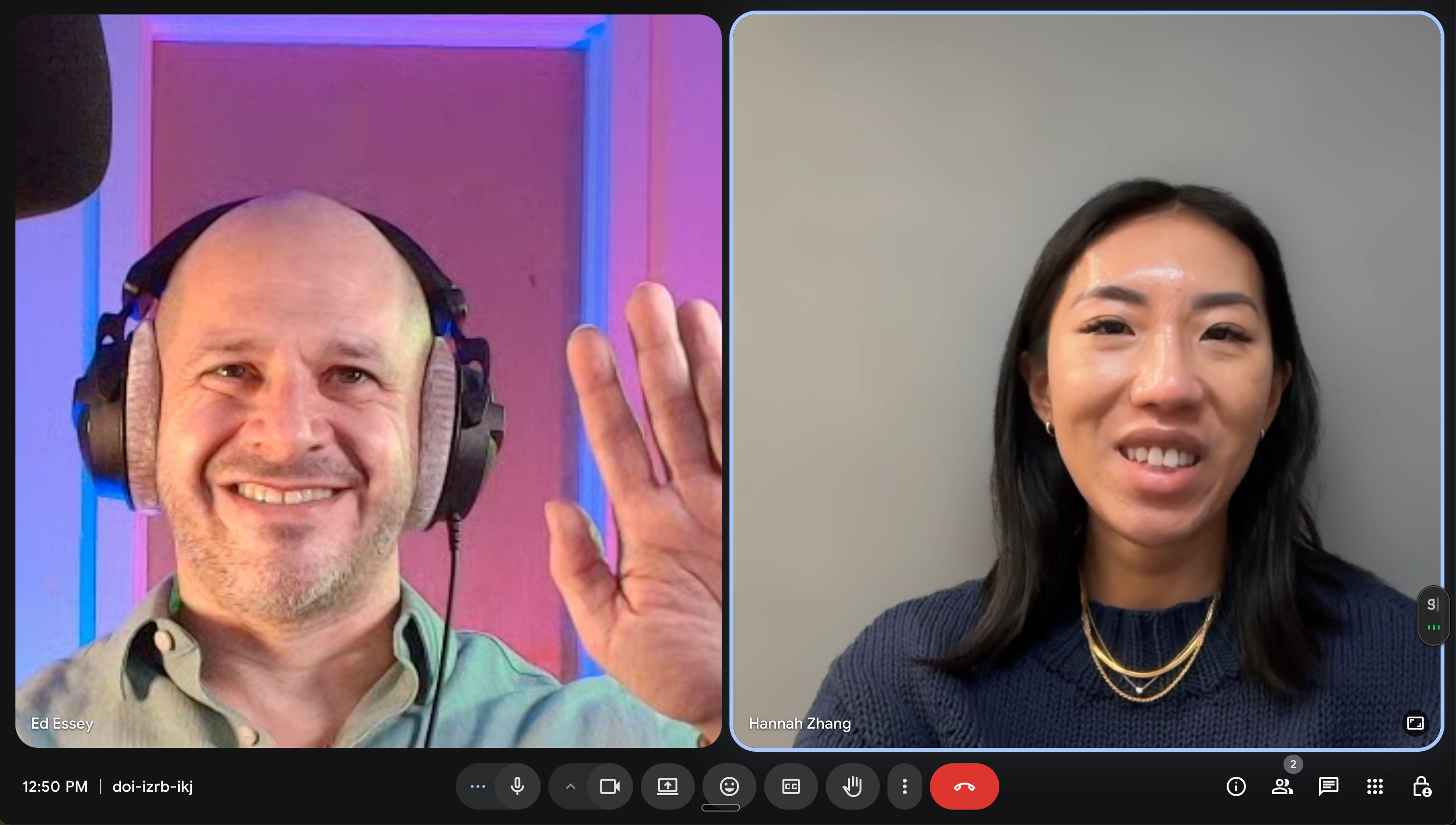
Starting a Career During the Dot-Com Crash and 9/11
Hannah: To start, how would you describe your early career?
Ed: I graduated from college in 2001, which was an absolutely wild time. The dot-com bubble had just burst. A week before finals, my job offer was rescinded. I already had an apartment in Mountain View and had moved out there early.
Then a second offer was rescinded. A third one, I showed up for one day, got called into jury duty for three days, and when I came back, the office was gone. Literally butcher paper on the windows. The company had shut down without telling anyone.
Hannah: That’s a pretty chaotic way to start a career.
Ed: It really was. At one point I was doing the classic “five MIT guys in a basement” thing while interviewing. I flew out to interview at Microsoft, and that same day our startup was supposed to put out a press release to attract VC funding. That day was September 11th.
I flew into Boston. Family was panicking. VCs stopped answering calls. Everything froze.
Around the same time, my girlfriend’s father wanted me to work for him at Enron. Enron had just collapsed too.
So I ended up taking a job at Microsoft, even though I didn’t see myself as a Microsoft person at all. I saw myself as a startup guy.
Why Ed Stayed at Microsoft
Hannah: And yet you stayed.
Ed: Yeah. What’s funny is Microsoft kept putting me on “startup” teams internally.
I worked on early versions of products like InfoPath and Office Server. Later I moved into DevDiv working on parallel computing. Almost everything I worked on was net new.
Every year, I was still interviewing externally. I always thought I’d leave.
Hannah: What kept changing your mind?
Ed: Every time I’d get an offer elsewhere, I’d go to my manager and say, “I want to work on different problems.” And my manager would say, “I agree. Let’s shape your role around that.”
Over time, I realized something important. I didn’t actually need outside leverage to advocate for better work. I just needed to articulate what I wanted to learn and why it mattered to the business.
So my role kept changing. It kept getting better.
Hannah: That kind of support from a manager feels pretty rare. How did you build that kind of relationship?
Ed: I was explicit about what I wanted to learn and how it tied back to real business outcomes. I didn’t frame it as dissatisfaction. I framed it as growth.
Managers respond when you’re thoughtful about impact and not just personal advancement. Over time, that builds trust.
Hannah: When you say you advocated for better work, what did that actually look like?
Ed: It meant having ongoing conversations about scope and direction, not waiting until I was burned out. I’d say, “Here’s what I’m seeing, here’s what I think I could contribute, and here’s why it matters right now.”
It wasn’t about asking for permission to leave but rather proposing a better use of my time.
Leaning into to Public Speaking and Teaching
Hannah: Was there a moment where things really shifted for you?
Ed: Yes. At one point I said, “I want to get really good at design thinking.”
I talked to the central design thinking group, and they said, “Actually, we think you’re already one of the best people at this. Would you teach it?”
Hannah: You’ve said you were terrified of public speaking. What made you say yes anyway?
Ed: I knew it was the thing I needed to do, even though it scared me. I didn’t feel ready, but I felt called to it. So I said yes.
I spent a year teaching design thinking to engineers, eight hours a day, about 200 days and I trained over 22,000 engineers. That experience completely rewired my confidence.
Hannah: Did you realize at the time how much that year would change things?
Ed: Not at all. I thought I was just developing a skill. Looking back, it changed how I saw myself and what I believed I could do.
How Cross-Team Collaboration Became Ed’s Source of Leverage
Hannah: You talk a lot about cross-group collaboration. Was that something you intentionally built towards in your career?
Ed: It was intentional very early.
People act like working across teams is reserved for senior leaders. But I joined one team late in its lifecycle and immediately saw how much integration opportunity there was with other groups.
Because I was new, building a relationship with someone on another team took the same effort as building one on my own team. So I just started doing it everywhere.
Over time, I built a huge network of trust across the organization.
Hannah: Did that change how leadership saw your role?
Ed: There was a moment that really stuck with me. Microsoft used to rent out the Mariners stadium for internal all-hands.
Bill Gates got on stage and talked about how important it was for one product, InfoPath, to connect with the rest of business. And I realized he was describing my job. That’s when it clicked that what I was doing was strategically meaningful.
How to Build Influence Beyond Hierarchy
Hannah: You coach a lot of people now. What do you see holding them back?
Ed: People get very hung up on hierarchy.
There’s a psychological behavior called leveling. People are constantly assessing whether they’re above, below, or equal to someone else, and then behaving accordingly. I never did that. I treated everyone as a person trying to solve a problem.
Hannah: You mentioned that you have a metaphor you use for this.
Ed: Yeah, the puppy analogy.
If a stranger rang your doorbell and handed you a puppy, you’d be confused. Even if you like dogs, it’s weird. A puppy isn’t free. It changes your life.
That’s how a lot of people try to add value at work. They show up with solutions before understanding context.
Hannah: What does that look like in practice?
Ed: It means understanding the other person’s circle first. Their goals, constraints, incentives.
Once they see you as part of their circle, trust forms naturally. Otherwise, you’re just handing people puppies they didn’t ask for.
Why Ed Built His Personal Brand
Hannah: You already had strong internal credibility. What made you realize that wasn’t enough?
Ed: About ten years ago, I started thinking, what happens if I get laid off?
My business card opened doors, but not because of me. Because of Microsoft.
If I lost the title, my name wouldn’t carry me anywhere.
So I started building a brand around my thinking. Writing, blogging, posting on LinkedIn, speaking, and eventually getting invited into innovation communities around the world.
Ironically, that helped Microsoft too, because I could bring outside experts into internal conversations.
Later, I got cancer at 37. That was the real forcing function.
It made me deeply aware of how short life is. I realized my calling was helping people understand their worth and use their gifts to make meaningful change.
Creating Content and Learning the “Language of Instagram”
Hannah: You eventually moved to Instagram. How did that happen?
Ed: I wasn’t even an Instagram user. I had maybe 220 followers, mostly friends and family.
At first, I talked about innovation and intrapreneurship, which was my area of expertise. It didn’t work.
I had to learn the “native language” of the platform.
I found that what resonated was the term high performer, especially people navigating politics, burnout, or toxic environments.
Once I reframed my message, things clicked. In six months, the account grew to over 100,000 followers.
The content that resonated most was about toxic bosses, not because people wanted to complain, but because they wanted more agency.
The Framework For High Performers Who Feel Stuck
Hannah: You create content for high performers. Who do you consider a high performer and how do you help them?
Ed: First, I don’t define “high performer” for people. If you believe you are one, you are.
What I see consistently is that high performers struggle with boundaries because they don’t know what they’re protecting.
So I teach a framework I call the Four Cs that every high performer should get clarity on:
Core — who or what you won’t let down
Calling — the impact you want to make
Care — how you care for your body, mind, and environment
Community — who nourishes you and whom you nourish
If you don’t know these, boundaries erode. Decisions become reactive. Burnout follows.
Everything else — navigating toxic bosses, career growth, leadership — builds on that foundation.
What’s next for Ed
Hannah: As you look ahead, what’s exciting you most right now?
Ed: I’m really focused on my book, The Inside Job, which comes out February 12.
It’s about everything we’ve talked about here. How people build leverage, influence, and meaning from inside the systems they’re already in, without waiting for permission or blowing everything up.
Writing it forced me to put language to patterns I’ve seen over decades. It feels like a natural next chapter.
Connect with Ed:
Ed’s book, The Inside Job, will be available for purchase on Feb 12. Learn more about it and sign up at https://edessey.com/book for early and behind the scenes access.
I hope this conversation was helpful if you’re wondering whether reinvention always requires leaving your environment, or if you’re starting to build your personal brand.
If you have a story you think should be shared, my inbox is always open!
Reads, Ideas, Tools
Jack and Jill: I tried this tool that lets you get on a call with Jack, the AI recruiter, who helps you get hired at top startups. Most “AI recruiter” tools feel scammy or generic, but this one somehow understood the nuances of Product Marketing in B2B vs B2C, so I’m bullish - give it a try if you’re looking for clarity (and leads) for your next step
A new approach to living a good life comes from a most unlikely place
Podcast: if you have multiple interests, do not waste the next 2-3 years
Jobs & Resources
cool jobs for ambitious nonlinears (updated ~weekly)