


Hi, I’m Hannah! Welcome to Nonlinear News, where I write for smart, ambitious people choosing the nonlinear route.
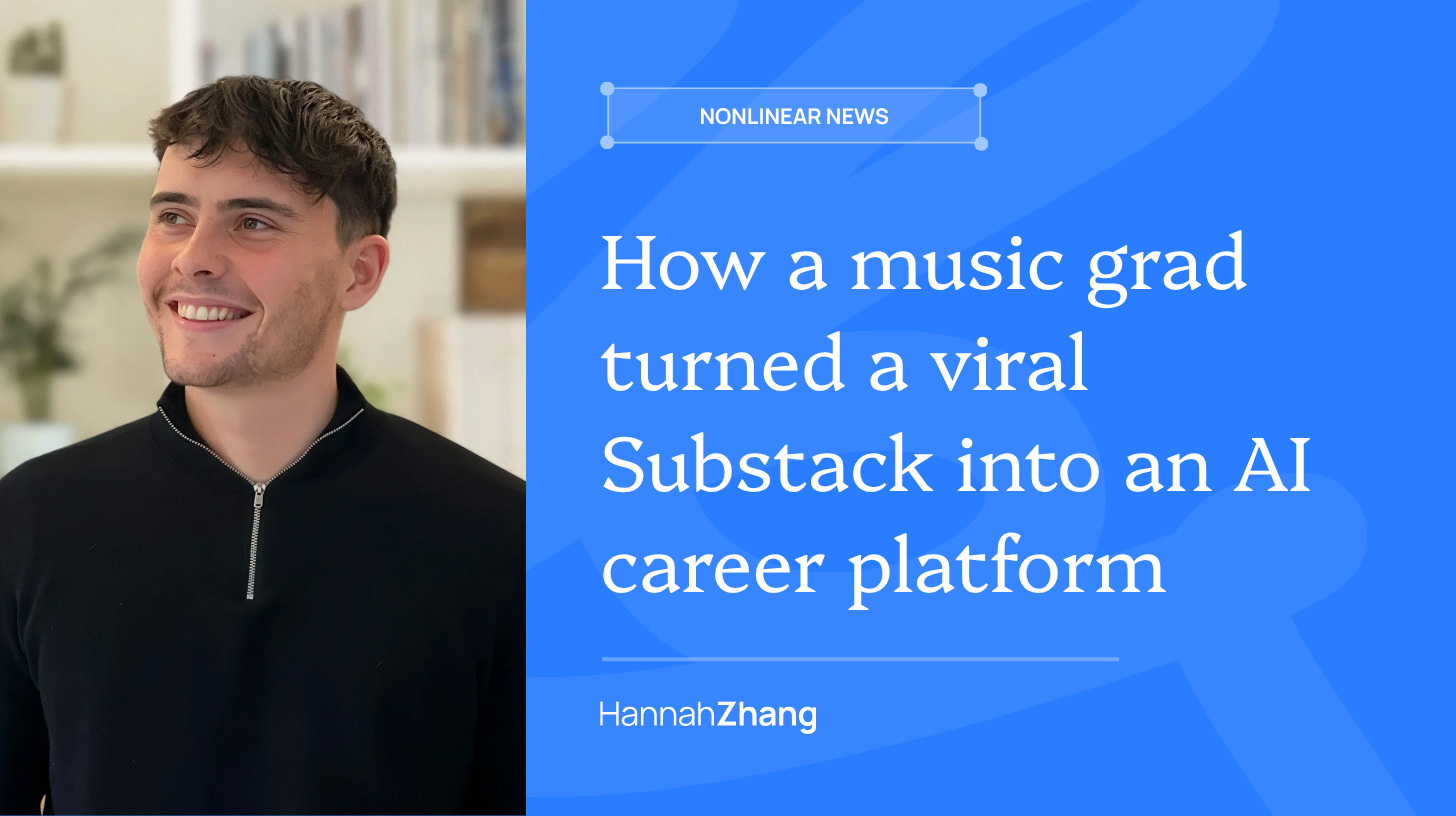
Alex McCann has never had a corporate job. He studied music. He ran a boutique marketing agency that didn’t work out. He digital nomaded across Latin America with friends who quit their jobs to come with him. And then he wrote a Substack post called “The Death of the Corporate Job” that got 17,000 likes, got picked up by The Times, and somehow led him to a call with the CEO of Bayer. Then he build an AI career platform.
None of that was his plan. His plan (if you can call it that) was to document what he was learning in real time and see what happened. After his Substackpost blew up, he did something I think is underrated (and exactly what I did before I first started creating content): he opened his calendar to strangers, took hundreds of calls over two months, and used every conversation to understand exactly what people were stuck on. That research became Rumbo, an AI career tool built around the idea that most people aren’t asking the wrong question, but answering it in the wrong vocabulary.
Alex and I connected through our career-related content, and I’ve been wanting to have this conversation for a while. So many of you are in corporate jobs that feel like they’re running out of road, and so many of you want to build something but have no idea where to start. Alex has thought about both of these things more carefully than most people I’ve spoken to.
Whether you’re thinking about your next career move, figuring out your next creative direction, or building your own product, I think you’ll get a lot from our conversation.
From engineering to music to founder: the long way around
Hannah: You’ve made so many pivots: engineering to music to creative director to now founder and content creator. A lot of my audience has been in the same job for years while you’ve done all of that. How did you get clarity on what the next step was every time? And how did you get the confidence to actually go do it?
Alex: It was a combination of things. I really believe in this idea from the book Tiny Experiments, just trying things out. That was something I didn’t realize was a skill, but I had always just been somebody who would give stuff a go. And that coupled with a really intense curiosity, just asking a lot of questions of myself and other people. I think that was what allowed me to pivot quickly.
I also have to acknowledge that I was young and didn’t have any responsibility, so I could take on a lot of risk. But the culmination of voracious curiosity, willingness to try things, a kind of attitude of I’m just going to try stuff and then see what happens, and circumstances that allowed that to happen. It was a combination of luck and people around me encouraging that curiosity.
Hannah: Did you ever fear that by switching from engineering to music, or music to creative, you were throwing away all the work you’d done previously?
Alex: Yes, a little. I never got so into it that there were too many sunk costs. The biggest shift was definitely the move from engineering to music, because up until that point my whole life I had really identified as an academic person who loves this type of thing. I had crafted my identity around what I thought I was going to be. And then when it all came crashing down, there was a real identity shift. That was hard.
I was pretty early on clued into the idea that qualifications were less valuable than they used to be, and the corporate ladder wasn’t what it used to be. So the sunk cost piece was less of it. But I definitely felt the weight of the identity changes that came with the pivots.
Building the content muscle before anything went viral
Hannah: You said several times that you were really lucky. And I’m sure you feel that way, and you’re a humble person. But luck only shows up when you’ve done the work to maximize your surface area of luck. Every piece of content you post is a lottery ticket. How did you first start creating content? What was your initial goal with it?
Alex: I want to give myself credit for two things. One is the beginner’s mindset. When I started my first business, I went to a lot of networking events and I was often the youngest person in the room by a lot. The mistake a lot of young people make is going into those rooms trying to show what they know. I didn’t have that. I went in with an attitude of: you’re the expert, I’m the beginner, can I just ask you questions? That gave me access to people who ended up being mentors because they were interested in helping someone who was genuinely curious rather than performing confidence.
And the second thing: opportunity is a function of density. When you’re young, one of the best things you can do is just put yourself out there in whatever form that is. Networking events, content, reaching out to hundreds of people every week.
How I got into content: that graduate job I mentioned introduced me to personal branding because I was doing some LinkedIn posts for the founder. An early mentor said to me, you’re in a really steep learning curve right now, why don’t you just share what you’re learning and see what happens? So that’s what I did. And I started to get some traction. Nothing like now, but it helped me build the muscle.
Then I stopped for a while while I was traveling and working a previous role. And when I started this new venture, it felt like second nature. I thought, okay, there are interesting things I’m learning, interesting things I’m seeing, let me just put it out there. My coach was also on Substack and said it’s a good place for a slightly different style than LinkedIn. So I did. And yeah, rest is history.
Hannah: I love that you were documenting your learnings in real time. That’s the thing people don’t say out loud: most people who build a personal brand, it’s not their full-time job. The best approach is to document what you’re already doing, so it doesn’t feel like every post is a fresh thing you have to invent from scratch.
Alex: It’s like what they say about musicians. In the early stages, their work is the best because their proximity to real life makes it relatable. And then as they get successful, that proximity disappears and people stop connecting with it as much. When people are really in the thick of something, building a product, learning from a day job, it’s stuff people can relate to. It feels more authentic. And I can imagine that when your whole job becomes content creation, it gets harder to maintain that.
The viral Substack post and the CEO of Bayer in his DMs
Hannah: Your Substack post “The Death of the Corporate Job” had 17,000 likes. I usually get 50 likes on my posts. What was the core idea, and why do you think it resonated the way it did?
Alex: It came from reading Moral Ambition, which I highly recommend. The author talks about this idea that so many highly ambitious, highly intelligent people end up in what he calls bullshit jobs, this Bermuda Triangle of meaninglessness: corporate finance, banking, corporate law. And I remember reading that and seeing the people around me in my life who were so intelligent, so ambitious, great university degrees, genuinely kind and generous people, and yet the system had incentivized this particular kind of work, and the corporate ladder was still being sold as this glamorous journey.
I just thought there was something so different between the narrative around corporate work in media, from our parents’ generation, and the people actually living it. I wanted to uncover that and be honest about it. Why is the system set up to reward something that is so clearly not what it’s perceived to be? And what does the future look like? Because part of what I was writing about is that this understanding of the corporate ladder is changing anyway. It may not even be on offer to people who are interested in that path.
Hannah: And you’ve never had a corporate job. How do you think about those two things being true at the same time?
Alex: Totally get it from the people who’ve criticized me for that. Two things are worth saying. First, I was hearing this from so many people, so many conversations all coming to the same conclusion. I was prepared to be wrong. But the response felt like proof of concept, because so many people put their hands up and said yes, this is true to my experience.
The second thing is the fish in water observation. People who are inside the corporate machine get so heads-down, engrossed in the culture and the language, there’s this whole corporate vernacular, that sometimes it takes someone from outside to point out something that’s actually pretty obvious to the people in it. I was hearing a lot of the same thing from a lot of different people, and I thought: let me just put my observations out and see what they think.
Hannah: What was the craziest thing that happened as a result?
Alex: The press coverage was wild. The Times did a roundup of articles to read in 2025 and it was one of the top ones. The Free Press feature the same weekend they were acquired blew up too. But the craziest one was the CEO of Bayer reaching out.
This person messaged me on Substack with no profile picture, no context, said their CEO wanted to chat if I was interested in interviewing him. I was pretty doe-eyed about the whole thing at that point, said sure, put it in the calendar a few weeks ahead, and forgot about it. Then the weekend before, I’m looking at my calendar and I see this interview pop up. I looked it up. Bill Anderson. CEO of a company with nearly 100,000 employees, one of the biggest pharmaceutical companies in the world. And I had just casually booked it like it was nothing.
But honestly? The craziest thing is being at events now and having people I’ve never met turn to me and say, oh yeah, I’ve read your article. That still blows my mind.
How he turned 17,000 likes into hundreds of 1:1 calls and (eventually) a product
Hannah: You didn’t just double down on Substack after the post blew up. You had a really intentional approach to figuring out what to actually do next. Walk me through that.
Alex: When the article went viral, I knew we were going to build the platform, but it was really early stages. I didn’t know exactly who it was for or what it might look like. I asked myself: since I’m not the one building it, what’s the most impactful thing I can do? And I thought: understand the problem from every possible angle.
So I put out a link to my calendar and said, if anyone wants to chat, just book some time. I’m not a career coach, I’m happy to just be a sounding board. And it went crazy. Hundreds and hundreds of people booked calls over the next couple of months.
One of the things that kept coming up was that people had started using ChatGPT to help them think through their careers, but they were still lost. ChatGPT as a conversational partner can only respond to the quality of input you give it. And if you don’t have a clear understanding of what is likely to bring you career fulfillment and meaning, the results you get back are going to be pretty limited. So that was really interesting to me: people are open to exploring this with AI, but it’s not quite there, it’s missing something. And that’s where we landed on the idea for Rumbo.
Alex’s advice: Stop seeing your career as your CV
Hannah: Last question. For someone in a corporate job who feels like it’s slowly dying, but the paycheck is real and they feel stuck, what’s your number one piece of advice?
Alex: The number one problem I see is that people think about themselves through the lens of their CV. When I ask people who come to me in that situation what they’re good at, they answer in CV language. I’m really good with Excel. I can present PowerPoints in a meeting. And my advice is to try and get yourself out of that way of thinking and look below the surface.
What is the skill behind your ability to use Excel? Maybe it’s analytical skills or being a really organized person.
What is the skill behind being good at presentations? That’s communication, making sense of complex ideas, storytelling.
When you start thinking about the foundational skill beneath the things you’re doing day to day, it allows you to think much more broadly about where you could apply those things. Things end up being a lot more transferable than you might expect.
Subscribe to Alex’s Substack and follow his journey building Rumbo!

Chief of Staff – Live Near Friends (PropTech, Early Stage)
General Manager, Ghana – Capi Money (FinTech, Early Stage, Ghana)
PE & VC Partner Manager – Google (Tech, Public, SF/NYC)
Head of Finance – LangChain (AI, Growth Stage)
GTM Associate / Analyst – Basis (AI/Accounting, Growth Stage, NYC)
Product Strategy and Operations Lead – Google (Tech, Public)
Sr Operations Manager, US&C Merchant Ops – Uber (Tech, Public, Chicago)
GTM Engineer – Vanta (Security & Compliance, Growth Stage, Remote)
Strategic Partnerships Lead – Factory (AI, Early Stage)
Chief of Staff / Head of Business Development – Fortuna Health (HealthTech, Early Stage, NYC)
Chief of Staff – Lovable (AI, Growth Stage, Stockholm)
Sales Representative – Brex (FinTech, Growth Stage, NYC)

The most useful move here was turning a viral post into hundreds of conversations instead of immediately treating attention as validation for a finished product. Those calls exposed the gap between the language of a CV and the deeper skills underneath it. That feels like the real bridge from an interesting essay to something people can actually use.
I love the detail in this post, thank you!