Hi, I’m Hannah! Welcome to Nonlinear News, where I write for smart, ambitious people choosing the nonlinear path.
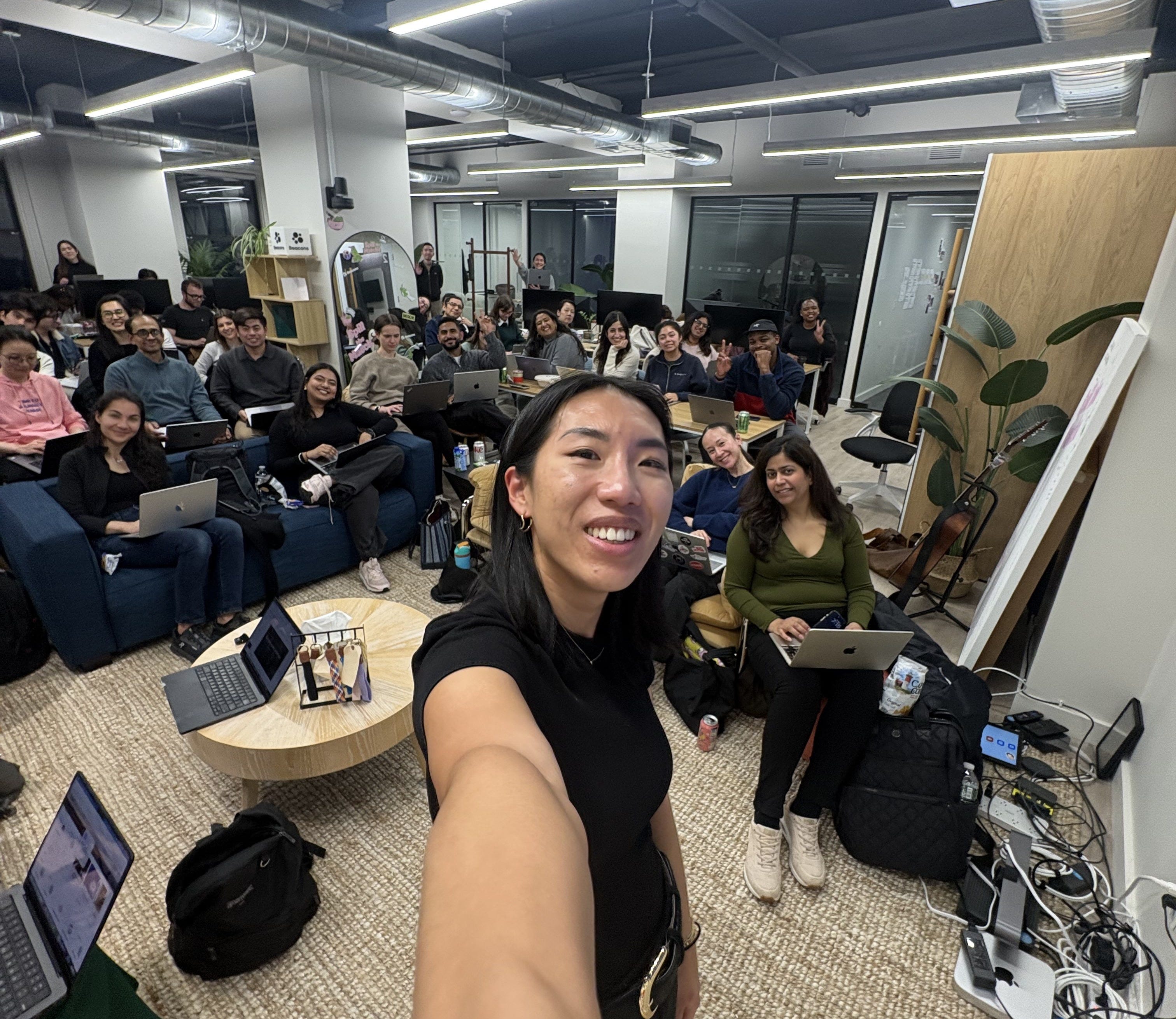
230 of you signed up for the vibe coding event I co-hosted with my friend Yuqi from GMI Cloud at the Beacons office in NYC on Thursday!! (stay tuned for future events I’ll share here if you missed this one)
Now…sharing Sophia’s story with you!
Sophia Mullins spent nearly a decade in banking, PE, hedge funds, and VC. In the middle of it, she was diagnosed with Hashimoto’s thyroiditis at 25 after two years of specialists couldn’t figure out what was wrong. She overhauled her lifestyle, sent it into remission, and kept working in finance while building her wellness brand. She didn’t leave until she was ready to leave.
Sophia now runs Wall Street Wellness, a wellness consultancy that provides workshops, coaching, and advisory for companies and individuals in high-performance industries. She's building what she wished existed when she was the person on a lean PE team trying to figure out how to eat well, manage stress, and not burn out while working around the clock. She’s the person you call when you’ve tried the supplements, optimized your sleep score, and still running on fumes.
Sophia and I met through Instagram as fellow finance dropouts. So many of you have asked me how to take care of yourself when your job is high-pressure and nonstop, and honestly, I’ve been terrible at answering that question because I’m bad at it myself. Sophia has much better answers!
Whether you’re in a high-pressure job trying to figure out how to actually take care of yourself, or you’re thinking about building something on the side and wondering when the right time is to go all in, I think you’ll get a lot from this one.
Reverse engineering Wall Street from rural Ohio
Hannah: You grew up in rural Ohio, valedictorian, first-gen college student. When did Wall Street even become a concept for you?
Sophia: I honestly think I kind of reverse engineered it because it was not a concept in rural Ohio. If I told most of my older family members that I worked in banking, they would think I was putting the little plastic thing in the tube and sending it into a drive-through as a bank teller. It just was not an industry that really existed to them.
When I got to Ohio State, I connected with some upperclassmen who were heavily involved in investment banking and sales and trading. They came back from their internships super excited. And I had always known, I think from eight years old, I had a poster of New York City in my childhood bedroom. Rural was not really my vibe.
When I met those upperclassmen and saw how intellectually stimulated they were, the rigor and grit and obviously the prestige that came with Wall street, that was attractive to me. But also with my background, being a first-gen college student, not really having that safety net of going to a big city that’s obviously quite expensive, Wall Street was also a pretty surefire way to pay the bills and support myself as someone going there solo. I got really lucky connecting with the right people when I got to Ohio State to spark that initial interest.
How she built a wellness brand inside finance (without it becoming her whole identity)
Hannah: You started Wall Street Wellness as an Instagram page while you were transitioning from banking to PE. Were you already feeling the tension between work and health at that point?
Sophia: Pre-COVID, it was a little less common to talk about your well-being as a means to peak performance. I wasn’t really getting that side of myself expressed in my day-to-day working environment, so I took to the internet to connect with people. I knew other people had to also feel this way. I wanted to find that community, share what it was like to meal prep and go to Equinox while balancing 80-plus hour work weeks.
Hannah: Was wellness something your team knew about you? How did people respond?
Sophia: Earlier in my career, it was definitely not something I was front-footed about. If you got to spend time with me and we were talking about our personal lives, you’d pick up that I was doing a lot of wellness-based things with my limited free time. But as I got more senior, at my first PE firm and then hedge funds and VC, it became a bigger part of my personal brand. People started noticing behaviors. After you’re somewhere for six months or a year and someone sees you meal prepping or bringing your food in glass Tupperware, maybe they want to emulate those behaviors too.
A big thing I emphasize with my community is that you have to earn your chips first. You can’t show up to your first day of investment banking and say, hey, I’m the wellness person. But when you really show up, meet your responsibilities, exceed what’s expected of you, then you can be that positive example of: I’m here, I’m crushing it, I’m a top performer, and I’m taking care of myself. By the time I was VP and beyond, people would jokingly call me the Chief Wellness Officer. It was always perceived as a positive because they knew I was leading with my work ethic first.
The health crisis that changed how she thought about performance
Hannah: Tell me about the health symptoms. When did you first notice something was off?
Sophia: I started feeling off about a year into my banking experience. All of the lymph nodes in my neck were swollen to the size of marbles all the time. Really inconsistent energy levels, weight fluctuations, some weeks my skin would be super dry and then completely fine. Weird patterns across a lot of different ways you can monitor your health.
What’s so interesting about autoimmune conditions, especially how they manifest in women, is it’s really easy to point to them as just the symptoms of working in a high-stress environment. I was able to kind of shirk that off for a while. But then my lymph nodes had been swollen for six months at a time. At 24 to 25, this probably isn’t normal.
I started working with traditional medical practitioners at one of the highly rated medical systems in New York City. I had a lymphoma scare, where I had full body PET scan, all the tests, all the panels. About two years in, two doctors came into my examination room and said: “You’re just a medical mystery”. That was so unsettling.
Hannah: How did you manage those appointments while working full time?
Sophia: It was not easy. I was very open with my team. When you tell someone you need to go get a full body PET scan with radioactive sugar to rule out lymphoma, no one is going to stop you.
I was close with my VP at the time and pretty open with her because she’d had similar health struggles. She was like, do what you need to do. And going back to earning your chips, if I needed to be gone for two hours, I was really committed to: if I need to make a sacrifice for personal, it’s never going to affect what my team can expect from me.
The waitlists were also so long that it could take three months to get into the next specialist. It wasn’t like I was off the desk five times a month. It was more like once every three months, going on this trail of breadcrumbs to figure out what was wrong.
Hannah: What finally gave you answers?
Sophia: I was connected with a functional practitioner who looks at the body systemically, how all of our organ systems and functional systems are interconnected, because so much of the decisions we make in our lifestyle don’t just affect one part of us. All of our organs are connected in a symphony rather than being individual systems separate from one another, which is kind of how Western medicine looks at things.
Within one intake, a really extensive blood panel, and about three weeks total, she said: you very clearly have Hashimoto’s thyroiditis. Because you’re 25 and this hasn’t been manifesting for long, it would be very hard to catch by traditional measures. But because we look at tighter biomarker ranges, we can detect it earlier.
We did an extensive lifestyle overhaul. An intense cleanse and gut healing protocol, eating an anti-inflammatory diet and also got serious about stress management. Then a few months later, we retook all of my biomarkers that pointed to autoimmunity and my Hashimotos’ had gone into remission.
Why she stayed in finance after the diagnosis (and doesn’t regret a single year)
Hannah: After the diagnosis and the lifestyle shift, you didn’t leave finance. You went deeper with PE, hedge funds, VC. Why stay?
Sophia: These careers can be super fulfilling and intellectually stimulating if you actually feel well enough to enjoy the fruits of your labor. I knew I could stay in finance and probably retire at 50 with a very healthy bank account but always have that proverbial angel and devil on my shoulder asking, did you take that bet on yourself? Or I could leave, walk away from a lot of stability, and never have to question the what if. As I sat with that, the what if just got heavier and heavier.
Hannah: You’ve said you’re pro-corporate, which is kind of unusual coming from someone who eventually left. What do you mean by that?
Sophia: Respectfully, I don’t think the world needs another generalized millennial health coach. I think we need health professionals with unique backgrounds who can deeply relate to the people they’re serving. I get asked a lot: do you regret your time in finance? Absolutely not. It’s what enabled me to serve this group of people (high-achievers) so deeply, to be so niche that it actually moves the needle for them.
The difference between “green juice wellness” and actually feeling good
Hannah: There’s a version of wellness that high achievers get caught up in, the green juice, the red light mask, the powders. You push back on that pretty directly.
Sophia: I am guilty of this, so I can say it. A lot of high achievers, top performers, type A recovering perfectionists, can get caught up in performative wellness. Those things are all well and good, but if your fundamentals, like your movement, your nutrition, your mental health, your baseline resiliency and mental safety are out of whack, then you’re just putting band-aids on a much larger problem. It can feel like you’re checking your wellness box. But it’s a much deeper conversation than what supplements you can add or what new workout class to try.
I always tell people: it doesn’t matter if you’re drinking a green juice or eating a slice of pizza. If you’re in chronic fight or flight, neither is going to help. You really have to get to the root of mental safety and feeling good in your internal and external environments.
Hannah: So what do you tell someone who’s in a high-pressure environment with limited time and wants to do more than just the green juice?
Sophia: Find your one to three practices that are actually exciting to you for your mental and emotional health, and figure out the easiest next right decision you can make to open up that practice. It probably doesn’t look like doing breath work for an hour every day. Maybe it looks like blocking five minutes between Zooms to open an app and do it.
Small, consistent changes will actually move the needle versus going in super hot and setting up something unsustainable. The same goes for running, if you’re telling yourself you’re going to run a marathon and you start shooting for long runs on a Monday afternoon, you’re setting yourself up for failure. There’s a level of practicality and realism that actually sets people up for success.
Why she waited until she could build from abundance
Hannah: You left your PE role in July 2024 to do Wall Street Wellness full-time. What finally tipped it?
Sophia: This would not have worked if I’d left when I was 25. First and foremost, I wouldn’t have had the professional credibility that I carry with my corporate and individual clients. But also from a practical financial angle, I worked on Wall Street, had really stable, high-paying jobs, and lived below my means. I was kind of buying my flexibility. I call it building from a place of abundance. If I needed to replace my salary day one of Wall Street Wellness, I don’t think it would be as intentional or as thoughtful as it is now, because good things take time. I bought myself the flexibility to build this in the best way I could.
Hannah: You’ve described having a calling as a blessing and a curse. What do you mean?
Sophia: I was never the person who wanted to be an entrepreneur or start their own company. If anything, I was like, “Well, this doesn’t exist, so I guess I need to create it.” I want to bring this into the world, so I guess I’ll have to start a business. A lot of people want to start a business and then back into what that business will be. I was very much vice versa.
It has led to a lot of incredible opportunities because it’s just really obvious to who we interact with that this is so service-based and driven from a place of care and excitement. That’s not something you see very often. It’s become almost like a superpower for us.
Hannah: What’s been harder than you expected about going from VP in private equity to running your own thing?
Sophia: I came from finance thinking, oh, I’m so dynamic, I know what it’s like to wear 10 different hats per day. I didn’t know shit. It is so dynamic. Maybe you’re doing different types of tasks in a narrow corporate role, but here it’s like: I’m the CTO for an hour, then I need to go be the CAO, then the COO, then the CEO, then the chief salesperson.
I honestly just call entrepreneurship personal development boot camp. It requires you to not just figure out what you’re good at, which is sometimes easier, but get really honest about where your weak spots are. And either get better at those things, or outsource them, or hire someone with skill sets complementary to your own. If I hired another Sophia, we’d be duplicative. It’s been incredibly stimulating. I’ve grown professionally, obviously, but personally, it’s unmatched. I’ve really uncovered who I am.
Sophia’s 3 non-negotiables for daily wellness
Hannah: You now have the strictest boss you’ve ever had, yourself. What are your actual non-negotiables for your own wellness?
Sophia: I try to make it practical and realistic. If I came out of the gate every day with a 20-step morning routine, I would fail by 7:30am. So I narrow it down to what actually makes a difference for me.
Number one is eating an anti-inflammatory diet. Really mindful around gluten and dairy, trying to get 30 to 40 different plants on my plate every week, eating organic, high quality plant and animal proteins. I can notice a 30% difference in how I show up mentally and physically on a day after I’ve eaten really clean versus a day where I was more laissez-faire. That’s non-negotiable number one.
Number two is I walk outside every day. Rain, sleet, snow, shine, and I was in New York City for a long time before Miami. It is truly the biggest anchor for my mental health. Getting outside, getting fresh air, resetting my perspective that the world is so much bigger than my nuclear experience.
And number three is meditation. I personally am very easy to get wired and wound up, shoulders up to here, jaw cramping with tension. I am primed for that state. A lot of this work I’ve had to learn so deeply myself because that high-cortisol, high-tension state is like my nervous system’s comfort zone. But it’s not the comfort zone for any of my other bodily systems, so we had to figure that out.
What stayed with me is the idea of building from abundance rather than desperation. That’s such an underrated distinction. Businesses started from panic often end up serving the founder’s fear. Businesses started from enough clarity, enough runway, and enough self-knowledge tend to be much more grounded. This felt like the second kind.




What stayed with me is the idea of building from abundance rather than desperation. That’s such an underrated distinction. Businesses started from panic often end up serving the founder’s fear. Businesses started from enough clarity, enough runway, and enough self-knowledge tend to be much more grounded. This felt like the second kind.