


Hi, I’m Hannah! Welcome to Nonlinear News, where I write for ambitious people choosing the nonlinear path.
In April 2025, I hit 100,000 Instagram followers after creating content for 6 months.
By December 31, 2025, I’d barely grown, ending the year with just under 110,000 followers.
This year, I’ve grown to 180,000 in 4 months.
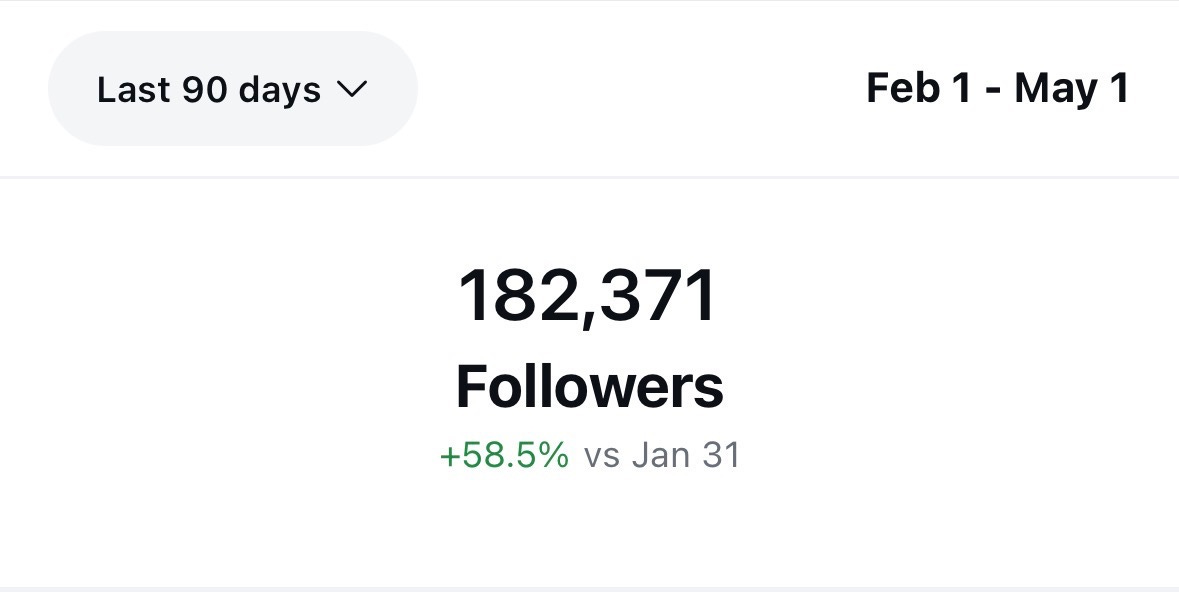
That’s 70,000 followers in 4 months, after about 9 months of near-flatlining.
Engagement followed the same shape: dead for most of 2025, then back.
Brand deals followed too, including the biggest single deal of my creator career so far (multiple five figures for 1 video), alongside others with OpenAI, Anthropic, Amazon, Microsoft, and LinkedIn.
I didn’t write this to brag but to offer a candid reflection and tactical guide for anyone creating content in 2026, especially if you’ve hit a plateau, are shifting niches, or are trying to reposition yourself. Because 6 months ago, I didn’t think this was possible.
This is specifically about my experience on Instagram, but 90% of the advice applies whether you’re building a personal brand for your career, for a creative pursuit, or as founder-led content for a business you’re growing.
If you’re completely new to content creation, you might want to start with the piece I wrote last year on building my content business from zero as a 5-9 creator. I cover how to get started when you have no idea what your content should be about, who your audience is, or where to reach them. Think of this as Part 2, but it’s still legible if you haven’t read Part 1.
Why I wasn’t growing
Before I could reposition my content and grow this year, I had to examine what was going wrong, both qualitatively and quantitatively.
I had started my content journey in 2024 by sharing “career advice”: leaving investment banking, breaking into tech, tactical job-search tips, and reflections on business school.
I had momentum from going viral in late 2024, an audience I’d grown into, and a sense that I’d “found” my niche.
The problem was that the niche I’d found, and the story I told (”career pivots and leaving banking for tech and getting an MBA”), had gotten stale. I was talking about breaking into tech and finding a new job when tech was laying off thousands of people every week.
At the same time, I left a big tech company for a startup and focused more on the creator economy and my 5-9 personal brand than on building a “corporate career,” even though that was still much of the content I created.
But I’d been told (and told myself) that you have to stick to your niche, post consistently, follow the formats that work, and not confuse the algorithm.
So I posted what I thought my niche demanded. It felt mechanical, and it became a vicious hamster wheel: I wasn’t excited, so the content wasn’t great, so it didn’t do well numbers-wise, so I felt more pressure to post things that “worked,” which made me less excited.
By the end of 2025, I’d convinced myself I’d plateaued, that people weren’t interested in what I was saying anymore, and that I’d probably exhausted my creator lifespan. I thought I should happily accept that this was a side project I’d make a bit of money from and leave it at that.
To reinvent yourself, you first need to reset and reposition
The result of the vicious hamster wheel was that I was unmotivated to create. I couldn’t open the camera, never wanted to hit post, and didn’t even want to scroll because I felt so stagnant compared to other creators. But I also couldn’t get off the hamster wheel, so I kept making mediocre things.
What forced me off it was taking a 2-week vacation at the end of the year, saying “f*ck it,” and scheduling my top 10 past-performing videos as reposts.
What started as a way to avoid creating turned into a way to examine what excited me and what didn’t about the content I’d made in the past. An audit and a recalibration.
And what moved the needle was realizing I’d been focusing on a “niche” when I should have been focusing on my audience and my positioning.
A lot of people use “niche” and “positioning” interchangeably but they’re not the same. Your niche is the topic you cover. Your positioning is what makes your content different from everyone else’s when you speak to a specific audience, because of what you uniquely offer that’s distinct from what’s already out there.
I needed to reposition. And to do that, I had to go back to my audience and ignore everything else: my old content, other creators, the algorithm.
