


Hi, I’m Hannah! Welcome to Nonlinear News, where I write for smart, ambitious people choosing the nonlinear path.
The first time I came across Mishti Sharma was from her LinkedIn post earlier this year, where she told the story of how she landed the storytelling job that tech companies were “desperately seeking”:
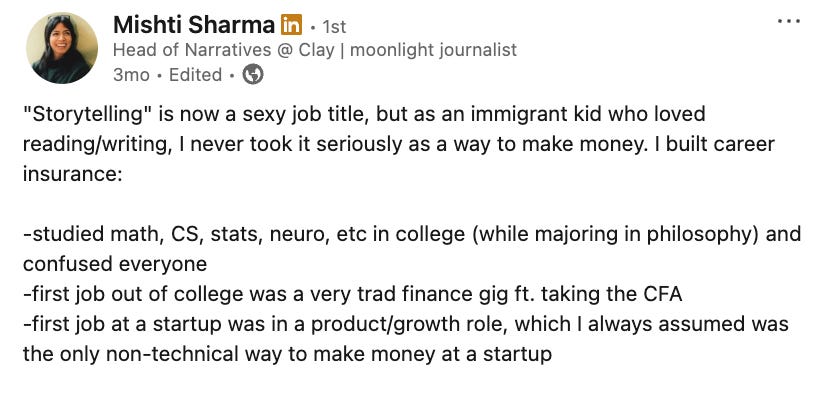
I instantly stalked her LinkedIn, and realized her career was anything but linear. She studied philosophy at Princeton, worked in finance, joined startups, went self-employed, and somehow ended up leading storytelling at Clay. At the same time, she was writing maildrop by mishti about diaspora stories and getting published in the New York Times.
My conversation with Mishti was a treat because of the range we were able to cover, given how much she’s done in her career, and I’m so excited to share this one with you. We covered:
making two “low status” career moves in a row, and why you can’t plan your career
what storytelling actually is and how to do it
how to become a better writer, and how (not) to use AI
the value of a personal brand and how to build one
what a GTM engineer is and who makes a great one
Princeton philosophy to endowment fund
Hannah: Take us back to the start. What were you like in college, what did you want to do, and how did you end up at the Princeton Endowment Fund?
Mishti: I loved college so much. I loved all of school. I majored in philosophy, partly because I was interested in it as a subject, but also because it was the most flexible major and had the least requirements. I’ve always had a strong independent streak. I wanted to take whatever classes I wanted and not be constrained by some department requirement. So I constructed my own experience. I took everything from ancient Greek and Sanskrit to classes that took me to Brazil to study contemporary art and Mexico to study Mayan hieroglyphics. My thesis even combined STEM, psychology, philosophy, and politics.
I loved college so I extended the ride. I did a Fulbright in India the year after I graduated, which was also very self-directed and an amazing life experience. I was trying to postpone coming into the real world for as long as possible, because I had this view that, “Alright, I’ve got to earn some money,” and pretty much the only routes are law or finance for what I’d studied. I had a job offer from the endowment fund, but I applied to the Rhodes and the Gates. I was basically asking, “what can I possibly do to not take this job?” I almost got some of the fellowships, but none quite worked out.
Hannah: But you ended up taking the endowment fund job eventually?
Mishti: I ended up moving back to Princeton. I remember having a huge argument with my parents, because I said, “What if I just moved to Spain and learned Spanish for a year?” And they said, “Are you out of your mind? You have to get a job.” So that’s how I ended up at the endowment fund.
I had a great mentor I’m still in touch with, but as a whole, it was the absolute worst personality fit I could have had with a job. We did a personality test called the Predictive Index.,The whole office had to take it. I remember them, graphing people’s extraversion, formality, and other factors and showing our aggregate results on a screen. I was all the way over on one end of the graph and everyone else was on the other end. It was a very corporate and hierarchical place. “Don’t leave your desk until your manager has left or it’ll look bad” energy. We had these huge sprints every quarter before board meetings where we did insane amounts of what often felt like busy work, but we took it so seriously. It is a great opportunity for some people, but it was just a complete mismatch for me and I wasn’t happy.
Why you can’t plan a career ten steps ahead (and what to do instead)
Hannah: Was there any upside to your finance role?
Mishti: The one upside was that the endowment fund invested in a lot of venture capital funds, which gave me exposure to the startup world from the investor side. I got to travel to India, China, and Silicon Valley to meet VCs, and they’d often bring founders from their portfolio companies into meetings. Watching them, I realized, that’s what I want to be closer to. I’d actually tried starting a company in college, so that pull had always been there. Working at the endowment fund just made it impossible to ignore. That’s what led me to create my own first startup role in 2020, right as COVID was starting.
It was a product growth role—basically me and the founder and a bunch of engineers. I was in Figma designing screens and thinking about UX a lot, and it was a consumer social startup, very different from Clay, which is B2B. We were constantly building and tearing down, seeing if we could build apps or web experiences people would enjoy. During COVID, we started by hosting virtual conversations with authors before eventually exploring a bunch of different product ideas. It ended up being product, growth, community, or whatever needed doing. I was showrunning and hosting shows.
Hannah: Something you’ve said about pivots stuck with me, that you can’t really plan that many steps in advance.
Mishti: Someone in college asked me how to think about career trajectory, what to do when. And I said you can’t really think that many steps in advance. I did one thing, I really liked it. I did the next thing, it was absolutely awful. And when I’m there I think to myself, “okay, not that, but I’m closer.” You’re making little adjustments, and it ends up putting you in the right place eventually.
Hannah: That’s hard to take in the moment, though. How were you okay with it in real time?
Mishti: Definitely hard. I had a really hard time leaving the endowment fund, because my parents said, don’t quit until you’ve found another job. So it was a grind. Every waking moment I wasn’t working, I was talking to founders. I’d spend my lunch breaks on calls and write one-pagers every evening. That felt like a bigger shift because I was exiting the industry entirely.
After that, it’s been adjustments within the startup world, because that has its own status hierarchies. You work at a startup, then you’re supposed to be a founder, the whole tech Twitter status ladder. Or at a startup as a generalist, you should do product, that’s the sexiest thing unless you’re technical. But those felt like much smaller adjustments once I’d found the kind of work that actually fit me.
Building the connections that got her into rooms like Clay
Hannah: You knew Varun for a while before Clay, through a friend. So much of early-stage startups is about the people, not the product, since the product is going to pivot. How do you build those connections, and read that energy from the outside?
Mishti: It started with me wanting to make my first pivot out of finance. I made a list of everyone who was a relevant college alum, all the VC funds I thought were cool, and asked, do I know anyone there. From Princeton, because we’d invested in some funds, I had a few routes in. I looked at portfolio companies at those VCs, saw which ones seemed interesting, and asked, “could I find a connection?” It was a giant mapping exercise. That’s actually how I met Varun. A friend introduced us after I asked who she thought I should know. That was probably the most proactive I’ve ever been, because making that career change felt existentially important.
I still do this. On LinkedIn or Twitter, if I see someone really interesting or like-minded, I’ll reach out. I’ve made a lot of internet friends, more on Twitter before the Elon acquisition, who I’m still in touch with. Sometimes years later, someone you reached out to online might end up working with you. It happens a lot. It’s about being open to finding kindred spirits and reaching out to them.
Making peace with two “low-status” moves simultaneously
Hannah: In your First Round piece you wrote that you made two low-status moves at the same time: joining a cold-email startup and taking a content role there. Coming from the same world, I know how unsexy content reads to finance people. How did you become okay with that?
Mishti: I think people are most worried about that kind of thing when you don’t really trust or know your company that well. If Clay had been the median company, the kind that doesn’t value this role, doesn’t pay it well, doesn’t have career progression for it, then I’d think: why wouldn’t I do my own writing projects on the side, and at work, just play the game really well? I know I can play any game well, I’ve studied all sorts of things. Why wouldn’t I optimize for that and save my soul for myself? But that comes from a lack of trust and knowledge about what the company would value. And it would probably have been a correct assumption at a lot of companies.
What made me comfortable was the proof from the founders, and as Clay grew, the validation that this was one of the most important things you could be doing at the company. People respected it. I wasn’t setting myself back. Money talks, the fact that I was paid well and got a good equity grant made me feel a lot better, because the role felt respected and valued.
Why the same work can be “low status” in one room and “high status” in another
Hannah: So you essentially have to find a place where what the outside world sees as low status is treated as high status.
Mishti: A friend of mine tweeted that some people spend their lives chasing what’s high status, and some people have the conviction that they’re just going to do whatever they’re amazing at, and that it will become high status.
It’s both. It’s being in the right environment where I’ll be valued for this. And then you see it play out. Now everyone in the industry is reaching out asking, how do you do your narrative and storytelling, how can I build teams like this, how can I hire people like this. No one knows what amazing work in a so-far-ignored discipline looks like until someone actually does it for the first time. That applies to any function: community, partnerships, whatever. When you push the boundaries, the industry notices eventually. But being able to push the boundaries of a function assumes you’re in the right container to do it.
Hannah: It’s wild how relative status is depending on the room you’re in.
Mishti: It’s very weird. The endowment thought highly of themselves; they had $36 billion, they were funding these VCs. The VCs would be catering to the us, trying to get our investments—but if you talk to VCs, many of them don’t really respect their LPs that much, or at least consider most LPs to be that smart. The same thing happens between VCs and founders. And if you talk to founders, they often don’t consider most VCs to be that smart. Everyone thinks they’re the one doing the right thing, and it comes with this derisive approach to things outside your bubble. I don’t know why we feel the need to do that as humans, but there’s a lot of it.
What storytelling jobs actually are (and how to get one)
Hannah: Storytelling is having a moment, but how do you actually define the job? Every founder, every PMM, every operator wants to do it, and these narrative and brand lead jobs keep popping up that people say Netflix is paying $775K for, but no one quite knows if it’s comms, content, or something else.
Mishti: I can define what I do now, and it’s different as an IC versus leading a team. After PMM I went back to being an IC and did a lot of foundational narrative work, though we weren’t really calling it that, I was just an IC in marketing. Then we said, okay, this is worth building a team around. So we started the narrative team, which blended social, influencer, all editorial (video and text), and creators. Everything that’s a creative storytelling function, all in one. Notion has done this too.
Our job was mostly responsible for how the world understands Clay and the industry we’re in. PMM, for us, is Clay the product. Narrative is responsible for how people see Clay the company, and whether we’re creating something like GTM engineering as a whole new industry and career, powering the growth of how the function evolves.
Hannah: And now that you’re back to being an IC?
Mishti: About six months in, I realized I was more interested in being a creator myself, learning to do that really well, telling these stories, doing my own one-shot projects. It’s a critical team, and as the company grows, leading it gets super operational. So now my job splits in two. I still lead our messaging on every major announcement, the most fundamental moments for the company: fundraise announcements, a big product moment, a manifesto, GTM engineering expanding into a new region. And the other half is being an in-house creator for Clay, focused a lot on YouTube right now. We just launched a channel for business explainers and journalism about interesting companies and really niche jobs. I source and create those stories. The bet is that if they do well, it’s worth Clay’s investment in me, because once a video blows up it’s an evergreen lead magnet. Clay is such a horizontal platform that we can tie almost any story back to something we do, and if not, it’s brand awareness.
Hannah: This is such an emerging role. For someone who wants it now, how do they even get the job?
Mishti: A couple of things help. One is having a public body of work, ideally writing, or at least including writing. There’s maybe a separate, more video-focused track, so you could combine both, but have at least one strong body of work that shows quality. It doesn’t have to be about startups. If it’s really good, people trust you can write. If it’s about startups, even better.
Beyond that, my general advice on creating jobs: most companies don’t have storytelling strength and want it, especially now. Really learn about a company and reach out. Say, I saw this is what you do, I imagine you’re trying to reach this kind of person, here’s what’s falling short on your website, or, I tried your product and here was my experience, your case studies read like this. Do an audit, give them free advice, and make it good. If you have both of those, there’s no way you don’t get a job.
If someone reached out to me right now and said, Clay has a huge newsletter opportunity, you started a Substack but you’re not active on it, here’s the kind of stuff I’d write, and here’s my writing, what if I just did a newsletter for you? We’d hire them in one second. It’s simple but hard. You almost need years of work to get to the point where you can do it, but it’s possible
How to become a better writer (and how to use AI)
Hannah: To do storytelling you have to be good at writing. Have you always been? Is it a natural thing or a buildable skill?
Mishti: I think I’ve always been good at writing, it’s been my thing as early as I can remember. It ties back to reading a huge amount as a kid. Always maxing out the library, reading at my desk, reading with a flashlight in bed. I’ve kept a meticulous Goodreads since middle school, and it basically averages out to a book a week for my entire life. I was always interested in writing, I just never thought it would be lucrative. I wanted to be an author. I admire people like Jhumpa Lahiri and Joan Didion, diaspora writers and essayists, and I was modeling my path against theirs. So the convergence has been really cool.
I think studying philosophy helped a lot too. You don’t have to study philosophy, but people still don’t register in their souls how critical it is to be able to form a logical argument well and tell it cleanly. Even if you can’t write to make me feel emotion, can you at least construct an argument coherently?
Hannah: You mentioned you use AI a lot. How, exactly?
Mishti: I do, a lot. That First Round piece, I used AI so much, but in a very different way than people assume. I’d say, give me seven different transition sentences from this paragraph to the next, because it doesn’t flow. Or, this logically doesn’t flow, how do we rearrange the ideas? It’s very much how I imagine engineers use AI to code. You have the logic and the vision, and you test different ways and pick what gets you in the right direction. I’ll also write something messy and say, give me ten ways of saying this sentiment, because if you don’t start with anything, it won’t give you anything good.
Hannah: So can writing be learned?
Mishti: I think and hope so. The number one thing is read good stuff. If you don’t think you’re a good writer, read ten times more high-quality things than you do now. When I’m trying to write a short story, I’ll read a short story first to get in the zone. It sounds simple, but that’s where I’d start. People could also learn a lot about argument construction. Argument mapping is an exercise we did in college, and it’s amazing how many people think they have an argument when it’s just an opinion with no logical coherence.
Hannah: Banking helped me here, oddly. Building a PowerPoint slide, thinking about what the header is and what supports it, is a different side of the same skill.
Mishti: Exactly. And it’s important to have people with high standards pushing back on you, who won’t let you put random stuff on a slide. Writing is iterative too. Only about 1% of editors give me good feedback on the bones of an argument. Most say, oh, this is great, great vibes, you’re a great writer. You need someone who goes seven layers below and says, you said this earlier but you’re not backing it up in the middle of the piece.
What a GTM engineer actually does and who’s good at it
Hannah: So many new roles are being invented right now at startups where you don’t need the perfect background. Storytelling is one. The GTM engineer is another, and Clay really created that role. How do you define it, and who’s good at it?
Mishti: Go-to-market engineering is the practice of removing every obstacle to a company’s growth. Any process that’s too manual, too slow, too broken, a GTM engineer should be able to go in and use technology, AI, and systems thinking to automate it away or make it much more efficient.
On who’s good at it: on our own team we have a variety of backgrounds. You don’t need a coding background at all, you can teach yourself anything right now with how good AI is. But you need the curiosity and the ability to break down business problems, plus you’ll either have or learn low-code automation or vibe coding really well. That’s the magic combination. On our team we have a former designer, former software engineers, people from RevOps who did traditional RevOps without AI and shifted into this, people from sales. Now they all heavily use Clay, Claude Code, lots of tools. GTM engineers can be T-shaped. One person’s job is, make our reps 100 times more productive, go sit with them, figure out what’s broken, and solve it. Someone else sits with marketing and figures out how to make event invites, follow-ups, and lifecycle emails more efficient. It’s like data science, you can embed them into different functions. The general skill set is automation and vibe coding plus business fundamentals.
How to build a personal brand that builds you optionality
Hannah: You’ve done a lot to shape Clay’s narrative, which supports your personal brand, and you also have your newsletter and post on LinkedIn. How do you think about your own brand versus Clay’s?
Mishti: I’ve been having the most fun at work now that I’ve realized they can actually converge. Clay and I both get a lot out of what I’m doing. After Clay, which I have no timeline on, but if and when I leave, I’d love the freedom to have a couple of high-value consulting contracts in my sweet spot that fund other things I want to do. Or maybe I’m a creator full-time and that pays my bills and more. It comes from knowing myself. I don’t think I’m that interested in working for another company again, and I don’t want to build a giant company. I want to earn a lot of money powered by just myself.
I posted about this on LinkedIn, but I’ve met people who just give LinkedIn posting advice, not even ghostwriters, charging clients 50K a month. There are so many ways to make money that come from being yourself visibly and authentically online, attracting the right people, and using that. People have already reached out wanting to hire me or asking if I’d do consulting, and I haven’t really done anything yet.
It builds optionality. Even if you never leave your company, it gives you power and a sense of agency, knowing you could do anything. So whatever you’re doing in the moment is really what you’re choosing to do.
The best metric for brand-building: “Did the right people see this?”
Hannah: What’s your best advice for someone building a brand or doing storytelling, whether for their business or for themselves?
Mishti: For both, but especially personal brand, it comes down to authenticity. People know when you’re being real. You can be real about being a hustler salesperson and it’ll work, or real about finding a nonlinear career, or finding your place with storytelling. Whatever it is, lean into what you’re uniquely excellent at and share it publicly.
The other thing, for personal and company both: early on, your success metric isn’t whether you get a thousand followers, or X many likes. It’s, “did the right people see this and reach back out to me?”, even if it’s one or two people. That will always lead you in the right direction.
There’s a Henrik Karlsson blog post about how blog posts are beacons, they say “here’s who I am, let the world see this and the right people will come find me”. Treating it like that is more rewarding and more mentally healthy, because you’re not trying to max out your metrics. You’re there for the right people to meet you. It’s a very human practice at the end of the day.
Connect with Mishti on LinkedIn, read maildrop by mishti on Substack, and check out her First Round essay on betting on Clay.

📣 Get your 5-9 Creator Starter Kit
Find me on: Instagram, Linkedin, Tiktok, Youtube

🤝 Town — My newest AI assistant (yes it beats what you hack together yourself on Claude or ChatGPT). Join me on Town → Try Town
💬 ManyChat — The tool behind every “comment X and I’ll DM you the link.” It auto-sends resources to everyone who comments, so I’m not manually replying to hundreds of DMs → Try ManyChat
💬 Stanley — If you’ve been wanting to post more consistently on LinkedIn, this is the writing partner I use. You’ll get a 3-day free trial with my link → Try Stanley
🎙️ Wispr Flow — Voice-to-text that actually works. I dictate messages, prompts, and emails instead of typing, and it saves me hours every week talking to AI → Try Wispr Flow
👩🏻💻 Fiverr — My go-to for hiring freelancers for things like design, editing, one-off projects (I use Fiverr Pro to save time on vetting talent) → Try Fiverr
🧊 Othership — My favorite sauna/cold plunge! → Try Othership
🧾 Xero — The accounting software running the back end of my business. Bookkeeping and invoices without me having to think about it → Try Xero
Thanks for such an in-depth interview with Hannah. This was super cool to read and really is evidence of how taking opportunities and trusting yourself always leads you to the right places.
Thanks for this post!