


Hi, I’m Hannah! Welcome to Nonlinear News, where I write for smart, ambitious people choosing the nonlinear path.
✨ NYC event: Career, confidence & personal style ✨
I’m joining Her Workplace and M.M.LaFleur on Thursday September 10 for a conversation about career, confidence, and personal branding, followed by a Power Dressing session. Attendees will also get $50 off purchases during the event!
Grab your ticket here! I have 5 complimentary spots. Reply to this email if you want one and will definitely attend. First come, first served.
A year ago, I had 20,000 followers on LinkedIn, but I had no idea if I could build an audience for someone else.
I had just joined a B2B tech startup as its first marketer, responsible for product marketing and content.
The startup sold a complex B2B product in a niche market with several customer personas. It wasn’t widely known, and there was no established marketing playbook to follow. We needed more people in the industry to know who we were and why they should buy, without the budget or name recognition of a large company.
Founder-led content felt like one of our best opportunities.
And I was terrified I was about to discover that I knew how to market myself, but had no idea how to build a brand for someone else.
Ironically, I had gotten the job because the founder found me on LinkedIn and reached out.
That was proof my personal brand could bring an opportunity to me. It wasn’t proof I could do the same for the company.
I’d helped friends and founders clarify their positioning, decide what to write about, and develop content strategies, but most of that work was advisory. I’d never owned the entire process inside a company with different teams and stakeholders, and everything from defining the founder’s brand to building the weekly system and being accountable for the results.
Maybe my audience had grown because my experiences translated well online. Maybe I had good instincts about what I should write. That didn’t mean I’d developed a method I could repeat for someone with a different personality, industry, and audience.
Founders are (understandably) skeptical of personal branding
They’re busy building products, talking to customers, hiring teams, and raising money. Spending hours writing LinkedIn posts can feel like a distraction from doing the work.
The idea of becoming a “thought leader” feels cringe because it sounds like performing expertise online.
In reality, doing the work is exactly what gives founders something worth saying.
Founders share interesting ideas every day. They come up in customer calls, product decisions, internal messages, investor conversations, and predictions on where the market is going.
They notice patterns before most people because they’re actively building.
The ideas were already there. We needed to capture them and turn them into something useful for a specific, but broader audience than one customer or an employee-only Slack channel.
We narrowed the strategy to one audience, a clear position, and three content pillars. Then we built a process that could turn a founder’s existing work into two or three posts a week without making content another full-time job.
Customer conversations became posts about changes in the market. Internal explanations turned into frameworks. Company research became industry overviews. Product launches evolved into stories about the problems customers were trying to solve.
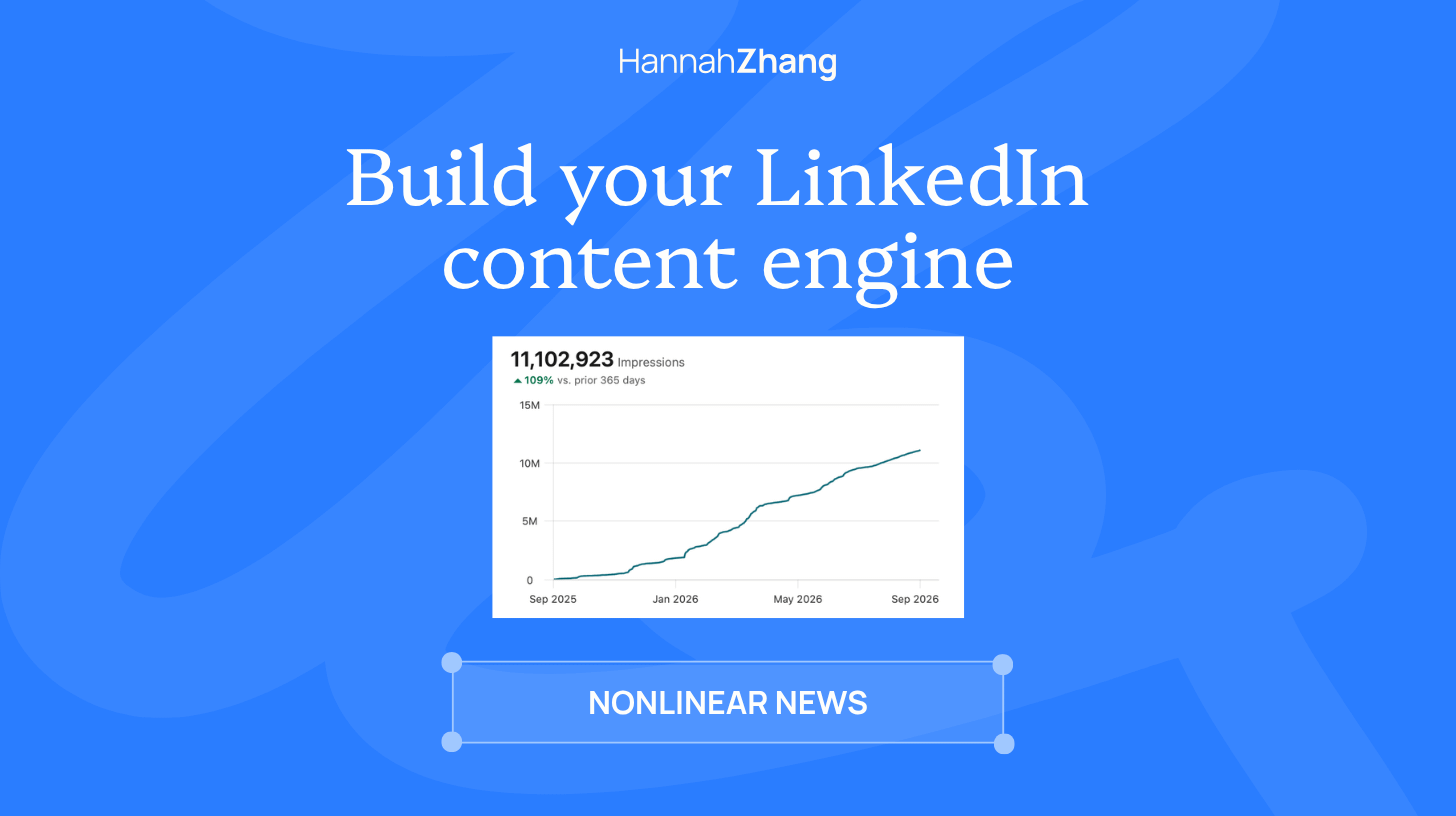
Over the following year, LinkedIn generated more than a million impressions and tens of thousands of engagements. The audience doubled, and individual posts reached tens of thousands of people in a niche B2B market.
The content also led to press inquiries, speaking opportunities, investor conversations, relevant connections, and posts being shared inside the companies we wanted to reach.
That experience showed me that the process could work beyond my own personality and audience. It could work for a founder who didn’t consider themself a creator and had no interest in performing online.
I’ve since used the same principles to help founders and operators in different industries clarify what they want to be known for and turn their expertise into content.
Your work is already producing content
Last week, I taught this framework to a room of founders in New York, mostly of B2B businesses.
Most of them had the same problems I hear from almost every founder who wants to build a personal brand:
“I don’t have time.”
“I don’t know what to write.”
“People will think I’m spending all my time posturing instead of building.”
But building a company creates more material than most founders realize, without allocating time to “creating content” from scratch.
“Content” is the byproduct of:
The explanation you gave on a customer call
The Granola notes from an investor meeting
The Slack message where you explained a product decision
The presentation you built for your team
The objection you keep hearing from buyers
The pattern you noticed after talking to 20 customers
The decision you made that goes against conventional advice in your industry
A content engine captures those moments and turns the strongest ones into post ideas.
After seeing how well it worked, I rebuilt my own content process around the same system. It’s now how I turn my meetings, notes, conversations, and projects into a steady source of ideas.
This post is my content engine in practice! The original source was a presentation I gave to a room of founders. I turned that presentation into this newsletter, a LinkedIn post, and a short-form video, adapting the same core ideas for each format.
The framework also works if you’re building a company outside your 9-5 or you’re an operator who wants to share what you’re learning through your work.
In the rest of this post, I’m sharing the exact slides I presented last week, including:
How to choose the business goal your brand should support
How to define the buyer, investor, or stakeholder you want to reach
A positioning exercise that connects your experience to what they value
The three types of content that build reach, trust, and proof
How to turn calls, messages, research, and company work into a weekly idea brief
The 2-post-per-week workflow I recommend to busy founders
A template for writing your first post
Plus: the prompt you can pop into Claude or ChatGPT to create the weekly content brief that drives the engine (after plugging in the tools you want to pull from - e.g. Notion, Slack, Gmail)
If you don’t scroll any further and take one thing away from this post:
Your work is already producing content. You just need a system for capturing and sharing it.
I think of content as the exhaust of meaningful work: the useful explanations, decisions, and lessons your work naturally produces. If an idea is valuable enough to share with one customer or employee, it’s probably valuable to future customers, hires, investors, and other people facing the same problem.
A content system allows that insight to keep building trust and creating opportunities long after the original conversation ends.
If you want want 1x1 support building this out or want my help with personal branding, tell me what you’re working on here!
