


Hi, I’m Hannah! Welcome to Nonlinear News, where I write for smart, ambitious people choosing the nonlinear path.
🗽NYC EVENT 🗽Build your Content Operating System with me!
I’m co-hosting an in-person workshop with Ellie de Wit at Notion on Tuesday, Sep 29. Spots are limited and by approval only. This is for you if:
you keep saying you want to create content but still haven’t started OR
you want to use AI to create more without losing your voice

“It’s a gift to be a corporate creator.”
I was halfway through my conversation with Ana Cordera when she said this. I stopped her and told her I was going to open this post with it.
I loved the framing because I agree entirely—and because it runs against how we usually talk about building something outside a 9-5. Corporate work is often framed as the thing taking time away from the business you really want to build. Ana sees her job at Meta as part of what makes her a better creator and entrepreneur.
Ana is the creator behind @anabuildshabits, where she helps ambitious women turn scattered ambition into focused action through life design, habits, and sustainable productivity.
She’s grown the account to more than 10K followers while working full time, planning a wedding, and protecting Saturdays as a no-work day. Her brand looks cohesive now, but it took five years, four creative projects, and more than a year of experimentation to get there.
I’m sharing my conversation with Ana about how she found a distinct point of view in the crowded productivity space, the weekly system she uses to publish consistently around a demanding job, what working at Meta taught her about building a creator business, and how she turns online visibility into opportunities offline without needing hundreds of thousands of followers.
She treated content like a business before she had an audience
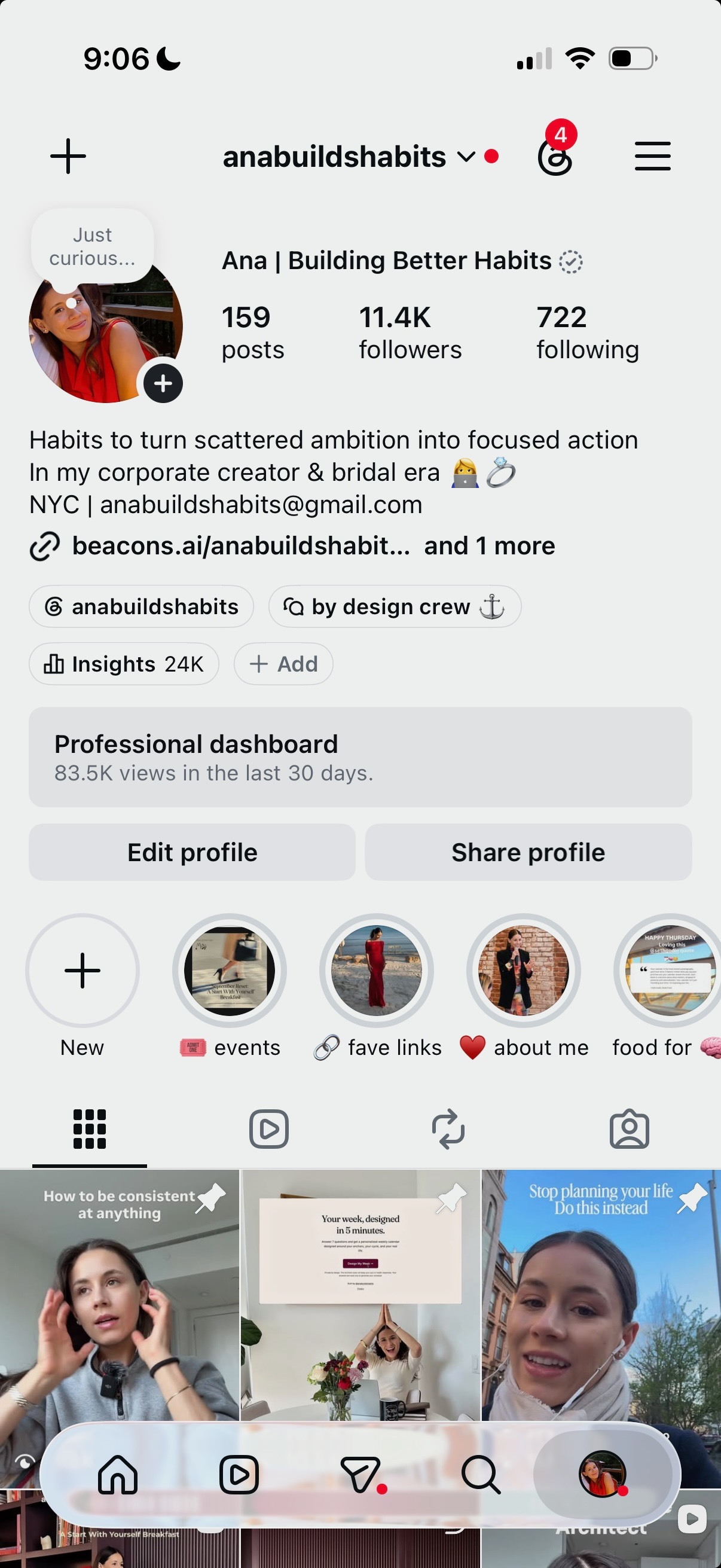
Hannah: A year ago, @anabuildshabits had a different name and around 1,000 followers. What did the account and your strategy look like then?
Ana: From day one, the strategy was: this is a business. This is something that will eventually be bigger than it is now, so I might as well treat it that way.
But I was also learning. I like an idea from Ali Abdaal: first get going, then get good. I treated my first year as a year to experiment. I saw other creators post for three weeks or three months and blow up overnight, but I never assumed that would be my path.
My goal was simply to post consistently and get into the habit of showing up online, speaking to the camera, scripting, filming, and finding a system. I describe that first year as finding content-market fit, similar to how founders think about product-market fit. I didn’t find it until about a year and three months in.
Hannah: What gave you the confidence to treat it like a business before you had the results?
Ana: It’s important to say that this was my fourth business or creative endeavor.
I started a wellness Instagram account in 2020. That evolved into a newsletter, and the newsletter evolved into a podcast. By the time I started the Instagram account that eventually became @anabuildshabits in January 2025, I had five years of creating, trying, and figuring out what worked with my rhythm, what I wanted to talk about, and which medium fit me.
Podcasting wasn’t the medium through which I was going to grow an audience and build a community. Short-form video was something I loved consuming and creating. The idea might evolve, but I knew I had to get going.
One viral video revealed her content-market fit
Hannah: A video you made about the “Designing Your Life” class you took in college brought in a lot of new followers. What did it show you?
Ana: Nothing about the mechanics of that video was different from other videos I had made. The script, format, and scene were similar. That signaled to me that the topic itself—designing your life—was what people wanted to hear more about, especially how to apply it to their own lives.
The class had a huge impact on my life and career, and I still think about it every day. I assumed everyone knew about these ideas. The comments showed me that they didn’t.
I listened to the reaction of the market and immediately doubled down. I knew the halo effect of a viral video might last a month at best, so I started a Design Your Life series. That evolved into Life by Design vlogs about how I design my life while working in corporate, planning a wedding, and building as a creator. Now it has also become a newsletter.
I don’t think my creator business would be where it is today if I had simply enjoyed the viral video and done nothing to understand why it worked.
She found her niche by rejecting “toxic productivity”
Hannah: Habits and productivity are crowded categories. How did you arrive at “design over discipline” and create a point of view that felt like your own?
Ana: It took me about a year and a half to realize that this was what I wanted to keep talking about.
Part of it came from seeing how people responded to the Design Your Life video. Part of it came from looking at my own life and realizing that I had built it through design, not discipline. My positioning is “design over discipline” and “turn scattered ambition into focused action.” The root of what I talk about is action, and action comes from having clarity and momentum.
I also realized that I already talked about these ideas endlessly with my friends. That made content feel like an extension of my life rather than another task I had to complete.
When I first started creating, I talked a lot about money and running. I love both topics, but not as much as I love talking about habits, women’s health, productivity, and routines. I’m not surprised that the video that took off was about designing your life.
I also looked at the productivity space and saw white space for a woman thinking about fertility, health, energy, and how those factors affect her routines. Most of the advice I saw came from what I call the “toxic productivity bro”: wake up at 3 a.m., cold plunge at 4 a.m., and drink two shots of espresso before eating.
That never resonated with me. Women’s energy doesn’t remain the same throughout the day or month, and telling women they can’t plan around those fluctuations isn’t true. I wanted to bring that perspective into the conversation.
Her calendar turns a full-time job into a content system
Hannah: You work full time in Big Tech, run @anabuildshabits, and are planning a wedding. Walk me through how you design a week in which the content actually gets published.
Ana: I live and breathe by my calendar, but I design my life around what I call anchors: the priorities for the current season of my life.
My anchors right now are moving my body and building @anabuildshabits. I design my time around respecting both of them.
Practically, my content week looks like this:
Sunday: I do a performance review, look at how my content performed, and plan the week.
Monday through Wednesday: I’m usually in the office, so I try to film while I’m dressed and already have my makeup on.
Thursday and Friday: When I’m working from home, I focus on scripting, editing, and work that doesn’t require me to be on camera.
Saturday: No work, no creating, and sometimes no consuming content.
I’ve found that I show up best when I have at least one day to rest, reset, socialize, and fully unplug. I wouldn’t be able to sustain this pace without one day to breathe.
Hannah: How can someone decide what their anchors should be?
Ana: Start by reviewing how you’ve spent your time over the past month. You might discover something that should become an anchor. You might also realize you’re spending a lot of time on something you don’t want to prioritize and decide to discard it.
The sweet spot is one to three anchors. Anything more becomes a distraction because you can’t give each one enough attention or energy.
Anchors can change with the seasons of your life. Someone with a newborn may have the same anchor for much longer. Someone focused on dating may choose it as an anchor for three months. You can shift once you feel like you’ve reached a good rhythm.
Her 9-5 taught her how to pitch and tell better stories
Hannah: How has working at Meta and with creators, brands, and agencies changed how you approach your own creator business?
Ana: I’ve learned so much about storytelling at Meta. In my day-to-day work, I talk to brands and agencies about how to connect with their audiences through content, video, and images. I’ve learned both the art and science of effective storytelling and how to connect with people emotionally.
More than anything, I think it’s a gift to be a corporate creator.
How I pitch brands, talk to event sponsors, and present myself and my ideas to my audience is rooted in frameworks I learned at my job. That corporate mentality is extremely effective when you’re building a business, especially one rooted in video and storytelling.
Hannah: How do you manage the perception and risk of becoming more visible while working for a major company?
Ana: I’m grateful to work at a company and on a team where having an identity outside the office is encouraged.
At the same time, I’m respectful of what it means to have a corporate job and a creator business. I respect the hours and expectations of my work. Many of my coworkers and friends at work follow my account, and my hope is that the person they see in the office is the same person they see online.
I want there to be one Ana. The goal is to respect the corporate job that gives me this opportunity outside my 9-5 while showing up with the same integrity online and in real life.
She builds relationships through small, consistent acts of generosity
Hannah: You’ve spoken on panels, hosted events, and built a strong network without being the loudest person in every room or the one with the most followers. How do you approach relationships and create those opportunities?
Ana: My motto is that relationships are everything, and those relationships need depth.
Even before I graduated from college, I was intentional about attending events and asking for coffee chats with people who were five, 10, or 15 years ahead of me. That helped me build a valuable network, but it took time and consistency.
Getting access to rooms and opportunities comes from showing up with value—something that helps the other person, their business, or even simply brings them happiness.
Sometimes that looks like supporting a friend’s book launch. Sometimes it’s sending flowers when someone receives a big accolade. Those small actions show people that you remember them and are thinking about them. When a speaking or investing opportunity comes up, they may have you top of mind.
The same principle that applies to building an audience applies to relationships: be consistent, be visible in that person’s life, and be valuable.
Ana’s three rules for building outside your 9-5
Hannah: What advice would you give someone with a demanding job and a busy life who wants to build something creative outside their 9-5?
Ana:
Design your week. Every Sunday, sit down and design the week ahead around your anchors. Decide what they are and how you’ll respect them.
Use Parkinson’s law. Work expands to fill the time you give it. If you give yourself eight hours to write a proposal, it will take eight hours. If you give yourself two, it will take two. Constraints help busy people get more done.
Manage your energy, not only your time. This is especially important for women because our energy can fluctuate throughout our cycles. Pay attention to when your energy is highest and protect that time for the work that needs it.
Connect with Ana
Ana writes By Design, a weekly newsletter about the science of building focus, energy, and habits, plus the messy middle of designing a life while living it.
Follow Ana on Instagram and LinkedIn.

📣 Get your free 5-9 Creator Starter Kit
Build your LinkedIn personal brand in 14 days via my guided Notion brand sprint
Find me on: Instagram, Linkedin, Tiktok, Youtube

✋ NexusPoint — Not a tool, but this is the best resource I’ve used so far for hiring assistants and editors overseas (and I’ve tried a LOT) - they take care of everything up to the point of hiring and don’t charge until you onboard someone → Book a free discovery call
🏦 Relay — If you’re still using your personal bank account for your business, switch to Relay in 5 minutes and thank me later. → Try Relay
💬 Stanley — If you’ve been wanting to post more consistently on LinkedIn, this is the writing partner I use. You’ll get a 3-day free trial with my link → Try Stanley
🎙️ Wispr Flow — Voice-to-text that actually works. I dictate messages, prompts, and emails instead of typing, and it saves me hours every week talking to AI → Try Wispr Flow
👩🏻💻 Fiverr — My go-to for hiring freelancers for things like design, editing, one-off projects (I use Fiverr Pro to save time on vetting talent) → Try Fiverr
🧊 Othership — The sauna/cold plunge I go to! → Try Othership with my discount
🧾 Xero — The accounting software running the back end of my business. Bookkeeping and invoices without me having to think about it → Try Xero

Great peace! I love the part about getting going first and then getting good.
This is great! I love the idea of taking action and building further when you find an aligned spark!