


Hi, I’m Hannah! Welcome to Nonlinear News, where I write for ambitious people with unconventional paths.
Follow me for ~weekly posts on pivots, portfolio careers, and personal brands.
5 questions to ask before you start a newsletter
Out of all my content channels, this newsletter has been the least strategic yet most rewarding.
I got back from the holidays earlier this month and opened Instagram to see three different people announcing new newsletters. Then I checked LinkedIn and saw two more. Everyone is starting a newsletter in 2026.
It makes perfect sense. People are tired of short-form content. Consumers are tired of quick dopamine hits that keep them in an endless scroll. Creators are tired of fighting algorithms - they look to long-form for higher quality engagement with audiences they own.
The newsletter makes for an attractive side project or creative outlet. The startup cost is one of the lowest. You don’t need to film or edit, and writing on Substack feels less cringey than broadcasting to your network via reels or LinkedIn posts.
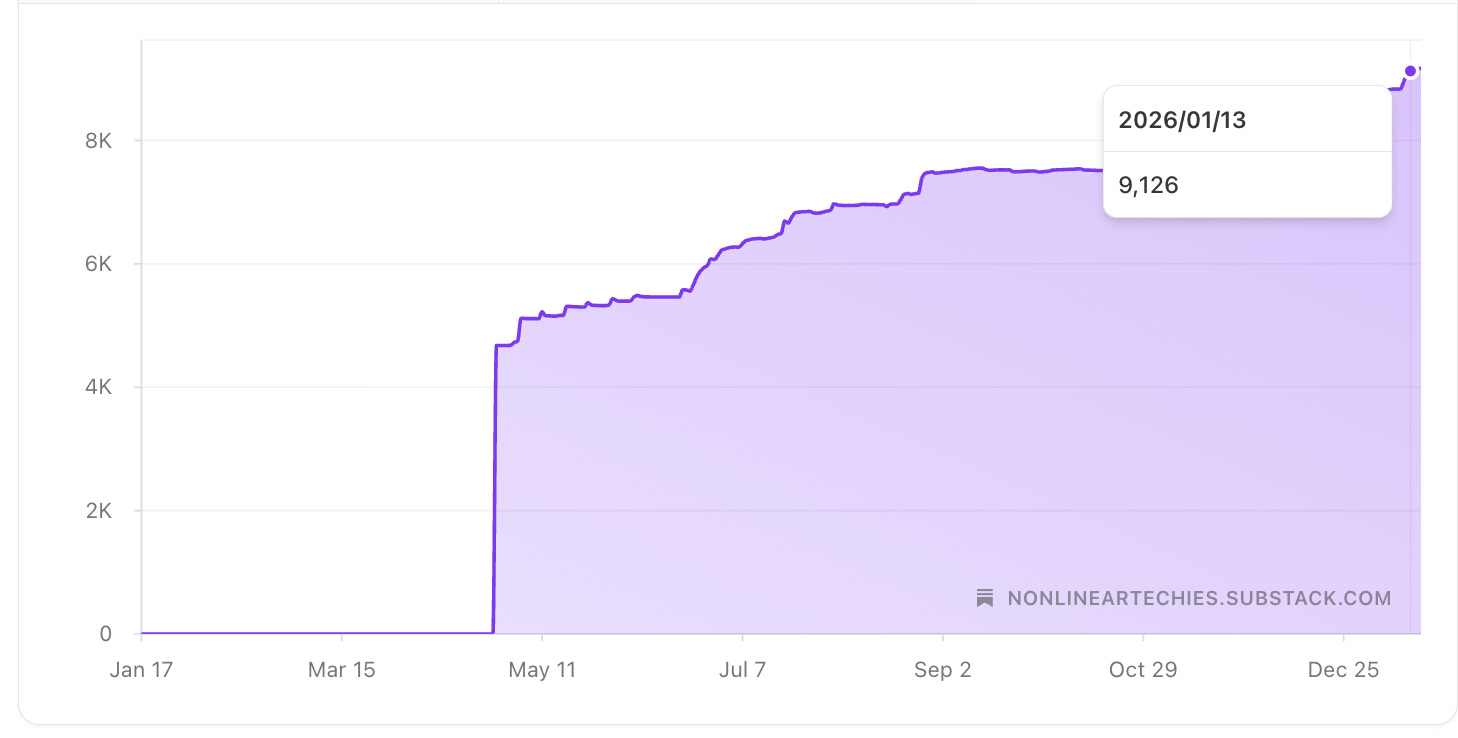
I started this newsletter a little over a year ago. I have over 9,000 subscribers now. And yes, I recognize the irony of writing a newsletter about writing a newsletter, but I wanted to share my experience for anyone starting or thinking about starting one.
I’m not going to tell you about my great, well-researched newsletter growth master plan. I never had one. I started a newsletter a few months into creating content on Instagram because I panicked about the algorithm controlling who saw my content, changed my approach multiple times, and spent months feeling overwhelmed by the idea of writing it before having everything figured out.
If you’re thinking about starting a newsletter - whether you’re exploring an idea or side project outside of work or adding a channel for your personal brand - here’s what I wish someone had told me before I started.
1. Why start a newsletter?
The owned audience argument (and the tradeoff)
If you’re still reading, you’ve decided that a newsletter might be a good way to broadcast your thoughts to the internet. You’re weighing it against other channels - short-form video, LinkedIn, whatever else you’re already doing or thinking about doing.
A newsletter lets people get to know you, how you think, whether they trust you. Eventually they might buy from you or stick around long enough that you can monetize the attention through partnerships, land speaking opportunities, or even get a new job out of it.
The big selling point is that a newsletter is an owned audience - no algorithm controlling who sees your work. But here’s the tradeoff: growth is much slower than social media because there’s no algorithm to push out your work. You’re asking people for their email instead of a follow. That’s a higher bar. (Yes, Substack has some built-in discovery - more on this below!)
As a marketer, the convention I’ve heard is to have one long-form and one short-form content channel you’re good at so you can balance the pros/cons of each.
The best deciding factor
Do you like to write?
I love to write. Looking back, it probably would have made more sense for me to start here instead of with Instagram. If you don’t love to write, a newsletter can feel like drudgery. If you prefer creating in another format more, start there instead. That said, writing a newsletter can also be a great way to improve your writing.
Two models for thinking about ROI
As an ex-finance girly, no I can’t forget about the ROI! There are two ways to look at a newsletter - a binary but useful heuristic.
Your newsletter can be your product - paid Substacks where the newsletter itself is what people pay for.
Your newsletter can be marketing for your product. Your product might be you - your personal brand, just your ideas if you start it for fun. Or it might be how you sell courses, coaching, other services.
For me, it’s the second one. I use my newsletter to build a specific audience and occasionally sell sponsorships.
I don’t substantially monetize my newsletter itself and that’s intentional. I have 2 paid posts that I only gate because we value what we pay for more. I’d only do this with high-value guides. (Maybe I should with this one, but it feels weird to gate a newsletter post about starting a newsletter!)
I use it as a deeper form of engagement with my audience because I don’t have time for consistent creation on YouTube. And I’ve found it’s a valuable additional channel for sponsorships.
2. How do I start?
Platform: what I tried and what stuck
I’ve tried three platforms. Compare more platforms.
Beacons (don’t) I started here because that’s what I used to collect emails in my Instagram link in bio. Beacons isn’t built for email. The editing experience is poor, you need a lot of formatting and templating. Skip this.
Kit (depends on your use case) I moved here after hearing the founder speak at an event. I’d heard good things and it was cheaper than Beehiiv at the time. But the pricing scaled as you grew in ways that made more sense for brands selling programs or digital courses because they need drip campaigns, growth loops, all that infrastructure. Wrong use case.
Substack (where I landed) The editor is simple. I like that there’s discovery built into the platform. I’ve heard creators who prioritize their paid newsletter offering say it’s not the best because of platform fees, but I like it here for now.
Figure out who you’re writing for
Same advice goes for starting any personal brand: know your why, your audience, and your positioning. Your newsletter is just an avenue for your brand. It’s less about picking a niche - more about an angle or specific audience you write for. I wrote one of my few paid posts about this.
Getting your first subscribers
This is personal. You need to test.
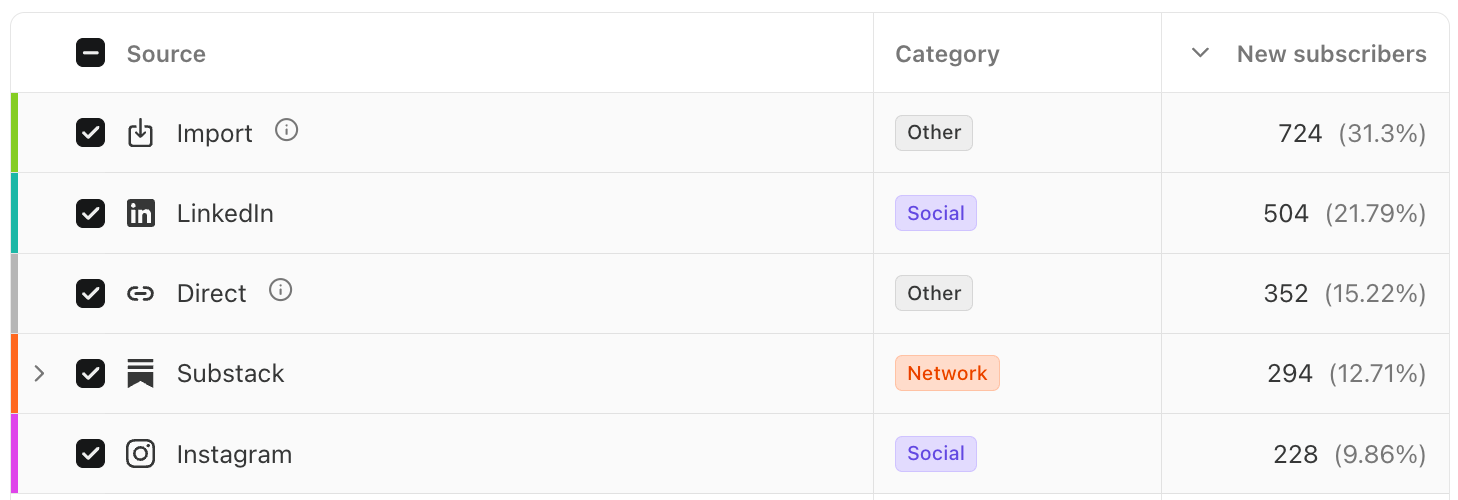
More than half of my subscribers came from Instagram because I was collecting emails through lead magnets before I even started the newsletter. Substack has some discovery built in - you can grow through Notes. I also grow via Linkedin by restructuring every newsletter as LinkedIn posts and link back to Substack for the full read. Your first subscribers could be friends and family. Your most sustainable growth may be through shares and referrals.
Good exercise: Think about whether someone in your target audience would share each post as you write it.
Newsletter growth guide from Beehiiv
3. How do I sustain it?
The time commitment (and the invisible work)
1-2 hours per week, give or take, but probably more because I’m thinking about it all the time. Every week I know what I’m going to write about before I sit down. I think about what questions my audience might ask and start answering them in my head before I open the doc.
Making it sustainable
You have to enjoy it or make it enjoyable. If you’re challenging yourself to do this, create a ritual. Saturday morning. Coffee and breakfast. Deep thinking time.
This is my weekly anchor to think about my audience - who they are, how they think, how I connect with them, what I want to say.
How I never run out of content
Create content flywheels. You might remember my welcome email where I ask what you’re interested in and what goals you have. I get topics right there. (If anything, my problem is too many ideas.)
Use LLMs (strategically). I created a Claude writing style of my voice. I dictate drafts using voice, get Claude to structure it, and review/rewrite the whole thing. I’m fastidious about how I sound on long-form and I’ll take a few typos over AI slop. If you ever see me use the word “quietly” when it makes no sense in the context, I’ve been hacked.
I repurpose like crazy. Whenever I go on a podcast, speak at an event, or have a conversation with someone interesting - boom, that’s a newsletter.
4. How do I grow it?
Where my subscribers come from
Here’s my growth over the last 90 days. Imports are from lead magnets, Instagram is through my bio and stories.
The cold start problem (and how I avoided it)
I didn’t have a cold start. I used free lead magnets I distributed on short-form to get a few thousand newsletters. You can also start on Substack and grow via Notes.
You need to give yourself an initial boost, but the best long-term growth hack is writing good content. Think of your newsletter as your product and short-form as your marketing.
How this became my content flywheel
My newsletter content has been chaotic and inconsistent until recently.
I wrote a few posts last March and April. I had no idea who I was writing for or what consistency meant. I tried to match my lead magnet topics. That was fine but I struggled to find ideas that I cared about. It also felt like one more thing to create.
Then I switched to a weekly jobs list that my assistant helped curate. I still include this in every post. It drove growth but not engagement or trust. A jobs list is a utility - people aren’t learning anything about you.
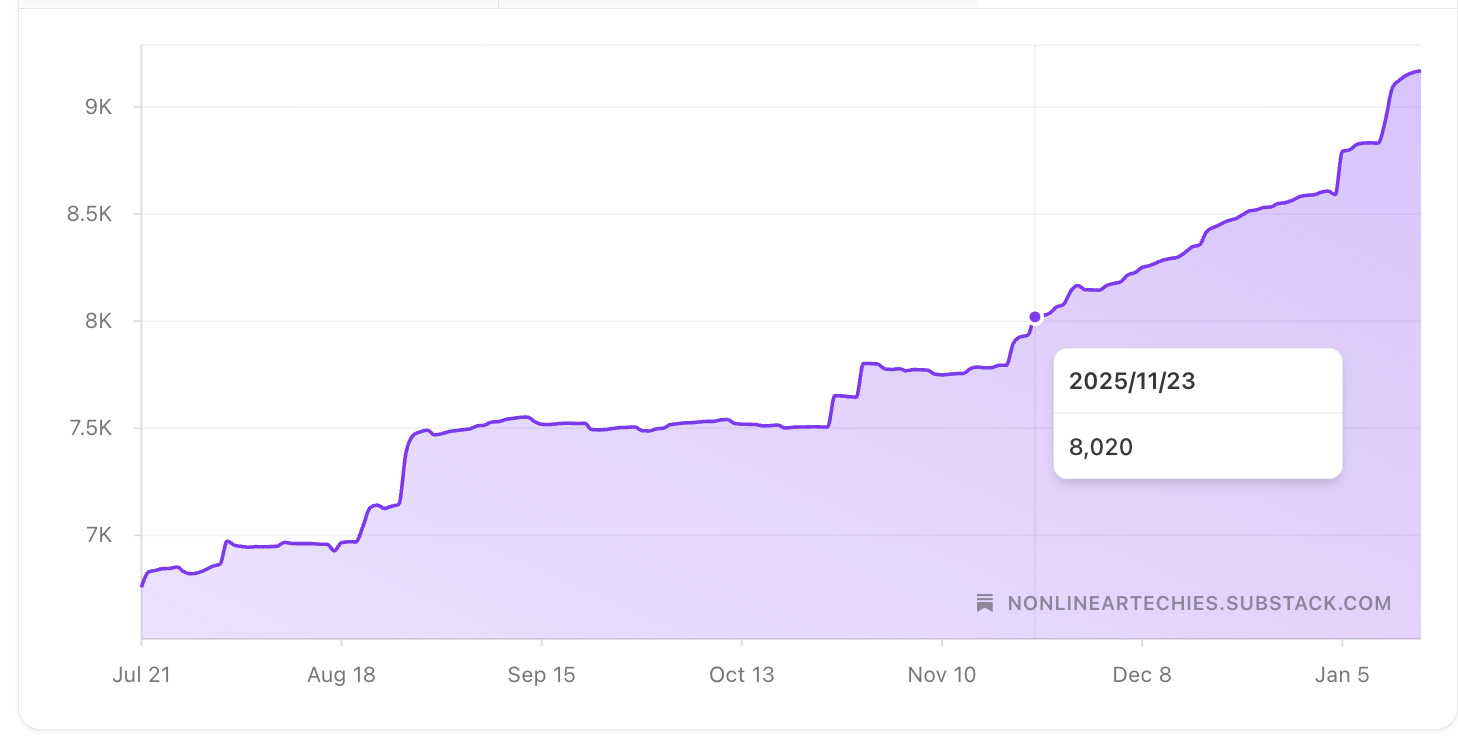
In November, I decided it had to change. Brandon Smithwick writes about content and mentioned his version of a content flywheel in his newsletter - a long-form piece that feeds everything else.
That’s what my newsletter became. It’s the central thing I do every week. Even if I don’t do anything else, I write this. It gets repurposed into at least one Instagram carousel, one video, a few LinkedIn posts. It’s also a thought exercise. I get deeper on my thinking around one topic and research it thoroughly.
My subscriber growth after I stopped being lazy with my newsletter in November:
5. Is it working?
How to measure success
Go back to which operating model you’re using (newsletter as marketing or newsletter as product).
Set three metrics: one acquisition (subscriber growth), one engagement (replies or shares), one outcome (related to your goal - could be booked meetings, link clicks, or sponsors).
My newsletter is working (I think)
I have an email list ready for when I launch something. The trust, engagement and ownership often feel more meaningful than my 100K audience elsewhere, even if it doesn’t bring in as many direct dollars yet.
It gives me clarity of thought and an anchor for consistent messaging across channels every week. It helps me stay focused on building for an audience, not an algorithm, and it makes me a better writer in my 5-9 and my 9-5!
Reads, Ideas, Tools
10 new interesting startup and side-project ideas: good products for your newsletter to market!
Breaking into strategy: good post on people who want to work in strategy, especially if as fractional advisors/consultants.
Jobs & Resources
cool jobs for ambitious nonlinears (updated ~weekly)
I use the same flow with Claude as you described! I felt a bit relieved to hear that you also rewrite after Claude takes a pass. I'm similarly adamant that the final post sound clearly like me, not AI. Thanks Hannah for sharing!
Would love to hear more about your lead magnets and overcoming the cold start problem!