


Hi, I’m Hannah! Welcome to Nonlinear News, where I write for ambitious people with unconventional paths.
Follow me for ~weekly posts on pivots, portfolio careers, and personal brands.
I sound like a broken record every time I say this, but my favorite thing about building my career in public is the people you meet along the way. And I’ll never stop saying it!!
I met John Crowley almost a year ago when I first started creating content. John is an HBS grad and startup operator who also had a 5-9 as Co-Founder of M7A, making MBA admissions consulting work for Gen Z.
I loved that John and his cofounders (also HBS grads) were doing this alongside their full-time jobs and how they built in public (35K on Tiktok!).
I spoke with the M7A team about:
Why I went to business school (my real reasons vs. what I wrote in my essays)
How I thought about school selection
What I found valuable (and surprising) about the MBA, and my #1 takeaway
How I pivoted from product management to product marketing post-MBA
Why I started building a personal brand
Here’s what I said! I hope this is helpful for anyone curious about, actively applying to, or currently in business school. Or you can watch the video.
I also have some VERY cool jobs to share this week!
Why business school?
I first started thinking about business school during my senior year of college, so the idea was always here. I bought the GMAT book and never took the exam. If there was one thing I could go back in time and do, I would have taken it that year I was still in “study mode” because the exam ended up being a huge hurdle when I applied later.
After I quit investment banking, I was considering several paths. I wanted to do something else, but didn’t know what. A lot of people in that boat consider grad school, and business school made sense given my background in finance.
When I think about the “why” now, I’d tell anyone starting the application process to ask themselves three questions:
Is this going to help me pivot my career?
How is this going to change my long-term compensation picture?
Is growing my network valuable to me, and is business school the best way to do that?
If you can answer those three questions in a way that affirms you should do this, it’s also going to give you direction on where to apply.
My real MBA goals vs. what I wrote in my essays
They weren’t the same. And that’s something I regret looking back.
When I was writing my essays, I was thinking through what would look best on paper. What’s the best story to tell? For me, at the time, it was a story about how I had worked in finance and then in tech as an operator, and why those experiences made me want to be a VC investor.
To some extent, I did want to explore VC. But later, when I took a real look at my career interests and stopped optimizing for an admissions committee, I realized I was more of an operator than an investor. I also concluded that in order to be a good investor, you have to be a good operator first. I didn’t want to be an investor, at least not then.
My more “real” MBA goal was to move back to the US with a softer landing. I’d spent a lot of time internationally and didn’t feel like I had much of a business network in the US. I also wanted to explore what being a product manager in a US big tech setting would look like.
How I chose Wharton over Booth
I got into Wharton and Booth, and the decision came down to geography.
Booth employment data showed that two-thirds of their grads ended up in the Midwest. I’d never lived in the Midwest and didn’t see myself building a life there, so it didn’t make sense to build my network there through the MBA.
I did see myself coming back to New York (where I went to college), and Wharton was basically a satellite to New York. I also liked that Wharton had a Semester in SF program for people in tech to get more hands-on learning and in-semester internships.
The other reason was more “vibes based”. I’d worked with a few Wharton alums at my last company. I thought they were smart and likeable. They helped me when I applied and shared enough about their experiences that dispelled my long-held belief that Wharton was just “the finance school.”
What helped me stand out as an applicant
I love Wharton’s essay prompt because it’s straightforward, no fluff: What are you bringing to the program, and what are you hoping to take away?
I see it as a Venn diagram between you and the school. On one hand, what’s unique about you and your background? On the other hand, what’s unique about the school or something they want candidates to resonate with? Where’s the intersection?
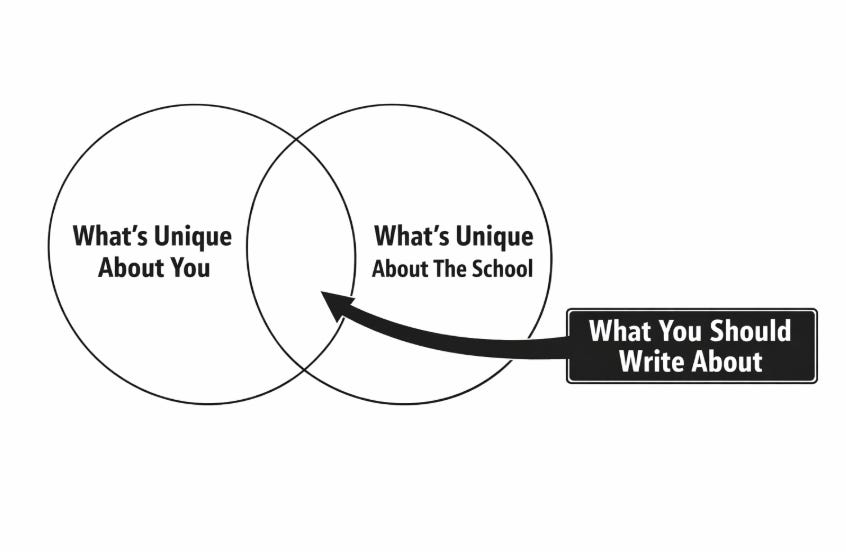
One thing that was unique about me was my international work experience. I’d worked in Asia and Latin America. Wharton has a lot of global programs, so I wrote about that angle. I’d also worked on logistics marketplaces, and Wharton had a future mobility club, which was fairly niche.
The more specific you can get with the Venn diagram between you and the school, the more it feels like you did your research. The best way to do that is to speak to actual people - current students and alums. Use their language and their stories to inform yours. This applies to every school, even if their essay prompts are more abstract!
My first year vs. second year experience
Your first year feels different than your second.
My first semester felt overwhelming, especially at a school like Wharton with 900 people per year. You come to campus with ideas and a vision of what you’re going to do, and it’s hard to stay grounded because you have so many opportunities - internships, fellowships, clubs…It’s like a buffet you have to pick and choose from before you fill up on junk you didn’t go there for.
You’re trying to build your network, milk everything you can out of this expensive degree, get all the opportunities, and recruit for internships. You’re meeting hundreds of other career-oriented overachievers, going on international trips with huge groups of people you just met, and it can be hard to find your people.
Second year is when things settle down a bit. You get to know your classmates, build meaningful relationships, get more intentional about how you consume at the buffet, and figure out what you want your life to look like after graduation.
I about 5 things I wish I knew about business school before I started (3,000+ people on Linkedin found this helpful so I figured I’d share it again here!)
How I pivoted from product to product marketing
My career was nonlinear before business school. I thought it was going to be more linear during and after, but that wasn’t in the cards!
I went in thinking I’d try product management in big tech and got an internship doing product at eBay. And I had a similar experience to a lot of people in huge teams at big tech: spending a lot of time optimizing a tiny part of a huge platform, feeling like a cog in a machine. The work-life balance was nice compared to a startup, but I craved more impact.
That brought me back to the drawing board at the start of 2nd year. I returned to the Venn diagram of what jobs are attractive to me versus what unique skills I bring. I realized I wanted to be distributing a product rather than building it because I wasn’t technical and didn’t want to get more technical. I felt I had a better competitive edge on the distribution side - storytelling, marketing, sales just came more naturally for me, while still letting me use what I had learned in product management.
Long story short, that led me to a chief of staff role at a B2B SaaS company on the go-to-market side. I ended up shifting to product marketing quickly in that role due to both experience in GTM strategy and the business needs, and I still work in product marketing now.
Why I started building a personal brand
After graduating, I worked a 9-5 remote job for the first time in my life. I’d never had that much free time before.
On one hand, I needed a hobby. On the other hand, I felt like if I wanted to do product marketing, I had to put in the work to learn marketing. I had to prove that I could execute, not just do strategy and messaging.
So I started tinkering on the side, posting first on Instagram. I shared my own career experiences and missteps, built a community of people who’d navigated difficult transitions and explored different things. People who felt like they weren’t tied to one corporate ladder. I wasn’t thinking about it as “building a personal brand. I was just doing something that felt useful and interesting. Once I got traction, I also started posting on LinkedIn and writing a newsletter.
Recently, I started a new job in product marketing at a series A startup. I got this job because my company found me on LinkedIn. They saw what I was creating, and it was proof I could do the work.
That’s when it clicked. I hadn’t set out to build a personal brand, but I’d built one anyway. And I started to understand its power. I used to believe my credibility came from Columbia, Wharton, Morgan Stanley. And for a while, it did. But increasingly, especially in tech and startups, those credentials don’t carry the same weight. These companies don’t care where you went to school - they need to see that you can do the work. What I’d built became my way of broadcasting my intentions and demonstrating my capabilities at the same time.
My #1 takeaway from business school
Most people go to business school to recruit for finance or consulting, but most of the classes are about successful businesses and the people who built them. You study strategy, capital raising, and business plans.
My #1 takeaway is that you have to own something, and there are more ways to do that than you think. I used to believe starting a business meant raising VC funding - that was the optimal route. But in business school I learned about search funds and entrepreneurship through acquisition, where you buy an existing business like a dental practice or a car dealership instead of starting from scratch. I learned about bootstrapping and debt funding. And now I’m learning how you can be a content-driven solopreneur.
I’ve taken a “middle path” for now. I have a full-time role at a very entrepreneurial company where I have equity, but I’m also building leverage for myself on the side. Because at the end of the day, if you learn business, you realize that working for a salary is only going to get you so far. You have to own something, whether that’s equity in a startup, a side business that cash flows, real estate, or even a personal brand. Business school taught me what ownership could look like. Building in public is teaching me how to actually create it.
Reads, Ideas, Tools
Shortlist NYC: Andrew Yeung launched a new platform for startup founders to pitch to job seekers
Can you optimize love?: A friend shared this thought-provoking read on tech startups building AI for dating
Wonder Tools: If you ever “wonder” where I hear about new tools and products!
Jobs & Resources
cool jobs for ambitious nonlinears (updated ~weekly)
Really relate to the difference between the 1st and 2nd year and how you 'calm' down and focus on what you want in the buffet.
Highly agree, I feel like as a non-linear who went to a top full-time MBA program, building a personal brand and navigating the "in-between" is the key!