


Hi, I’m Hannah! Welcome to Nonlinear News, where I write for smart, ambitious people choosing the nonlinear path.
Today’s post is on a topic I've been thinking about a lot because I'm working on a new series on Instagram on building a personal brand in your 5-9 as a knowledge creator (stay tuned!!).
I know a lot of us are probably sick to our stomachs hearing about personal brands…but this is slightly different view I hope you’ll consider xx
And stay tuned - I also have a VERY exciting interview dropping in next week’s issue with someone who will talk more about her nonlinear career and building a personal brand in a very unique way!
My resume is all over the place.
When I was 21, I started my career in equities sales, then moved into real estate banking…both in Hong Kong. Then I left finance for tech (more specifically - at a global ride-hailing company that was launching in Latin America). Then I got an MBA to pivot into product, but ended up doing product marketing at a B2B SaaS company. Now I’m also the founder of a creator business.
If you just looked at that on paper, you’d probably ask the same thing many interviewers did:
“So what do you actually want to do?”
I’ve sat across from people who were visibly confused, trying to work out how any of that added up to the role I was interviewing for.
If that’s you, you know the feeling. You spend the first ten minutes of every conversation justifying your path instead of talking about what value you bring. You sound defensive. And the longer you spend explaining, the more you start to sound like the exact thing you’re afraid of being called: an unreliable job hopper.
There’s a way out of that, and it’s the same solution whether you want a better job or something bigger, like your own business:
You build a personal brand.
My definition of a personal brand (there are many others!) is simply what you’re best known for, which you can eventually build, amplify and monetize into a brand or business based on your expertise and point of view. The latter is often what you see referred to as a “personal brand” more broadly.
There are about as many reasons to build a personal brand as there are definitions. You might want to:
Land jobs
Get promoted
Build an income from sponsorships
Grow an advisory business
Network in your industry
Hire talent
…
If I were to sum it all up:
A personal brand brings you more opportunities so you can attract, not chase.
And people with nonlinear careers have the most to gain from building one.
When your career path follows a straight line, your title and your resume explain you. You show up in LinkedIns searches for “Product Manager” or whatever job you want because it’s already the title you have. Or you look like a star founder when fundraising because you have years in an industry.
When your career zig zags, you're left to do the explaining yourself, over and over. You don’t show up on recruiters radars because they can’t search for you by title. When you’re starting a new venture you look completely inexperienced in your field or function.A personal brand fixes that.
You craft a clear story that you can get in front of the right people so you skip the explaining and attract opportunities instead.
It’s what got me numerous inbound offers like this one despite having less than 2 years of formal “marketing” experience in my title and a very nonlinear career:
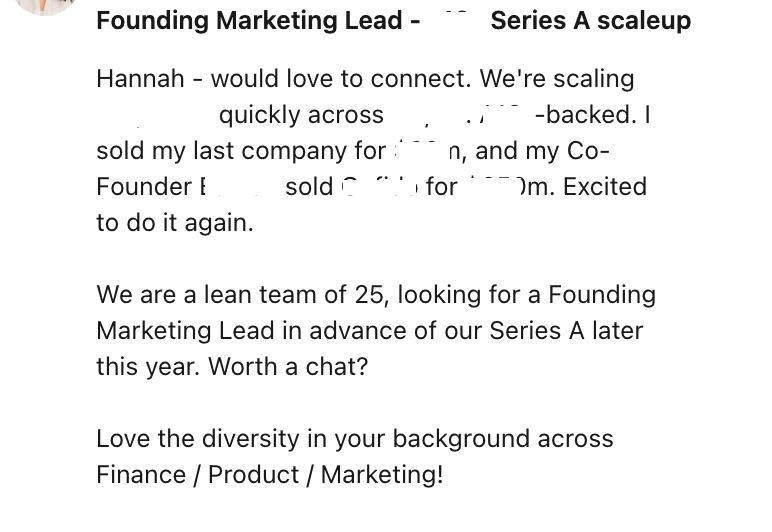
It’s what gets me 90% of my brand deals, with brands like LinkedIn, Notion, and Adobe.
It’s what gets people I admire in my industry (marketing, startups, creator economy) to reach out to me instead of the other way around for networking.
Without a story, you look like a flight risk, and you spend interviews explaining it instead of selling yourself. That’s the visible cost, and it’s the one people focus on. The cost we rarely talk about is what all that explaining does to you on the inside.
Without a brand, you feel like an imposter
A reader put it better than I could:
“I find that most people self-select themselves out of opportunities, especially boxing themselves into what skills they have and don’t. My background is years of consulting, I struggled with burnout and a toxic culture, and I was impacted by a layoff last fall. I’m trying to overcome the rejection from interviewing at multiple high-growth startups, and I’m scared to build and learn in public to build a brand. But I’m also seeing the pattern of others like me afraid of not just the rejection, but the fear of believing you’re worth the opportunity and the skill needed to thrive in a high-growth environment.”
I know this feeling well. When I left banking I was burnt out, and the startup I joined next was intense in a completely different way. While I was job searching, and even after I joined, I feared for a long time that I couldn’t “hack it” in a high-growth environment.
I had invented a story that everyone around me seemed smarter, sharper, better at execution, and I assumed I was the weak link. Because I was the one with the nonlinear path and they had done the job or held the title for longer than I did.
What I eventually figured out is that imposter syndrome starts before day one. It’s not really about whether you can do the job (in most cases, you absolutely can). A lot of it is set in motion before you ever walk in the door.
When you apply for a role you don’t obviously fit, you spend the whole process shaping yourself to it.
You trim your experience to match the job description, downplay the parts that don’t line up, and try to make the square peg fit the round hole. By the time you start, you’ve spent weeks making the case to yourself and others that you sort of belong, so you walk in primed to look for proof that you don’t. That’s where the imposter feeling grows.
A personal brand flips that entirely. When you’ve put out a clear case for what you’re good at, people come to you, and they’re the ones fitting a role to you instead of you contorting to fit theirs. You don’t have to explain yourself, which is the thing that sets off the imposter feeling in the first place, so you start on solid footing.
My friend Yuqi, who I interviewed for this newsletter, is a great example of this. She leads Developer Community with no formal community experience. Instead, she’d built a brand that articulated why her product background and her habit of building community in public made her the right fit. She showed she could do the job before she her first interview and never had to justify her experience against the job description line by line.
And sometimes the role doesn’t even exist until your brand creates it. My friend and mentor Upasna recently joined the American Journalism Project in a Head of Product & AI Studio role at the intersection of journalism, AI, product, and venture. It was created for her, because her brand made it obvious she was the person for a job nobody had even written down the job description for yet.
With a personal brand, opportunities come to you
And it’s the new normal of how hiring will work in the post-AI era, because AI has made it too easy to fake competence.
You can generate a resume, a cover letter, and a portfolio with ChatGPT in 20 minutes. You can use bots to submit hundreds of applications.
Earlier this year, we were hiring for a role at my startup and got flooded with applications. Many were clearly AI-generated. Sifting through resumes where we had no idea if the person actually did the work they claimed was exhausting. Most of the people we interviewed came from referrals, or had worked at a similar company in the same role with experience that was legible and a track record we could verify.
But the person we ended up hiring came in through their personal brand. They’d posted a portfolio publicly, including a teardown of one of our competitors showing how they’d redo the strategy. We reached out, interviewed them, and hired them. They didn’t have the exact title we were hiring for, but they’d already shown they could do the work.
This happened to me too. I got two job offers last year. Both came from startup founders who reached out after seeing my LinkedIn content. Posting publicly helped me rank higher in search, and it gave them a whole body of content that showed what I was capable of before we ever spoke. They could see how I think, how I write, and what I care about. I went into the interviews from a position of strength because they had reached out to me, not the other way around.
And it’s the same content that does double duty. The brand that gets you hired is the same one that attracts clients, an audience, and eventually sponsors if you want to go that way. You build the asset once and it compounds in multiple directions.
How to start building your personal brand (30min version)
No, a personal brand is not built in 30 minutes. Or a day, even.
I’ve been building my personal brand for almost two years, with lots of false starts, and trial and error.
But what you can do in 30 minutes is start nailing down the positioning that serves as the foundation for your personal brand, and map out a few first steps to kickstarting the personal brand engine.
Your positioning is, in a nutshell: Who you are, what you’re great at, and why your path makes sense. Distilled down to 1-2 sentences you can reuse everywhere. (If you happen to be a PM or PMM, this is just product positioning adapted to yourself.)
The template version:
FOR [target audience/employer/investors], I AM A [how you describe yourself] WHO PROVIDES [unique value], UNLIKE [default comparison, competitors] BECAUSE I BRING [unique combination].
My positioning, which I adapt from the template version, after spending time figuring out each [bracket]:
I’m an investment banker turned marketer blending business and creative to help B2B brands and high-achieving professionals turn storytelling into revenue.
It’s the first thing you see on my LinkedIn description and how I connect my experience across marketing, my personal brand, and my past experience in finance, business school and B2B SaaS.
Here are three ideas to write yours for a nonlinear career path, if you’re stuck or the template feels too robotic:
1. Anchor around an industry.
Say you’ve spent years in finance and you want to move into operating. You lead with the industry as the throughline:
“I’ve spent years around top consumer companies and saw how the best ones scale, and now I want to bring that inside one as an operator.”
2. Emphasize your skill stack.
If your value is the combination of things you’ve done, lead with that. Say you’ve worked in finance and then operated at a startup, and you’re going for a VC role:
“I’ve worked in finance and as an operator, and a VC role needs both, understanding the numbers and helping founders actually run the company.”
3. Frame around a core question.
If a single thread of curiosity connects your jobs, name it. Say the same question pulled you from sales to customer success:
“I’ve always been curious how companies solve customer problems. That took me through sales and then customer success, and now I want to keep chasing it as a PM building for the customers I used to sell to.”
Your goal isn’t to pretend your path was linear. It’s to show you’ve thought about it and can say why it makes sense for the role you want. Most people with nonlinear careers waffle there. They either downplay their past experience or try to explain every single job. Neither works. And positioning isn’t fixed - it changes with you.
Pick one framing that connects your dots, iterate until it feels right, and evolve it when it shifts.
Your positioning statement is the foundation, but it does nothing sitting in a Google Doc. Once you have it, there are three ideas to put it to work:
1. Put it where people check you out.
Rewrite your LinkedIn headline and About section so the first thing anyone sees is your positioning, not your current job title. This is the part that made founders find me in search and reach out before I’d applied to anything. Do the same with your bio, your email signature, and how you introduce yourself in a room.
2. Turn it into content.
Your positioning is the source material for everything you post, so you’re never stuck on “what do I even talk about.” You’re just showing the work behind the claim. That can be a competitive teardown (like the one the person I hired did), a breakdown of how you’d solve a problem in your space, or thinking out loud about where your field is going. You don’t need to go viral. A handful of LinkedIn posts (or another platform, depending on your industry or goal) is enough to give someone a reason to reach out.
3. Use it to reach out.
Once you can explain yourself in one line, cold and warm outreach get a lot easier. Message the people doing the work you want to be doing, with a clear ask, and let your positioning and your supporting posts do the vouching for you.
The first time you do all of this it’s slow and it feels cringe. That’s normal. But once your positioning is out in the world and you’re posting against it consistently, it stops being just a line you use in interviews and starts bringing the opportunities to you.
If you want a structured way to do this…
I built a Nonlinear Personal Brand 14-Day Sprint in Notion. Basically…how I’d coach you to do all of this in 2 weeks.
It breaks positioning down element by element so you can actually build yours, then turns it into 14 concrete daily steps, 30 minutes or less each, to refresh your LinkedIn, publish your first posts, and send your first outreach. You come out the other side with the real beginnings of a brand instead of a plan in your head to start one.

Chief of Staff – Stealth startup w/ Tanmay Tankha (Early Stage, San Francisco)
General Manager (Stanley) & Chief of Staff – Stan (AI Content, Growth Stage)
General Purpose Smart Person – Tofu (AI GTM, Early Stage, Toronto/NYC)
Venture Fellow – ResilienceVC (FinTech VC, Washington DC)
Founding Marketing Lead & Expansion GM – Marble Health (HealthTech, Growth Stage)
Chief of Staff (2 roles) – Global media co & AI startup, via Omna Search (NYC)
Chief of Staff – Navan (Travel & Expense, Late Stage)
Strategy & Operations Manager – Rula (HealthTech, Growth Stage, Remote)
Director, Office of the CEO (Founder in Residence) – BillionToOne (Molecular Diagnostics, Public, Menlo Park / Hybrid)

Hi Hannah, great article. This recalled directly Dexter Holland from The Offspring.
I saw them at a music festival this week and was amused again by his story: a PhD, pilot, entrepreneur, and punk rock lead singer somehow living in one person.
In his USC speech, he said he used to feel he had to choose — science or music, one path or the other.
Then he said:
“I hope you reject that premise.”
And later:
“The gravity that pulls you also grounds you.”
I think this connects beautifully to nonlinear careers.
A personal brand can help other people understand your path.
But first, you need to understand the force that keeps pulling you forward and accept it)
Not just choose a career.
Choose a life as messy and brilliant as you are.
Hey Hannah, this is a really nice article and shares a lot of useful pointers. Reading the line "When you’ve put out a clear case for what you’re good at, people come to you, and they’re the ones fitting a role to you instead of you contorting to fit theirs..." sparked a thought --
While it's true that a personal brand helps employees create new roles and open doors that weren't there before, I wonder if this is enough to support non-linear careers in the future. Because the non-linear hire is still having to work within an existing system that has historically valued "linear" paths more than non-linear. Unless the environment and organizational systems change, the non-linear hire may find themselves bucketed once again into a role that only leverage a small portion of their abilities. I'm curious to hear your thoughts on this!