


Hi, I’m Hannah! Welcome to Nonlinear News, where I write for ambitious people with unconventional paths. Follow me for ~weekly posts on pivots, portfolio careers, and personal brands.
💼 This week’s jobs in tech/startups (as always, reply to this email if you have a role you’d like to share with the community!)
There’s a term I came across last year that finally put words to something I’ve been thinking about for years.
The Bermuda Triangle of Talent.
Simon van Teutem, an Oxford grad who turned down offers from McKinsey and Morgan Stanley, coined it after studying why the smartest people at elite schools keep funneling into banking, consulting, and law.
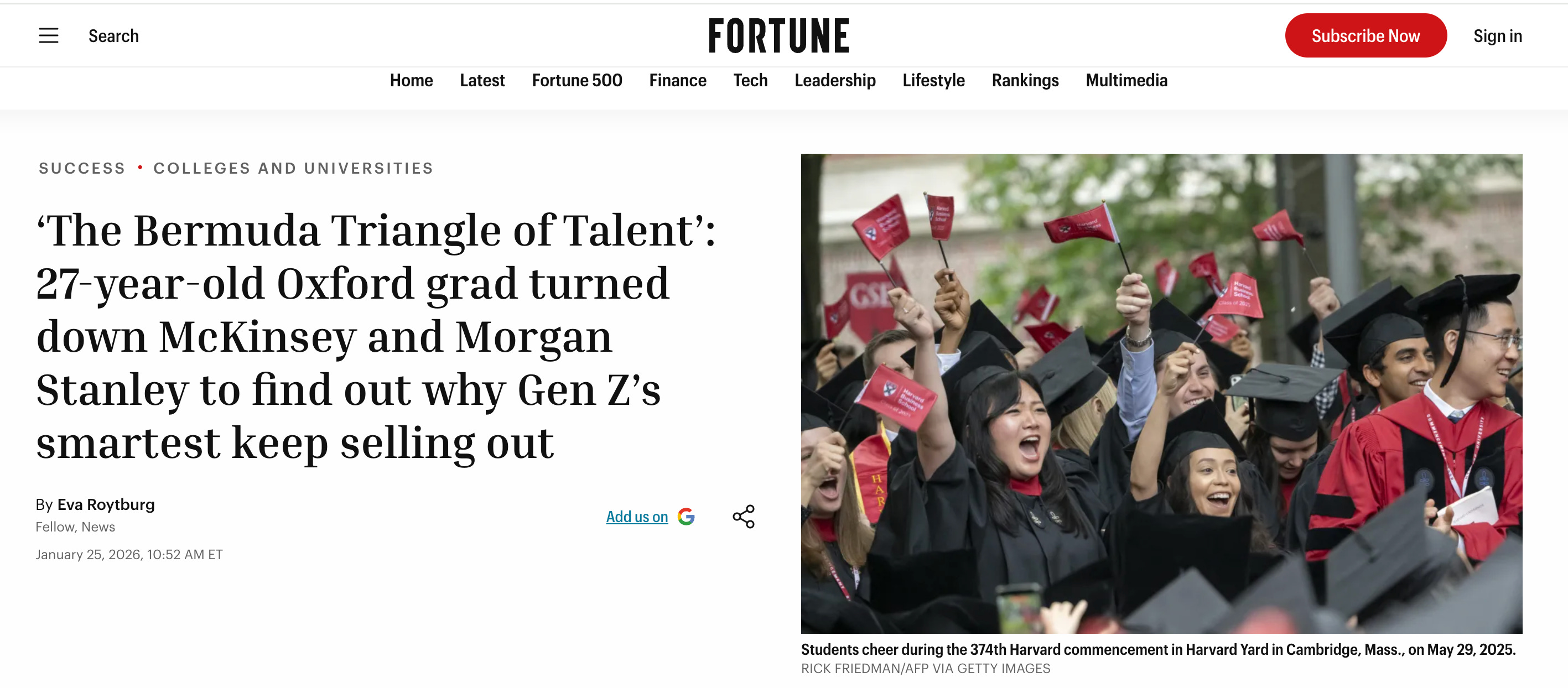
His research explains how these firms cracked the psychological code of insecure overachievers, drawing them in with money, status, and optionality. By the time they realize they’re deeply unfulfilled, they have “golden handcuffs” on and can’t leave.
As a former investment banker who fell into the prestige trap, I admire Simon for bringing this to light with research.
His proposed solution involves better institutional design—places like Y-Combinator or Teach for America that redirect ambitious people toward more meaningful work.
But as someone who quit banking, applied to YC and considered impact-oriented work…and still felt stuck for a long time before exploring several startup roles and the creator economy, I think institutional design is only part of the story.
YC has become its own prestige trap - many high-achieving young people building the millionth “AI-powered B2B SaaS meeting note app” for the money and status, not because they want to solve real problems. And a lot of TFA people I know ended up in banking afterwards. Institutions never change as fast as we need them to.
What’s actually shaking things isn’t a new institution. It’s that the old ones are falling apart.
McKinsey is thinking of cutting 10% of staff. Goldman and Morgan Stanley have conducted multiple rounds of layoffs since 2023. Big Law lays off more associates every year. Tech laid off 100,000+ people in 2025 alone.
The golden handcuffs are coming off whether people want them to or not.
I’ve seen this in my own path and in others around me. We’re pivoting, starting businesses, buying small companies, joining the creator economy, building side hustles until they can go full-time…
Not because any institution told us to, but because we’re figuring out what actually matters on our own terms.
This is my story of getting sucked into the Bermuda Triangle of Talent, quitting, hitting rock bottom, and eventually finding my way out through startups and the creator economy.
This is what I wish someone had told me when I was deep in it.
How I got sucked in
In college, I was never a finance major. I landed an internship in Sales & Trading at Morgan Stanley knowing close to nothing about banks and converted it into a post-grad offer. After a few months working full-time, I realized S&T wasn’t right for me. I was more interested in digging into one company’s operating model than tracking how 100 stocks traded on a short-term basis.
So I read enough Wall Street Oasis articles to convince myself that Investment Banking would be the best place to learn. I also convinced myself I would gladly trade a consistent 60-hour week in S&T for 90-hour weeks in IBD because the work would be more interesting.

Classic Bermuda Triangle logic: optimize for exit opportunities, prestige, and “learning” without asking whether I’d actually like the work.
I hustled. Applied to every opening. Studied accounting ratios like crazy. Got rejected again and again for lack of experience. Eventually made it into a sector coverage team through an internal transfer.
The gratification of finally landing my long-coveted IBD job lasted about two months. The thrill of getting staffed on my first deal. The fast-paced environment where I was learning new things about the sector every day from smart people. The new title on LinkedIn. Building my first model. Not thinking twice about being at the office on a Saturday. Wearing 90-hour weeks as a badge of pride.
I knew it was coming—but when the non-stop Friday night staffings, page-long 3am comments, and 100th version of an already perfect slide deck came, they came and they didn’t stop.
I stopped learning. I stopped performing at a high level. Instead, I was constantly fearful of the work to come. I quickly realized that 90% of the work I did on any given deck or model ended up being unnecessary, usually because of poor communication and planning from management or clients.
I became miserable, anxious, and unhealthy. Every waking moment spent with my friends and family became an endless complaint about the injustices I suffered and the pointless comments I stayed up all night to turn. I dreaded weekends. I was constantly anxious to receive messages and phone calls on nights out. The negativity poisoned and paralyzed my attitude and my relationships.
I needed to quit.
Rock bottom, then somewhere new
I felt lighter the day I quit. The day after, I felt like a complete failure.
What had I just done? I threw away everything I’d been working towards for years. I’d never make that much money again. What would I say to my classmates making associate at PE firms while I was unemployed?
If so many people went through this for longer and handled it well, why was I so weak? Wasn’t this exactly what I had signed up for?
I tried to escape by changing my environment. I left to backpack in South America with my boyfriend at the time. Of course, you can’t escape yourself. My relationship fell apart, and I found myself jobless, single, and directionless in a hostel in Patagonia wondering if I’d made the biggest mistake of my life.

I spent months at what felt like rock bottom, eventually moving back in with my parents. I read books like Design Your Life, The Pivot Year, and The Mountain is You. All great books, but they didn’t give me the clarity I craved.
Eventually I started applying to jobs. I didn’t care about the title or industry. I just wanted to work somewhere that had nothing to do with finance and sounded interesting.
I interviewed with a tech company hiring for a Product & Operations role launching a food delivery platform in Mexico City. I didn’t care about Product or Operations or food delivery. But Mexico City sounded fun.
A few months in, I was shocked to find that I actually liked my job. I went from working on $50M deals I didn’t care about to $10 food deliveries that I felt obsessively responsible for. I talked to our customers and drivers every week. When things broke, I saw it within seconds. When things worked, I saw that too.

I was still working a lot sometimes, but it didn’t feel the same. There weren’t pointless last-minute fire drills. No 100 versions of a PowerPoint deck that was already perfect. We were trying to do things quickly and well enough to get them into market.
We helped thousands of drivers and small restaurant owners make a living. The business grew fast. I got promoted after a year and led a strategy team for new launches across Latin America. (Not bad for thinking I’d be bad at every job after banking!)
After five years abroad between Hong Kong and Mexico City, I went back to the US for business school. I got an MBA, interned as a Big Tech PM (found it wasn’t for me), and eventually landed in product marketing at a startup. I started building content on the side and turned it into a six-figure business that I’m excited to keep building every day.
It’s been a nonlinear path. I took a pay cut to work at my first startup, but I’ve since tripled my income doing work I actually love.

The escape isn’t linear
Leaving the Bermuda Triangle isn’t a single decision. It’s an ongoing process, and here are a few things I’ve learned:
Don’t do it for the prestige (…but it’s hard not to). Prestige was why I did banking, got an MBA, and tried Big Tech PM. When I stopped optimizing for prestige—taking the Mexico City job, joining a no-name startup, building content—things got better. That said, I can’t say I’ve fully escaped. Maybe I’ve just replaced banking prestige with follower counts, honors like LinkedIn Top Voice, or “top VC-backed startups” on my resume. The pull is always there, but now I’m more aware and know how to fight it.
It’s okay to quit. It's okay to not buy into the suffering culture that leads to burnout—the idea that you need to undergo 2 years of grueling hours to "earn" a good exit opportunity…of doing more of the same work that drains you. The institutions won't change as fast as we need them to, but we can. People don't talk about why they quit these prestigious institutions or what went wrong because they want to preserve a certain image. I'm telling you mine. Share yours. Find people who will tell you theirs.
You can’t think your way to clarity or courage. I read all the career books. I journaled. I optimized my fitness routine and diet on paper. None of it gave me real answers. What worked was trying things—taking the Mexico City job on a whim, building content on the side, writing the first page, doing the first workout, surrounding myself with the right people, saying yes to opportunities that sounded like an insane detour.
The Bermuda Triangle experience is a double-edged sword. It isn't all bad. Banking made me much better at quickly analyzing information, structuring communication, and getting up to speed on any company or sector. And let's be honest—the prestige still opens doors, even on unconventional paths. In content creation, saying you did banking gets attention. There's a reason every article about Simon’s research mentions McKinsey and Oxford. But swimming in the Triangle also made me prestige-obsessed, less empathetic, more rigid, and deeply impatient. This takes years to undo.
People are everything. In banking, I rarely felt like my teammates were in the trenches with me or cared about my development. At my startup jobs, I built relationships with people across the world I still lean on today. When you’re on a path to doing something different, you need to be around others who share your journey. Startups and content helped me do that. If you’re only spending time with people from your past life stuck in the Triangle, you’ll feel bad about yourself and get dragged back into comparison traps.
The Triangle gives you clues if you pay attention. It can be overwhelming to figure out what you actually want all at once. What helped me was noticing the small binaries. I liked talking to companies about their business model, but hated formatting slides at 3am. I liked building an operating model from scratch, but hated the 100th round of comments on it. Eventually those small observations became a larger conclusion: I like analysis, but only with a clear link to action. This led me to become an operator in tech and a creator on the side—not an analyst. You might find the opposite to be true.
Work-life balance isn't the fix (at least for me). Between my startup job and building content, I probably work more hours now than I did in banking. But it doesn't feel the same. In banking, it was the irregularity and lack of agency that killed me—the sudden Friday notice of a deck due Sunday night, the uncertainty of whether I'd get summoned over a holiday weekend. That created a constant anxiety. Now, I wake up every day and know I've chosen how to spend that day. I have flexibility, support from teammates, and ownership over what I'm building.
If you're the type of person trying to escape the Triangle, you're probably not going to be satisfied with a chill 9-5. Maybe a chill 9-5 that gives you space to build something on the side—but not one where you're just coasting.
I’m no longer in the Triangle. Or at least, I’m swimming toward the edge.
And I've been thinking a lot lately about what would have helped me when I was deep in it. The career books didn't do it. The self-help stuff didn't do it. What actually helped was finding people who were on a similar path, trying things that didn't fit neatly into a traditional trajectory, and learning from others who had figured out pieces of this before me. Not just the career stuff, but the life stuff too: the mindset, the personal development, the whole picture.
I’m working on something for people who are ambitious, thinking about what’s next, and maybe feeling a little stuck. If that sounds like you, I’d love to learn more about where you’re at.
I’d be grateful if you’d take 5 minutes to fill out this survey. Your answers are shaping what I build next, and two people who complete it will win a $150 Amazon gift card.
Jobs & Resources
cool jobs for ambitious nonlinears (updated ~weekly)
Hannah, I was an investment banker during 1997-2000 and your story is exactly what I experienced. It’s almost unfathomable that there has literally been NO INNOVATION in this field since I left. The trappings are the same and the experience still turns promising, talented young people into dull automatons.
There are so many more ways to make money now vs selling this masqueraded form of insurance (what else did you think a fairness opinion is?) and “putting lipstick on a pig.”
Keep sharing your story….because that’s what gives others permissions to take a different path.
This really resonates.
I've been thinking a lot about how (for me anyway) a lot of prestige trap was about the perceived safety. Banking, consulting, big tech... they feel like the "reasonable" choice since your parents understand them and they're culturally validated. So like even if you're miserable at least you're miserable in a recognisable and relatable way. Startups and untraditional career paths feel riskier both financially and socially because they can fail and there is no established playbook you can follow. But I loveee how well you've captured the idea that the "safe" path has its own massive risks: burnout, years lost to work that doesn't fuel you, becoming someone you don't recognise. And with all the layoffs, that safety was always kind of an illusion anyway
Thank you for sharing!