


Hi, I’m Hannah! Welcome to Nonlinear News, where I write for smart, ambitious people choosing the nonlinear path.
This post is sponsored by Relay, a business banking platform.
Relay is a financial technology company and is not an FDIC-insured bank. Banking services provided by Thread Bank, Member FDIC.
✨ catch me at Create & Cultivate ✨
I’m speaking at the Create & Cultivate Festival in Los Angeles on September 19-20. If you’re interested in coming to “the Coachella for career women”, use code CAREERHANNAH20 when you grab your ticket for a discount.
I’d love to see you there!
“Your business brought in more revenue in the first six months of 2026 than your W-2 paid you all of last year.”
A few weeks ago, I was on a call with my accountant when he said this to me.
He was sharing his screen and walking me through the income statement, balance sheet, and cash flow statement for my business. They were the same three statements I used to pore over for other people’s businesses in finance and strategy, but now they were for something I was entirely responsible for starting and running.
I knew my business was doing well this year, after growing my Instagram following by 150K, landing deals with dream brands and starting to diversify my income streams.
But creator business money is lumpy and irregular, making it hard to see how the whole business is doing at an exact point in time. A partnership can be negotiated in one month, signed in another, published later, and paid months after that. Meanwhile, money is also coming in from Substack, coaching, product sales, TikTok, Meta, and several different payment systems.
I could find every number if I went looking for it, but I’d never seen all of them organized into one full picture, beyond just cash flow.
Seeing it in the three statements I’ve been used to seeing since my earliest days in business and finance felt surreal. I had started creating as a side project in October 2024; less than two years later, I was looking at the same three financial statements that “real companies” had, but with my own business’s name at the top.
I debated sharing any of this, and ultimately decided to because I wouldn’t be here if other entrepreneurs hadn’t shared how their businesses worked. Today I’m sharing the exactbreakdown of where my revenue comes from.
How my creator business makes money
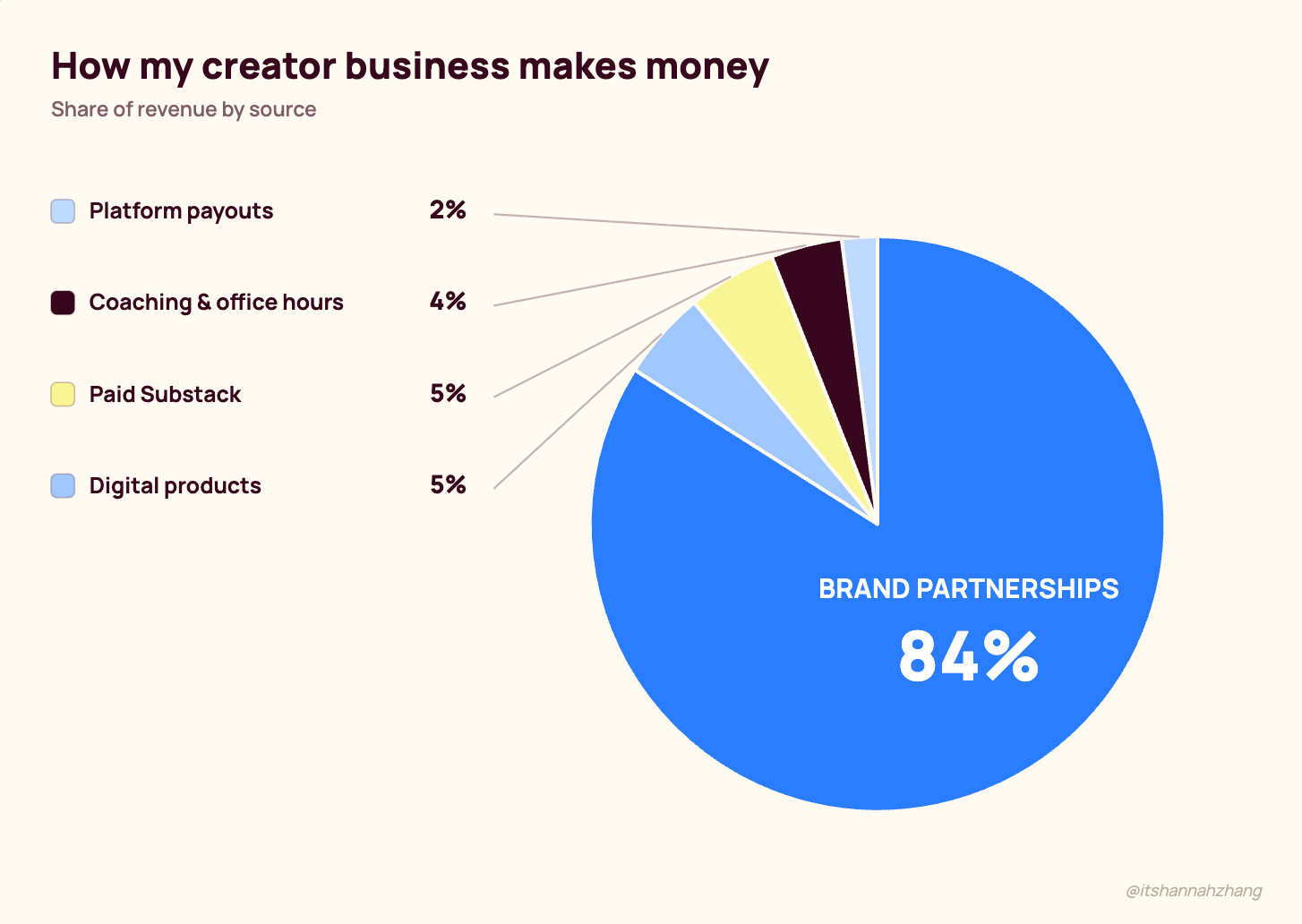
A quick caveat on the numbers: These percentages represent revenue, not profit or take-home pay. The business also pays editors, assistants, contractors, software, professional fees, and taxes.
2%: Platform Payouts
Only 2% came directly from platforms like TikTok, Meta, and YouTube. TikTok pays for views through specialized reward programs; Meta pays (very little) for views and has lately been prioritizing carousel views. YouTube is my latest, smallest revenue stream.
This was expected, as I’m building a creator business, not an influencer channel. The difference is that I’m not optimizing for maximum views but rather the right mix of content that will attract and engage my target audience for both brand partnerships and my own offerings.
I use platforms for distribution. Most of my revenue comes from the business I’ve built from that distribution, but I always see these payouts as a nice bonus for work I’m doing anyway.
4%: One-Off Coaching and Office Hours
This came from calls with people who wanted my help with personal branding and founder-led marketing.
I didn’t actively promote coaching or try to fill my calendar. People reached out, and I took a small number of calls when I thought I could help. It’s still a small percentage of revenue, but these are the conversations that shape what I want to build next, which feels even more valuable than the current dollar amount in the long run.
5%: Digital Products
I have one paid digital product that helps professionals with nonlinear experience build a personal brand on LinkedIn through a 14-day guided sprint in Notion. I only started selling it a few months ago, so this represents a relatively new part of the business.
5%: Paid Substack
Another 5% came from the newsletter you’re reading right now! I also only started charging for it a few months ago, when I started publishing longer guides in which I package up weeks, months, or even years of work and experience building my business and personal brand.
I’m excited about this one because a paid newsletter lets me go much deeper than I can in a 60-second video. I’m investing more in the content here, more tactical guides, and more live engagement with paid subscribers moving forward.
This has also been a great reminder that sometimes the least strategic, but most joyful things you do end up being what you do best, and thus feeling like “easy money”! For me, that was and is Substack.
84%: Brand Partnerships
The remaining 84% came from brand partnerships across all of my platforms. That includes the content itself, paid usage when brands run my content as ads, exclusivity, and other contractual parts of a partnership that add to its value.
Brand partnerships are the biggest part of my business today and will continue to be an important source of revenue. I’m focusing more on longer-term partnerships with brands I love that not only fit my audience but also bring it real value, cross-platform campaigns that leverage the channels I’ve built across Instagram, LinkedIn, TikTok, and Substack, and new collaboration formats like community events and speaking, so this bucket feels less concentrated.
What I’m focused on next
I don’t want to create five random businesses. I want one focused umbrella or portfolio with multiple related income streams laddering up to it and compounding with each other.
Brand partnerships: These will remain a core part of the business, with more emphasis on longer relationships and work across platforms.
Substack: I’m putting more into the newsletter, including deeper guides and more live engagement for paid subscribers.
Personal branding: I recently started working 1:1 with a few founders and experienced professionals on their personal brands and am building more ways to help ambitious people build personal brands around their expertise, particularly those with nonlinear life experiences. Fill this out if you want to get updates on this!
Speaking: I have my first paid speaking engagements coming up in September, which is relatively new for me.
All of this feeds into the same body of work: helping ambitious people use what they know to build a name for themselves beyond corporate, create new opportunities, and make money from their expertise. My content, newsletter, coaching, partnerships, and speaking are all different ways of doing that same work.
5 things I’d tell anyone serious about building a 5-9 business
1. Get financial clarity early
I couldn’t have written this post a year ago. The money was technically there, but the information lived across contracts, payment confirmations, spreadsheets, invoices, and a running tally in my head.
You can’t make a good decision about what to grow, cut, or invest in when you can’t see what each part of the business earns and costs.
Relay helps me keep my business and personal finances separate and split money into different accounts for things like income, taxes, and contractor payments. I don’t look at one big balance and accidentally treat all of it as money I can spend.
Relay also makes contractor payments cleaner, and it has built-in bill pay and invoice management. The invoice tools would’ve been extremely useful when I was self-managed: I used to send brands some truly ugly DIY PDFs, then track whether they’d paid me in a spreadsheet (not my finest ex-banker moment). Relay also lets you give your accountant or team members their own access as more people become involved in the business.
Your first monthly finance review doesn’t need to be complicated. Look at four things: cash received, payments still outstanding, major costs, and money already set aside or committed. Then break revenue down by source. You’ll quickly see which part of the business is carrying everything else.
2. Build something that compounds with your 9-5
A creator business isn’t the right 5-9 business for everyone. If you haven’t started yet, the best place to begin is with the skills, customers, and problems you already know.
I worked in marketing during the day while building a content business outside work. My job made me better at positioning, storytelling, understanding brands, and selling partnerships. Building my own audience made me a better marketer because I had to test those skills on myself, in public, with immediate feedback.
Each side made the other better. Starting from something I already knew also meant I didn’t have to learn a new skill, industry, customer, business model, and distribution channel at the same time.
List what your job has already taught you: the problems you understand, the people you understand, and the work people already trust you to do. Build from one of those instead of starting from zero or forcing yourself into a business model that doesn’t align with your zone of genius.
3. Get clear on your positioning and customer
Whether your business is content, products, services, a community, or fractional work, your positioning and customer are two of the most important things to get right.
I know because I didn’t get this right until a year into my creator business. “I make career content” (where I started) is too broad to guide what you create or sell. A clearer version is: “I help ambitious professionals build nonlinear careers and turn what they know into a business.”
For a strategy consultant, “I help companies grow” could become: “I help early-stage B2B fintech companies turn complex products into clear go-to-market plans.”
The more specific versions tell you who the work is for, what they need, and why your experience makes you useful.
My creator business started growing again when I stopped thinking only about a niche and got much clearer on my audience and positioning.
Start mapping your positioning by writing this down: the person you serve, the urgent problem you help solve, and the part of your background that makes you the best choice. Use it to decide what to make, sell, and decline. I wrote the full breakdown here if you want to dive into this more.
4. Delegate earlier than feels comfortable
I hired my first editor around 6 months after I started creating content, well before the numbers felt big enough to justify it. Hiring early is a major reason the business eventually grew big enough to justify the cost.
The same was true with assistants. I didn’t hire them as a reward for growing; they gave me the capacity to grow while I still had a demanding job.
One of the best things about starting a business in your 5-9 is being able to put your W-2 income toward the business by investing in resources like editors and assistants.
Track every repeatable task you do for two weeks. Start with something frequent, teachable, and outside the work that needs your judgment. For me, that was editing and repeatable admin.
5. Accept that your free time is paying for the business
Building a business alongside a full-time job isn’t easy, and your time becomes a scarce resource.
For me, that meant working on weekends and vacations. I’m not as consistent with hobbies. As an introvert, creating content, going to events, networking, and taking calls also used a lot of the social battery I might’ve spent with friends and family. Not all the tradeoffs are bad, though: having less time has also reduced my online shopping habit!
Delegation and better processes give you some of that time back, but the beginning is still hard, especially when you’re building as a solopreneur alongside a full-time job. Decide what can receive less attention for a while, what stays protected, and revisit the tradeoff periodically to decide what’s worthwhile.
You got this!
If you’re building a business, I hope sharing my breakdown made the path feel more concrete. I posted my first video less than two years ago with no idea what it would become. It took a lot of nights, weekends, ugly invoices, and help from other people, and I’m still figuring out what comes next. But it’s possible, and I’m more energized than ever to help you build yours.
—
Thank you to Relay for sponsoring this newsletter and supporting the practical business content I want to make more of. If you’re building a business alongside your 9-5, you can sign up for Relay here.
The part people skip is the tax and cash flow mess that comes right after this milestone. Once creator income passes salary, you're suddenly dealing with quarterly estimated taxes, no automatic withholding, and lumpy sponsor payments instead of biweekly deposits. Did you set up a separate business account before or after you hit that number?
Thanks for sharing this and giving us a breakdown of your income streams.