


Hi, I’m Hannah! Welcome to Nonlinear News, where I write for smart, ambitious people choosing the nonlinear route.
🌴🌴 This will be my last post for a few weeks. I’m headed on vacation for two weeks and taking a full break (or at least, trying). I’ll be sharing some of my old posts and guides in the meantime!
Is it just me, or are a lot of ambitious, accomplished people feeling really stuck right now?
In the past few weeks, not one, or two, but four friends have told me they’re feeling stuck, unsure, or stagnant in their careers and lives, and asked me how to get out of it.
One is a founder who can’t decide whether to pivot her startup or go get a job. One quit an intense finance job for tech and now feels unstimulated outside the high-pressure environment she used to complain about. One is burnt out from years of long hours building other people’s startups and wants to start a lifestyle business of her own. And one knows she needs to leave her job but has no idea what she’d do instead.
Call it a rut, a funk, the messy middle…More and more of my circle in their late 20s and early 30s seem to be going through it, especially the ones who are a year or two post-MBA or a few years into finance, consulting, or tech. They’re often silently wondering what’s next, afraid to admit that their perfect-on-paper careers aren’t perfect in practice, or even a little guilty over their “champagne problems”.
And it goes way beyond my group chat. Social media is full of it. I see TikToks every day of people “starting over at 30” or “I quit [insert name brand company here] and have no idea what’s next.”
It makes complete sense. A lot of us feel unaligned with corporate jobs that turned out to be bullshit work and stakeholder management theater instead of the impactful, exciting roles we were promised as high achievers. Meanwhile, a lot of those paths are falling apart in front of us anyway, between layoffs and salaries don’t move much each year.
How do I figure out what’s next?
My answer to this question was why I started creating content 2 years ago, so it’s one I still get a lot. I’ve written and spoken about my own life after banking, when I felt apathetic about basically everything, and how I slowly clawed my way to figuring out what came next.
And I’ve been back in that place more times than I can count: During my MBA, after I crossed product management off my list and didn’t have a backup plan. In the middle of a job at a mid-sized company that I didn’t love. Late last year, when my content felt stagnant and nothing about it excited me anymore.
It’s a question I’ll probably never get tired of answering, because I’ve been through it in so many forms. I know how hard and how impossible it feels when you’re inside it, and helping someone climb out is one of the most fulfilling things I get to do.
So I wanted to write down what I told my friends over the past few weeks, because I’m sure a lot more of you are feeling the same way.
This is a little different from my usual stuff. I’m a tactical, matter-of-fact, non-woo-woo person, but this one gets a bit woo-woo, because it’s kind of a woo-woo problem to solve.
A couple of notes before we start:
This isn’t a long how-to guide. It’s a loosely sequential mix of principles, mindsets, and a few specific things I’ve actually done that helped. If you want something more structured, I’ll point you to another resource at the end. But in my experience, when you’re in the messy middle, throwing a framework or a worksheet at you right away just adds to your anxiety without helping.
Feeling excited about nothing is a different problem from having too many directions and not knowing which to prioritize. That second one is related, but an easier one to solve, and I wrote a separate guide for it: a pragmatic multi-hyphenate’s guide to focus. My advice below is for when your well of inspiration feels dry.
1. Relax and realize: This is the oldest problem in the world.
Figuring out what’s next is a problem that’s existed for as long as humans have. When you’re in the thick of it, the not-knowing feels like a personal failing, like everyone else got handed a map and you’re the only one wandering around without one. Seeing it as the oldest human problem there is takes a real amount of pressure off.
My founder friend rambling at ChatGPT about which AI app to build is wrestling with the same thing as the hunter-gatherer deciding where the tribe should roam next, or the medieval craftsman paying to have their fortune read. (In a way…)
I was reminded of this recently on a visit to Mass MoCA, the contemporary art museum, where I saw an interactive exhibit on tasseology, the ancient art of divining the future from coffee grounds. Armenian artists and experts in the craft trained an AI model to read the grounds and generate your “fortune.” Here’s mine.
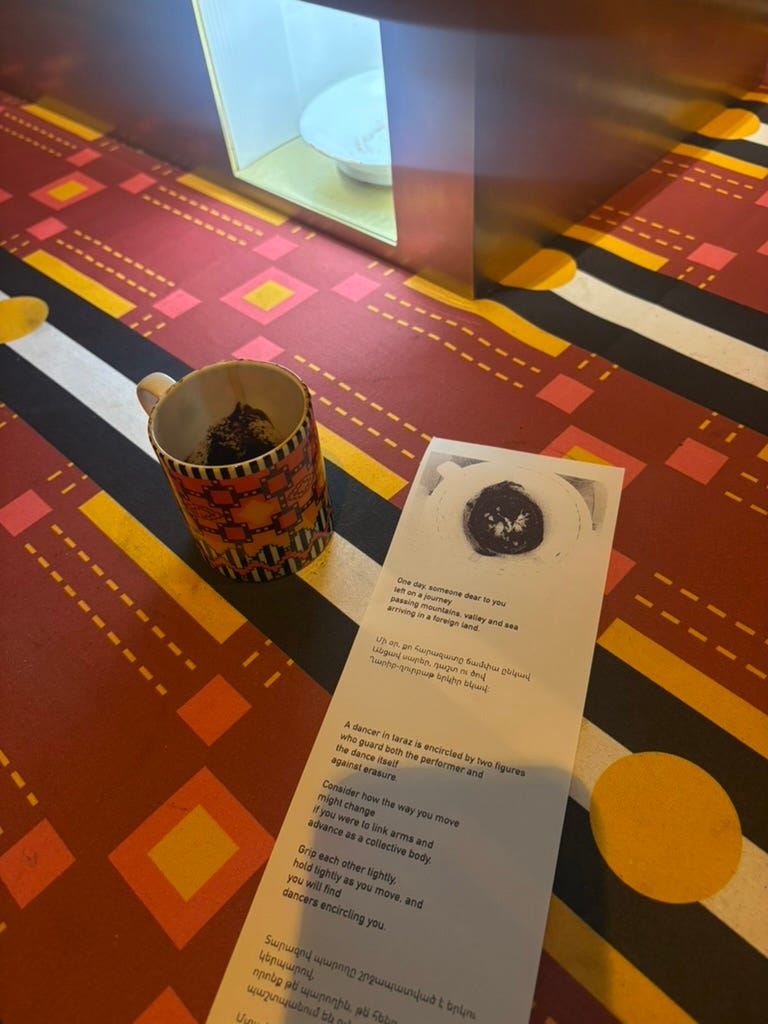
Humans have never stopped inventing ways to see around the corner: reading tea leaves, casting the I Ching, studying the stars, consulting the Oracle of Delphi, reading animal entrails in ancient Rome, cracking oracle bones in ancient China, turning over tarot cards. Different centuries and problems, but same craving to know what happens next.
But the not-knowing is the human condition. The struggle of figuring it out isn’t a glitch in your life or something you did wrong, but the eternal experience of being a person, where the only way past it is through.
Zooming out like this to begin always helps me. Knowing that people have wrestled with this exact not-knowing for as long as we’ve existed, often on far more life-or-death terms than a career pivot or a crossroads in my business, somehow makes my own version of it feel smaller and more solvable.
2. You’re numb. Clear the mental and physical fog first.
Rest and regulate your nervous system.
If you’re anything like me, when you’re in a career or life rut your instinct is to live entirely in your head, thinking harder, trying to brain-power your way out. I still do this and constantly need to take my own advice. But the first and biggest fix usually isn’t up there in your head at all.
I recently reread the book The Body Keeps the Score by Bessel van der Kolk, and the core idea is right there in the title: your body keeps a running tally of your stress, and when you’re exhausted, wired, tense, and anxious, you physically can’t access what you actually think or feel. You can’t trust your instincts or locate your interests if you can’t even hear them over the noise.
When I quit banking, where I’d been working 80 to 100-hour weeks with my body stuck in fight-or-flight, it took months of sleep, rest, and real relaxation before I could hear my own thoughts again. At one point I even went on a seven-day backpacking trip with no cell service before things finally got quiet enough.
I know what you’re thinking: I don’t have months. You don’t need them. Here are the things that have given me that same effect in bigger and smaller doses over the years:
Sleep and eat. Actually get your eight hours and eat real food.
Move. Something physical and intense to burn off the stress: a long run, dancing, martial arts, tennis.
Get offline and into nature. Phone-free walks and hikes, ideally somewhere out of your city.
Bodywork and woo-woo resets. Massage, acupuncture, sauna and cold plunge, breathwork, sound baths, sage smudging, reiki, or recreational drugs (be careful, and none of this is medical advice).
Get it out of your head. Journal, or if free-writing isn’t your thing (it’s not mine), turn on your phone camera and just talk, stream of consciousness.
Bring in help. Therapy or coaching.
3. Take a side quest.
Stimulate and explore.
Stop trying to solve the problem for a while, and go do something fun or creative that has nothing to do with it.
When you run straight at this kind of problem, you usually get nowhere. It’s the same reason the answer to a hard work problem or a relationship issue tends to show up in the shower, or on a walk, or the second you stop forcing it.
Researchers call it the “incubation effect”: your brain keeps working on the problem in the background once you step away and let your mind wander, and that’s often when the insight actually shows up.
In other words, you need a side quest.
A very random, very incomplete list of side quests:
Take in art and culture. An art museum, a movie by yourself, a concert or a festival.
Explore somewhere new. Travel somewhere you’ve never been, walk around a neighborhood you don’t know, or go vintage and thrift treasure hunting.
Make something with your hands. Creative writing, pottery, painting.
Learn something random. Show up to a talk or event in an industry you know nothing about but are curious about.
Go woo-woo. A tarot or astrology reading, a meditation retreat, or plant medicine like ayahuasca (use caution, and none of this is medical advice).
4. Get external input, selectively.
Once you’ve cleared some fog and taken a few side quests, so you’ve got a little distance from the problem, outside input starts to actually help.
A few forms this can take:
Talk to a friend, or someone who’s walked the path you’re eyeing. A single conversation probably won’t hand you the answer. But your friends see a version of you that you can’t see from the inside, and someone who’s navigated the same thing can tell you what worked for them.
Talk to someone whose life you find interesting. You might not know what you want, but you probably know a few people who seem energized by what they do. Ask them about it. You’ll learn a lot about what you’re drawn to and what you’re not. If you don’t see someone like this right away, ask a friend to introduce you to someone they think could help. If you don’t know anyone, I interview people in this newsletter with interesting paths - a few places you can start:
Talk to old friends and family about what you were like as a kid. This is getting external input from your younger self. As we get older we lose track of what actually makes us tick, and our talents that showed up early (you always made art, you built insanely intricate Lego sets) usually keeps resurfacing in different forms.
One caution, and it’s why I say to do this selectively: if you lean too hard on other people, whether friends, family, coaches, or experts, you can end up chasing something just because someone told you to, or because it felt assigned to you. That lands you right back at square one the moment you realize you’re stuck again.
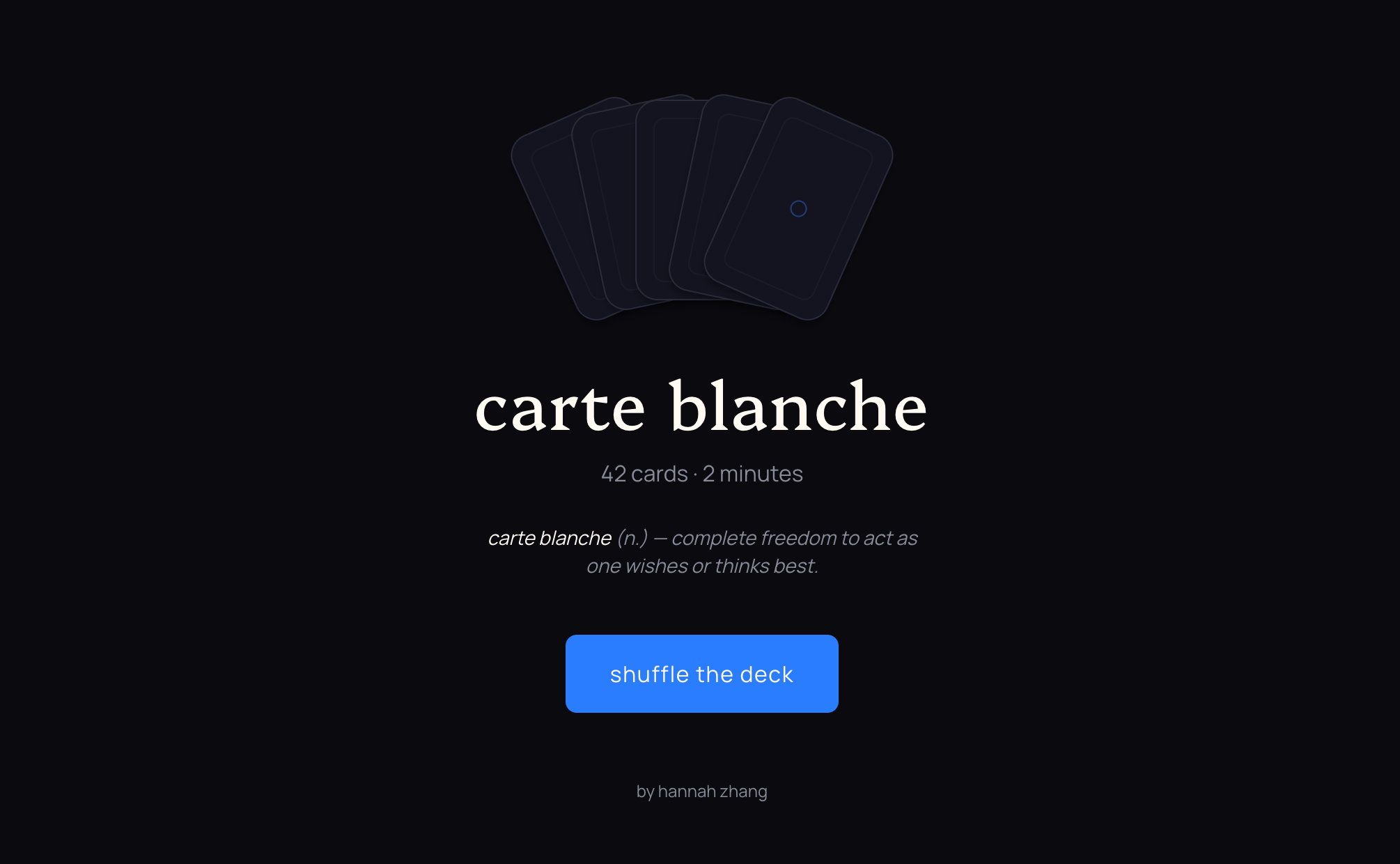
And speaking of woo-woo, I created a free career tarot card game to help you start figuring out what’s next! Swipe through paths and tradeoffs, and get a career archetype with practical ideas for your next move.
5. Just try something.
This is going to sound useless to you right now, because your immediate reaction will be “but I don’t know what to even try.” Fair.
So while you’re working through steps 1 through 4, keep a running list of anything that sparks even the faintest interest. Then pick the first thing on it and go.
And if you’re still coming up empty, stop trying to manufacture an interest that isn’t there.
Start with something you’re good at and don’t hate. Do more of it, or try it in a new form. Maybe you’re good at building slide decks at work. That might not feel like a calling, but think…what’s another way to use that skill? Could you make Canva graphics for local events, or build yourself a personal website? Pulling a thread you already have will get you moving faster than waiting around for a brand-new one to materialize out of nowhere.
Silver lining…
When I quit banking, and again during my MBA, the “stuckness” felt enormous, and those pivots felt huge and scary. What I’ve noticed since is that the closer I’ve gotten to things I actually like doing and feel aligned with, the smaller the pivots have become and the less scary each one feels. Really, they don’t feel like pivots and more like small adjustments.
So if the leap in front of you looks massive right now, it won’t always be that way (I think!). The more honest you get about what you actually want, the shorter the jumps get in the future.
If this helped, let me know, and please send it to a friend who’s in it right now (or bookmark it for the next time you are).
The Exit Plan
If you’re actively figuring out your next career move and want a much less woo-woo resource, The Exit Plan is an interactive Notion guide that gives you the structured guide for mapping your exit with frameworks, calculators and trackers that you can work through at your own pace over 5 weeks.
The goal is to get from “I can’t name what I want” to a next move you actually test. I almost ran it as a $400 live cohort, but turned it into a self-guided product so more of you could use it.

Hi Hannah! I’m way out of your target demographic, but 20 years ago this was me right after getting my MBA from INSEAD and feeling pretty miserable as a management consultant. But I will tell you this — at 50 most of us are still going through the same thing. Getting laid off by ageist Corporate America, having to cover a big mortgage with another 10-20 years of raising kids ahead of us. A steady income these days is a blessing and often more important than excitement at work. If I could go back to 30, I would have picked a path that ages well, where experience is valued as knowledge and wisdom and not a sign of being outdated or expired. Personally I would have become a doctor, but other paths that value age include professor, therapist, politician… okay I guess not that many, I wish there were more. Anyway my point is similar to your first one — this is a problem as old as humans, but it’s also a problem that doesn’t get “solved”. And AI is only making the future of careers more uncertain. These days my thought is this: choose a path that requires you to be a physically present human. I might start over at 50 as a nurse.
The line I keep coming back to is “stop trying to manufacture an interest that isn’t there.” Most advice in this genre can’t bear to say that—it has to promise a hidden passion if you just journal hard enough. There’s a quieter version I’ve lived, where the not-knowing wasn’t a fog to clear so much as a room I had to actually live in for a while before anything honest showed up. The side quests didn’t hand me the answer; they just gave me enough quiet to stop auditioning for the old one. Enjoy the two weeks fully offline—that’s its own kind of side quest. 🫶🏻