


Hi, I’m Hannah! Welcome to Nonlinear News, where I write for smart, ambitious people choosing the nonlinear path.
For the launch of Adobe Express’ AI Snapshot for Small Business study, I got to interview Daymond John, original Shark Tank investor and founder of FUBU. I’m excited to share our conversation with you today about how small businesses can use AI to grow without losing the “brand personality” that makes them unique.
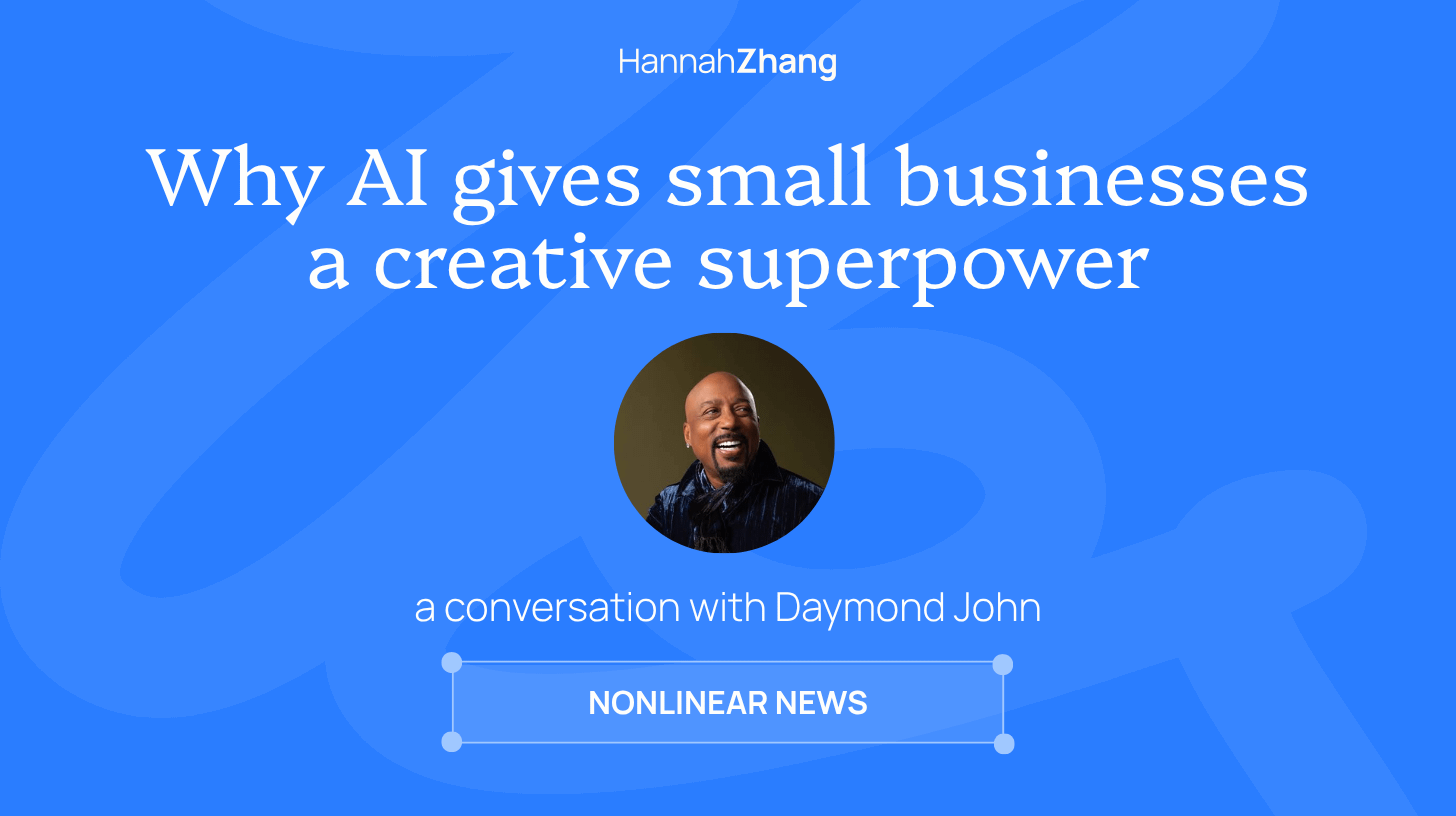
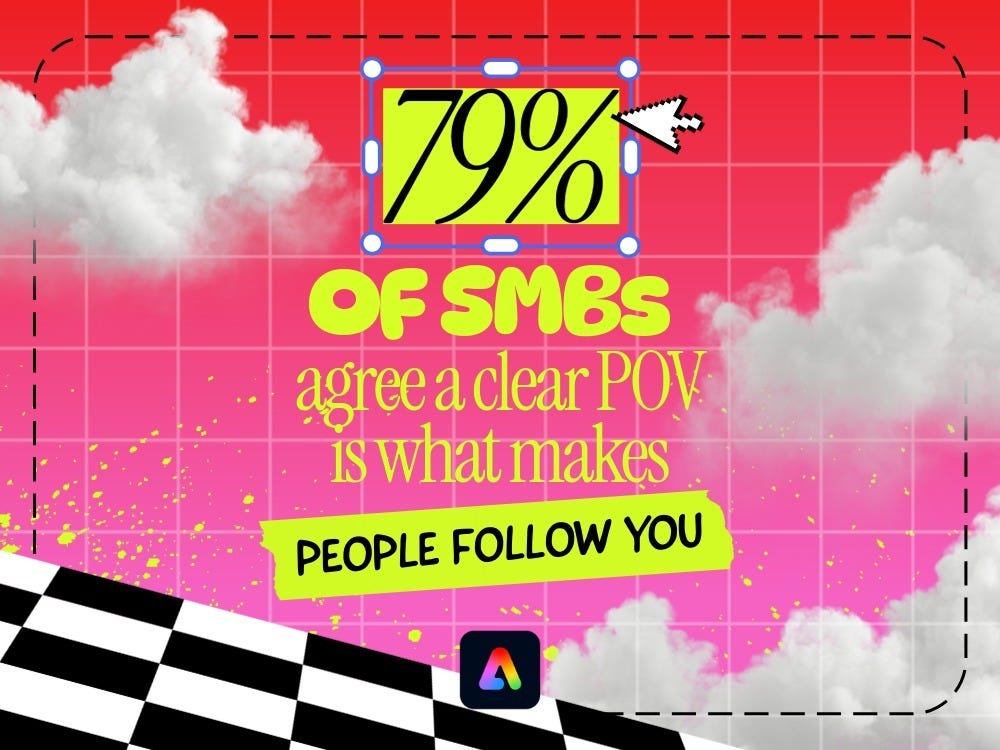
Adobe Express surveyed 850 US small business owners and solopreneurs in June and found:
Nearly two-thirds of respondents (64%) say AI helps their business compete but is also making it easier for brands to blend together.
56% agree that when everyone has access to the same tools, the competitive edge goes to whoever has the best taste.
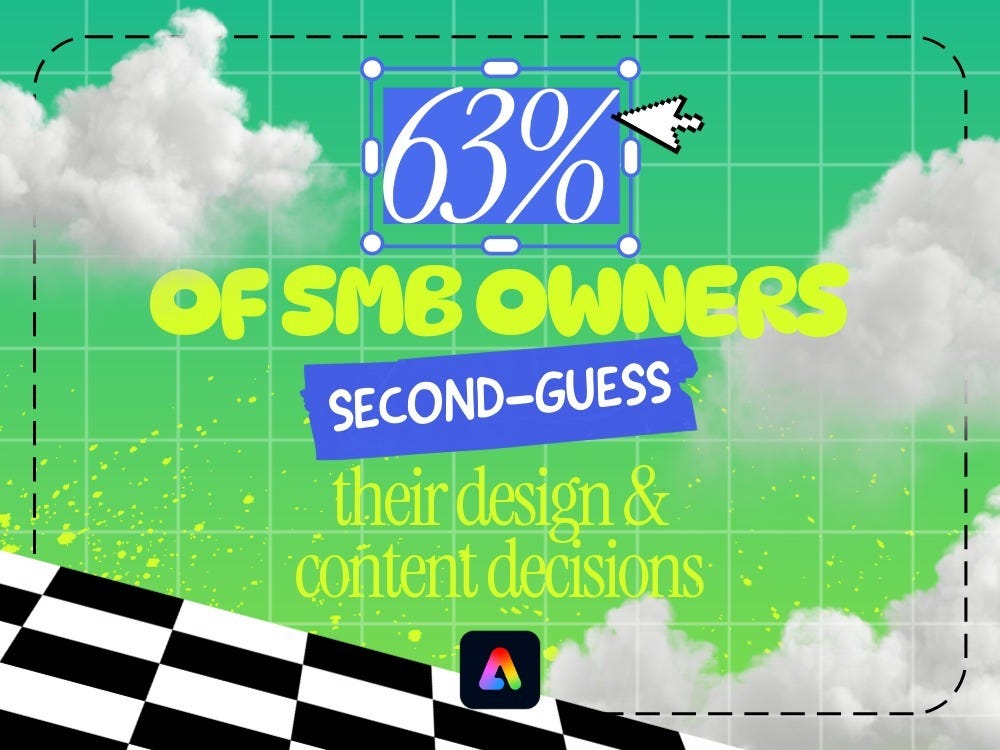
Most SMB owners (63%) second-guess their design and content decisions.
Small business owners are trying to use AI to move faster and compete without letting it flatten the taste and personality that make their brands recognizable.
Daymond founded FUBU “For Us By Us”, an apparel company deeply rooted in his community in Queens, turned it into a billion-dollar global fashion brand, then spent 17 seasons on Shark Tank evaluating founders.
Few people have spent more time thinking about what makes a resource-constrained but taste-forward business successful. I asked him how the Power of Broke changes when AI removes some of the constraints small businesses face, why community is still a moat, and where owners should start using AI in their workflow.
If you’re building a small business or brand, you’ll find something to take away from our conversation. I’ll also be diving into the Adobe Express study more this weekend, which I recommend checking out to see how businesses are using AI in marketing!
(Also…this interview is definitely going on the list of coolest things I’ve gotten to do because of my personal brand!)
AI gives a one-person business the resources of a team
Hannah: Adobe’s new study looks at how small businesses are using AI to build their brands. For an owner without a large creative or marketing team, where do you see AI providing the greatest advantage, and what becomes possible that wasn’t realistic before?
Daymond: AI is leveling the playing field for small businesses and isn’t going anywhere soon. Entrepreneurs have always had to figure out how to do more with less, and the biggest advantage of AI for small business owners is that it can help you show up as a much bigger operation.
Now you have technology that can give a one- or two-person business the resources that used to take an entire team. AI-powered tools like Adobe Express can help you bring an idea to life quickly while keeping your content on-brand and your vision authentic. What used to require more time and specialty skills can now be done in-house, so you can spend less time worrying about how to execute an idea and more time focused on growing your business. Sixty-six percent of small business owners already use AI for marketing.
How AI changes the “Power of Broke”
Hannah: Your Power of Broke philosophy is built on the idea that constraints can force entrepreneurs to become more focused and inventive. When AI gives a resource-constrained founder access to design, research, and marketing capabilities, how does the “power of broke” change? Does removing those constraints create more room for creativity, or can it remove some of the resourcefulness that gives an emerging business its edge?
Daymond: The Power of Broke has always been about being resourceful with what you have. I talk about OPM: other people’s money, mindset, mistakes, and manpower. Sometimes your biggest advantage is knowing how to tap into resources you don’t have yourself.
AI gives small business owners another tool to use to their advantage. The difference now is that a founder can turn an idea into a professional brand or marketing campaign without having a big team behind them. The technology is only as good as the person using it. The vision, hustle, and ability to understand your customer still have to feel true.
Fifty-six percent of small business owners agree the edge goes to whoever has the best taste. AI can help you move faster and remove some restraints, but it doesn’t change the Power of Broke. It can’t replace the clear point of view and hard work needed to make a business stand out.
Community is the small business advantage AI can’t copy
Hannah: In a recent interview, you said AI is “never going to have community.” Small businesses are often closer to their customers than large companies are. How can a small business turn that proximity into a brand advantage customers can see and feel?
Daymond: Small businesses still have to earn community by knowing their customers and making them feel like they matter. The voice behind a brand has to be real. That’s what we had with FUBU.
We weren’t trying to market to a community from the outside. We were already part of that community, and people connected with that because it felt authentic. When a customer sees their community reflected in your brand, that’s something a big company, or even AI, can’t easily replicate.
Why only 6% of small businesses publish AI content as-is
Hannah: AI is exceptionally good at recombining what already exists, which can produce content that looks polished but feels interchangeable. How can a founder use AI to find a distinctive angle instead of generating more versions of what everyone else is saying?
Daymond: Nearly half of small businesses heavily edited their most recent AI-assisted content before publishing, and only 6% published it as-is. AI can give you a great starting point, but your brand and how well you know your customer is what makes it yours.
That’s where a tool like Adobe Express can help. You can use AI to quickly generate a design based on what you need, then apply your Brand Kit, including your fonts, colors, logos, and other visual elements, to make it feel consistent with your brand. You get a starting point and still have room to make the design recognizable. It gives you the speed of AI without losing what makes people recognize your brand.
The $50 billion pitch that raises an immediate red flag
Hannah: As Shark Tank enters its eighteenth season, founders can use AI to create a polished pitch deck, write persuasive copy, and anticipate many of the questions they will be asked before entering the Tank. What tells you that a founder has genuine customer insight and original judgment?
Daymond: We invest in people. One of the biggest red flags is when somebody tells me, “This is a $50 billion industry, so if I just get 1%, look how big the business can be.” That doesn’t tell me you know the business.
I want to know your numbers, who your customer is, what they’re willing to pay, what it costs you to acquire them, and whether you’ve proven that people want what you’re selling. Founders need to know the ins and outs of their business and be able to manage tough questions from the Sharks. AI can help you build a better deck and prepare, but once we start digging in, you still have to know the answers.
Content at scale can’t manufacture authority
Hannah: You’ve said attention is the new currency. AI now makes it possible to manufacture an enormous amount of visibility. What separates real authority from a founder who is producing content at scale using AI?
Daymond: If you’re invisible, you’re vulnerable, and if you’re vulnerable, you’re replaceable. You can mass-produce content all you want, but that won’t be enough to manufacture credibility that drives people to keep coming back for more.
The founders with real authority are confident in showing people how they think, what they’ve built, and what they stand for. Only 37% of small business owners trust their instincts completely to move forward without hesitation, which shows us there may be a confidence crisis. You need to stay true to yourself while putting yourself out there with valuable things to say, and the right consumers will find you.
How Daymond would build FUBU with local ambassadors and AI
Hannah: If you were launching FUBU for the first time today, which parts of building and marketing the brand would you use AI for, and which parts would you still insist on doing personally or directly with the community?
Daymond: If I were relaunching FUBU for the first time today, I’d use AI to help me move faster. I probably wouldn’t build it around traditional retail. I’d have ambassadors in communities across the country. AI could help those people create content for their local audience and tell the FUBU story at a scale we never could have when we started.
The things that made FUBU what it is, the product, the point of view, and the voice of the brand, came from me and my partners and our connection to the culture we were building for. That’s something I wouldn’t hand over to AI. FUBU was born from our own experiences and from understanding what our community wanted because we were part of that community ourselves. AI can help you execute on a vision faster, but the vision still has to come from somewhere real.
The first step in a small business AI audit
Hannah: If a small business owner worries they’re falling behind on AI and wants to audit their workflow, what should they look at first?
Daymond: Make a list of the repetitive tasks in your week. Where are you spending the most time? Finance tasks? Creative and design materials? Admin?
Identify where AI can save you time without compromising the quality or personality of your brand. Start with one or two initial use cases, measure how much time you’re saving, and build from there. The goal is to spend less time working in the business and free yourself up to spend more time on the parts of the business that only you can do.
Read the full Adobe Express AI Snapshot for Small Business study, and learn more about Daymond at daymondjohn.com.

✋ NexusPoint — Not a tool, but this is the best resource I’ve used so far for hiring assistants and editors overseas (and I’ve tried a LOT) - they take care of everything up to the point of hiring and don’t charge until you onboard someone → Book a free discovery call
💬 ManyChat — The tool behind every “comment X and I’ll DM you the link.” It auto-sends resources to everyone who comments, so I’m not manually replying to hundreds of DMs → Try ManyChat
💬 Stanley — If you’ve been wanting to post more consistently on LinkedIn, this is the writing partner I use. You’ll get a 3-day free trial with my link → Try Stanley
🎙️ Wispr Flow — Voice-to-text that actually works. I dictate messages, prompts, and emails instead of typing, and it saves me hours every week talking to AI → Try Wispr Flow
👩🏻💻 Fiverr — My go-to for hiring freelancers for things like design, editing, one-off projects (I use Fiverr Pro to save time on vetting talent) → Try Fiverr
🧊 Othership — The sauna/cold plunge I go to! → Try Othership with my discount
🧾 Xero — The accounting software running the back end of my business. Bookkeeping and invoices without me having to think about it → Try Xero
The ability to get things done when maybe it would have been put off indefinitely instead, is huge for small business owners.
Some will say they should hire… and maybe that’s true in some cases. But in many others it’s not.
AI is a fantastic tool.
Good read!