

Hi, I’m Hannah! Welcome to Nonlinear News, where I write for smart ambitious people forging nonlinear paths.
I was at a wedding this weekend where several friends and acquaintances told me they had watched my recent Instagram videos about being “low status, high income.”
One even said it was giving her a lot to think about as she considered her next job.
This was a Wharton wedding. MBAs, consultants, bankers, people in tech - all high achieving, all who have spent their careers optimizing for prestige and equating status with wealth. When you’re that credentialed, status is hard to renounce. It’s your currency to be seen as peers with your social set, and until now it’s been your precursor to wealth.
So when even this crowd starts listening, I know the status game isn’t working.
The status-income matrix
The status-income matrix is a cross-section of how much society respects you versus how much you earn.
The x-axis is income, the y-axis is status. Two of the quadrants make sense. The other two don’t.
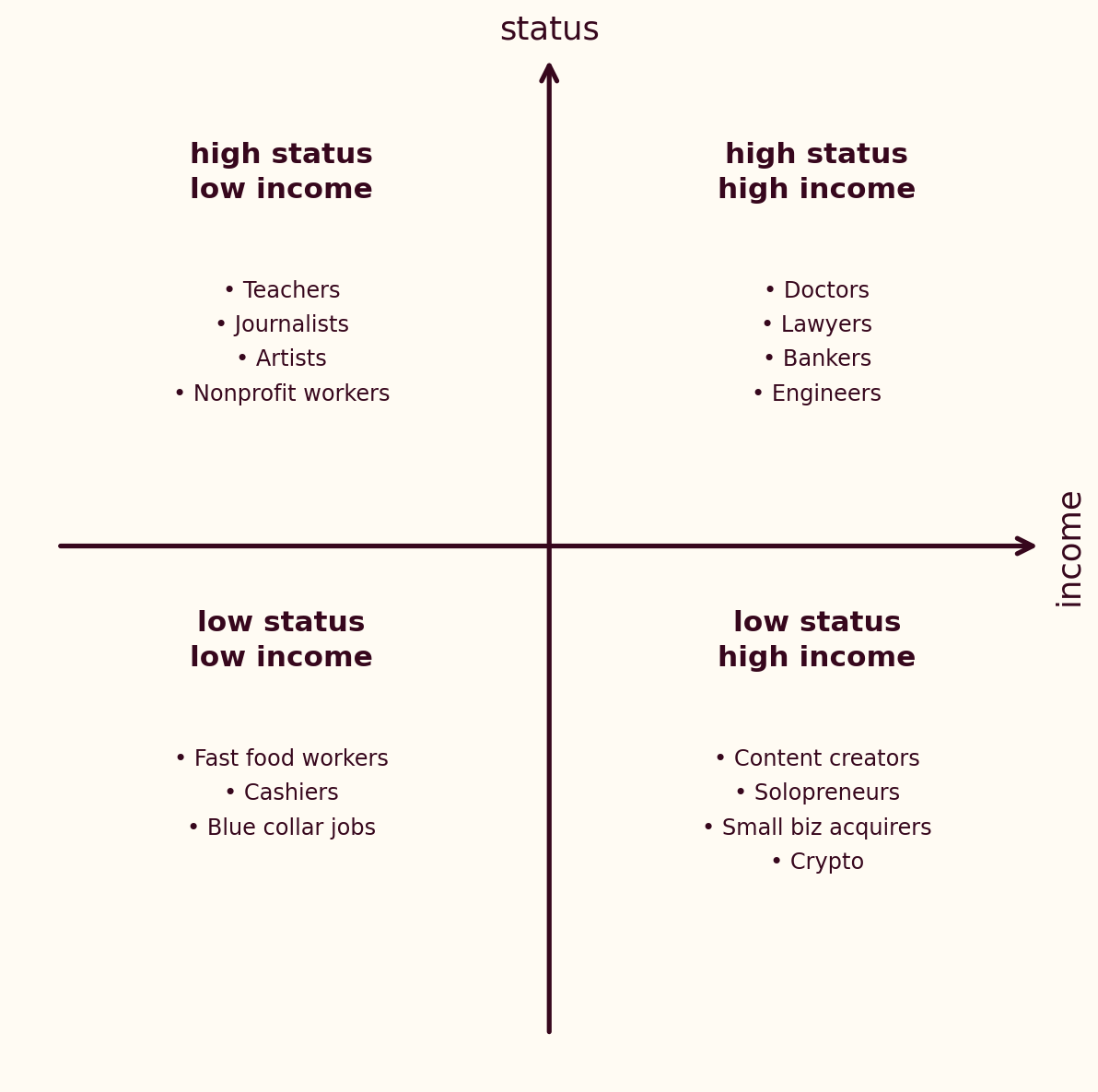
The two that make sense, because most of us have been trained to equate status with income:
Low status, low income (fast food workers, cashiers, a lot of blue collar jobs)
High status, high income (doctors, lawyers, bankers, engineers)
The two that don’t:
High status, low income: nonprofit work, artists, journalists, teachers
Low status, high income: solopreneurs, small business acquirers, people in crypto, content creators
These counterintuitive quadrants didn’t appear by accident. To understand how they got created and why the gap between status and income is growing, we have to first start with why we equate the two at all.
Seeking status as a proxy for wealth is human instinct
Naval Ravikant’s tweet storm “How to Get Rich” explains the historical reason humans value status:
“On an evolutionary basis, if you go back thousands of years, status is a much better predictor of survival than wealth is. You couldn’t have wealth before the farming age because you couldn’t store things. Hunter-gatherers carried everything on their backs. So, hunter-gatherers lived in entirely status based societies. Farmers started going to wealth-based societies. And the modern industrial economies are much more heavily wealth-based societies.”
So we’re wired for status first, wealth second. Once wealth started to matter, status became the signal we used to predict it. The Ivy degree, the brand-name employer, the right LinkedIn title. If you have those things, the assumption is the money follows. Sometimes it does, but sometimes you’re a journalist lunching on expense accounts with celebrities and wondering if you can make rent.
Institutions created high status, low income work
David Brooks published a piece in 1996 called The Tragedy of SID, or “status-income disequilibrium” - about what happens when the status signal and the wealth reality come apart. It’s the best explanation I’ve read for what created this quadrant.
His “sufferers” of SID include journalists, editors, news producers, and museum curators who are like “aristocrats” at work, lunching on expense accounts with the famous, but “like peasants” at home wondering if they can afford the bills. An army general might command 100,000 men but drive a Honda Accord.
Brooks traces this to “the proximity to wealth combined with the inability to match it,” but some of these fields also disequilibrate status and income by design. Teachers and nurses pay a “passion tax”. The tradition of starving artists receiving patronage from the wealthy stretches back centuries. UN internships are highly coveted but unpaid, available mainly to people who can already afford to be there.
The high status, low income job is a product of institutions that gave people status but kept the wealth for themselves.
Then the internet flipped that dynamic.
The rise of low status, high income work
A NY Mag piece that went around last month was a great example. They published the salaries of 60 New Yorkers, and some of the highest earners were jobs that barely existed, or weren’t that well paid, before the internet: ghostwriters, Substack writers, content creators. Ghostwriters and substackers out-earned bestselling authors. Exterminators out-earned nonprofit directors.
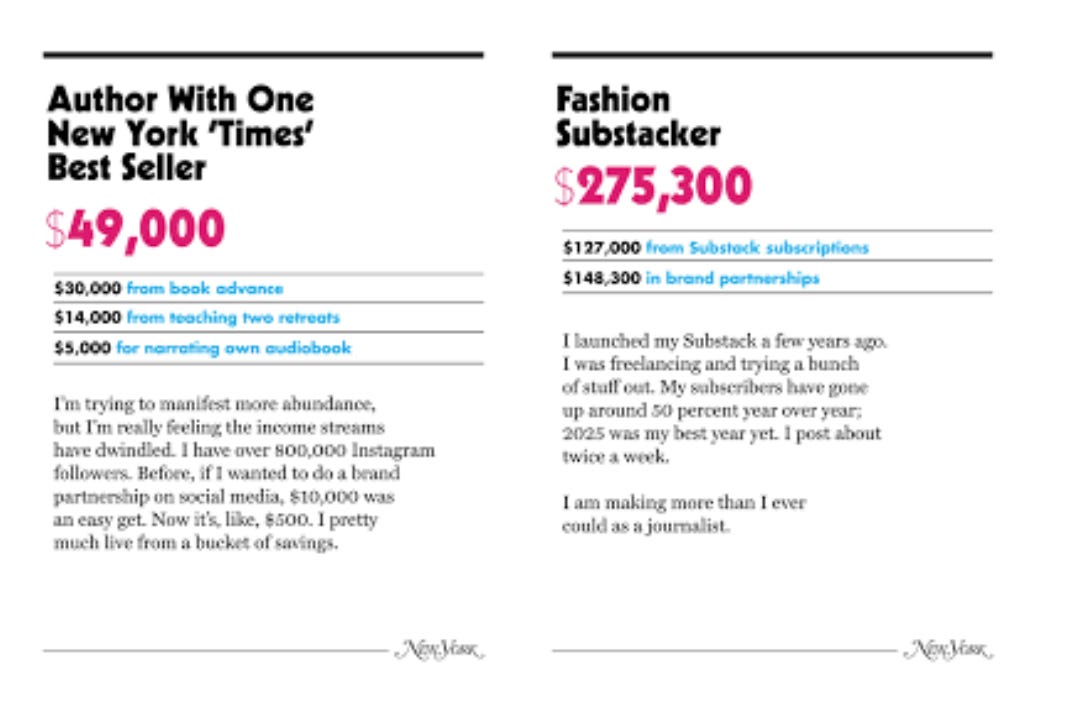
The internet has been the biggest innovation since Brooks wrote his article thirty years ago. Through the internet, more people no longer need institutions to vouch for their credibility or pay for traditional distribution of their work. Status becomes less necessary for building wealth.
And the people stuck in high status, low income jobs have a new out: the attention economy. Political aides can write tell-all memoirs. Laid-off journalists can launch Substacks. Often for much higher incomes than their prior high status institutions paid them.
The endpoint of this shift is when the originally low status jobs start getting perceived as high status.
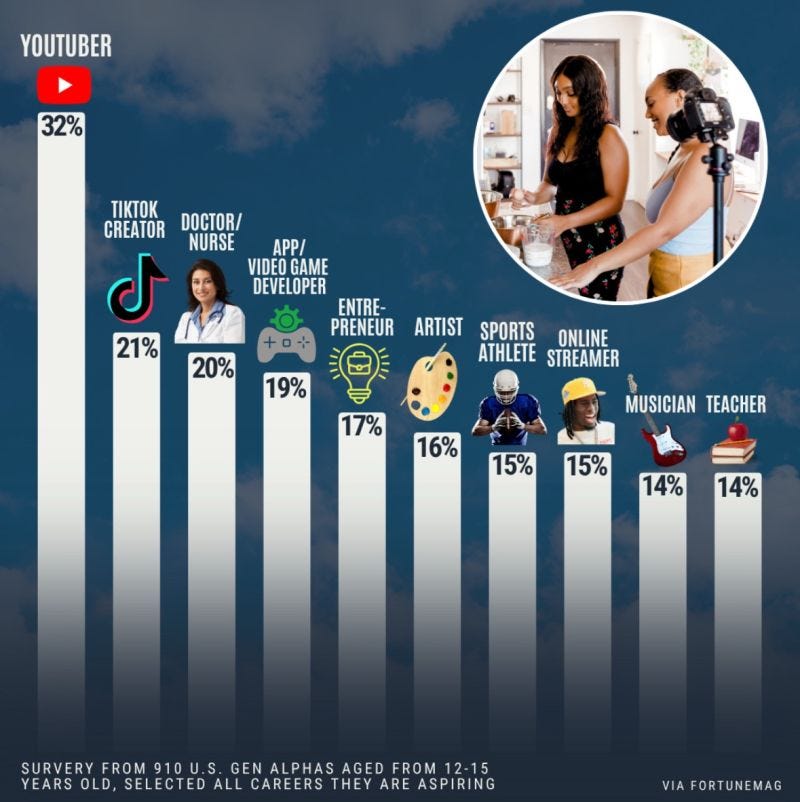
That’s already happening. 68% of Gen Alpha want to be content creators. I had dozens of angry commenters on my videos saying I was ridiculous for calling content creation “low status”.
AI is accelerating all of this further, and we’re in the first innings.
You used to have to be a FAANG engineer to be a high status, high income software builder, but that’s breaking down with vibe coding. Physical jobs like plumbing and electrical work are starting to feel scarce in a way they haven’t in decades.
Status is, at its core, a proxy for scarcity, and the internet and AI are reshuffling what’s scarce.
The predicament of high status, high income
A lot of high achievers spent their careers in the top two quadrants. We’re conditioned to value the the degree, the fancy title, the feeling of importance. The unspoken assumption is that status and wealth are two sides of the same coin. By pursuing status, we in turn get wealth.
So the highest achieving people pursue the high status quadrants, which means more competition, more burnout, and a lot of people who stay stuck not because they’re happy or well compensated, but because the pull of status keeps them there.
As elite, large companies from Morgan Stanley to BCG to KPMG keep downsizing, this dynamic only intensifies as the same number of people compete for fewer and fewer jobs.
Why low status, high income jobs are the hidden opportunity
For the formerly high status, accepting low status is the underrated path to high income. A few reasons why:
First, less competition. A lot of low status roles have fewer qualified people going after them, which means more room to grow and less of a ceiling on what you can earn.
Second, your background commands a premium because it’s rare in that world. For example, an HVAC small business looking for someone to run finance and operations isn’t usually getting credentialed former bankers applying. When you do show up, you get paid for that scarcity. Your rigor, your pace, your analytical instincts add more value to industries where the bar is lower than what you’re used to.
Third, the income upside is often nonlinear in a way high status jobs aren’t. You might take a pay cut and a status cut at first. But you end up in industries with more room to grow than you’d have fighting for your share of a shrinking pool at the top because the opportunity is early and feels “beneath” the high status.
How to play the wealth game (not the status game)
If you’re ready to move to the low status, high income quadrant of work, wrote a post last year on 11 career paths where high achievers have an unfair advantage, many of which I now realize map to this quadrant. Not all of them are traditional “jobs” - much of the low status, high income world requires some degree of entrepreneurship.
A few principles for succeeding here:
Build and monetize a specific skill. This path is less about the title and more about what you’re uniquely good at. Naval writes about this a lot. The goal is a skill so specific that no one can really compete with you on it.
Create multiple income streams. High status job seekers tend to optimize for a prestigious base salary. But the average millionaire has multiple income streams. By diversifying how you earn, you stop tying your financial ceiling to a single job title.
Invest for the long run. Morgan Housel’s The Psychology of Money makes the case that some of the wealthiest people are not flashy spenders or high-status signallers. They make disciplined, boring investments that compound. The status game encourages spending. The wealth game rewards patience.
Look beyond the base salary. A lot of high-status job seekers only evaluate base pay. Commissions, bonuses, and opportunities to monetize your own expertise often don’t exist in elite jobs that require your full loyalty. Low status, high income paths tend to have more of these.
Use status as a tool, not a destination. It’s easier than ever to build a personal brand and manufacture credibility. That can give you proximity to opportunity and eventually to wealth, as long as you don’t confuse the signal for the goal.
As Naval Ravikant put it: “play the wealth game, not the status game”.
Status and wealth aren’t equal. This is just the beginning of the disequilibrium.

Chief of Staff to the COO – Coinbase (Fintech, Public)
Builder – Replit (AI, Growth Stage, SF)
Strategic Consultant – Applied Intuition (AI, Late Stage, SF)
Chief of Staff to CEO – Alma (LegalTech, Startup, SF)
GTM & Deployment Lead – Felicity (SaaS, Startup, NY)
Chief of Staff – Atlas (HealthTech, Startup, SF)
Strategic Product Operations – Stealth (SaaS, Early Stage, Remote)
Solutions Lead – AI for Good – The Conduit (AI, Fellowship, Hybrid - London/NY)
GTM Associate / Analyst – Basis (AI, Late Stage, NY)
Sales Strategy and Operations Manager – Kong (Sales, Growth Stage, Remote)
Venture Relations Associate - AngelList (Fintech, Public, Hybrid - NY)

This was a great read, Hannah. The status vs. income tradeoff is definitely real, but IMO it can also come with a third variable most new grads don't price in: optionality. The low-status high-income path buys you time to figure out what you actually want to do. The high-status path locks you into performing a version of success you may not have chosen for yourself. if you had considered it more carefully and explored your options.
Super interesting take! I had never realized that I shifted from a high-status to a low-status career. But I definitely could do that because I was in a high-status career before, and this helped to keep a good level of income