


Hi, I’m Hannah! Welcome to Nonlinear News, where I write for smart, ambitious people choosing the nonlinear path.
Last week, an old friend told me she thinks I care more about money than people.
We were on a trip with two other friends, all of whom I met over a decade ago.
A few days before that, I had been in San Francisco filming a paid video with OpenAI.
When I mentioned the trip, the conversation quickly became about everything wrong with AI.

In New York, I spend most of my time around people in tech, startups, and the creator economy, where the default question is usually how to use AI, not whether using it at all says something troubling about your values.
That conversation made me realize how long it had been since I’d had a conversation about AI with people who weren’t already using it every day.
AI is deeply embedded in how I work and manage my personal life. When that’s your everyday reality, it can be difficult to pause long enough to understand why someone else’s first reaction is fear rather than possibility.
But my friend’s criticism wasn’t only about OpenAI.
She told me that over the past year, as my work became more public and my content focused increasingly on building businesses, making money, AI, and creating content, she had started to believe that I cared more about those things than about people and social issues—the topics we used to discuss all the time in college. She also questioned whether companies she considered morally corrupt were paying me to promote their views.
I don’t think most of my underlying beliefs have changed in the past few years. But what I talk about, work on, and reward with my attention clearly has.
She didn’t see a full picture of me. But her comment, in the context of the Open AI brand trip controversy, did make me ask whether my ambition has changed what I pay attention to, whose concerns I value, and how I justify the work I choose.
If you work in finance, consulting, tech, or startups, or you’re building a business of your own, you may have asked yourself some version of the same question. These worlds reward ambition, growth, and financial success. They also often require us to make compromises and become very good at explaining why our choices are worthwhile or simply not caring.
But how do you know when you’re making a reasonable compromise vs. when the pursuit of success is changing what you value?
Does caring about building a business and making money make you more likely to compromise your values along the way?
If you’ve read past issues of my newsletter, you’ll know that this is very different from my regular content (which looks like this or this!), but this topic was on my mind the entire week, and in the news, so I wanted to both share my thoughts and ask for yours.
How my career became “more moral”
My friend’s comment surprised me because I had been telling myself the opposite story this whole time: that my career had become more “moral” over time.
My first job after college was in banking at Morgan Stanley, one of those industries most people have no problem calling evil.
I worked on real estate financing deals with large Asian developers. Some of the companies we worked with faced allegations ranging from accounting irregularities to serious personal misconduct. Even though my individual role was just building models and presentation decks, it didn’t feel entirely separate from the institutions and people the work supported.
Then I left banking to join a ride hailing and food delivery company.
That felt like progress.
I could see the people using what we built. Drivers who needed flexible work could earn money. Small restaurants could reach customers they never would have reached on their own. Unlike moving numbers around in a financial model, I could watch an order happen in real time and feel good about sending a payment to Driver #15828.
Since then, I’ve moved into startups, marketing, and the creator economy. I can tell myself that I have become increasingly “ethical” with every career move: further from banking, closer to entrepreneurship, education, and helping people build things for themselves.
Over time, it felt like my work had become more useful, more personal, and easier to connect to people’s lives.
Is it “moral,” or is it storytelling?
But at every stage of my career, there were always two stories: one about the value we created and another about who might be paying the price.
In banking, the good story was that we helped companies raise capital, build housing, and grow. The less flattering story was that we helped already powerful companies and executives become richer at the expense of communities and environments.
At the food-delivery company, the good story was that drivers could access flexible work and small restaurants could reach new customers. The bad one was that gig platforms could shift risk onto drivers, provide little stability or protection, and charge restaurants fees they could barely afford.
Both stories were true, and all ambitious industries have their own versions.
Consultants help leaders solve difficult problems, but their work can also legitimize decisions that harm employees and communities. Creators educate their audiences, but they can also spread false information and make disingenuous sales. AI can help more people learn, build, and earn money while disrupting livelihoods, consuming natural resources, and concentrating power.
Most of us are trying to reconcile the opportunities available to us, the skills we have, the money we want, the people we need to support, and the beliefs we hold. Those things rarely form one perfectly consistent package, and we naturally emphasize the version that makes our work feel better.
Maybe my career did become more moral. Or maybe I just got better at telling the version of the story that made my choices feel moral.
Why AI is the latest catalyst for moral judgment
Lately, AI has made these questions much less abstract for me.
Last week, while I was in San Francisco filming a sponsored video for OpenAI, an OpenAI brand trip taking place the same week “ChatGPT Summer Camp”, was drawing intense backlash across social media.
Even though I wasn’t on that trip, I still appeared in someone’s TikTok criticizing creators who take money from OpenAI. I know creators who actually attended the trip that have received death threats.
The TikTok wasn’t really about me, the other creators, or even about one brand trip, but about what taking money from an AI company has come to represent.
AI has become a proxy for several moral debates happening at once: what happens to people’s jobs, who owns creative work, how much energy and water data centers consume, what happens to the communities where they are built, and how much power we want a small number of companies to hold.
For people who use AI every day, its benefits feel like superpowers. It helps them learn, build businesses, work more efficiently, and do things that previously required more time, money, or people.
For people who experience AI primarily as a threat to their work, environment, or community, the risks are tangible. The promised benefits can sound like sleazy marketing from the same companies creating the disruption. And it’s easy to blame the creators who act as the messengers.
AI is not the first technology to create this conflict.
Social media has enabled millions of people to find communities, build audiences, and run businesses. It has also contributed to cyberbullying, unhealthy comparison, and an attention economy that can be particularly harmful to young people.
Amazon has made products more accessible, created new income for sellers, and made it easier for small businesses to reach customers. It has also faced criticism over its labor practices, environmental impact, and effect on local retailers.
The same technology can create opportunity for one group while imposing costs on another. The people who benefit most directly are often far away from the people experiencing the greatest harm.
AI feels somewhat distinct because of how quickly it is moving and how many parts of our lives it touches at once. But in the end it’s just the latest version of a question we’ve faced before:
How do you engage with a technology that creates real value without ignoring the harm it may also create?
If every choice is morally compromised, how do you decide?
There are companies and industries I won’t work with as a creator. Gambling and prediction markets are among them.
But Substack, the platform I use to send this newsletter, supports native Polymarket embeds.
Does indirect participation make us hypocrites? Where does using a platform end and endorsing it begin? How much responsibility do we have for every institution that touches the work we do?
I don’t have a clean answer, but there are a few easy positions available.
One is the purity test: any association with a company that causes harm makes you morally compromised.
Another is deciding that because every company is problematic, we can justify working with anyone as long as the check is big enough.
A third is exaggerating the moral distance between competitors that share many of the same incentives and practices, then designating one as “evil” so choosing another feels ethically clean. (e.g. OpenAI becoming AI’s default villain, while its competitors are treated as categorically more virtuous)
All of these feel insufficient.
Moral ambition does not require a perfect institution
Of course, I can’t write about ambition and morality without mentioning Rutger Bregman. In his book Moral Ambition, he argues that ambition itself is not the problem, that impact depends on what we direct it toward. He believes ambitious people should direct more of their energy toward work that benefits society, such as using policy, entrepreneurship and institution-building to solve large problems like climate change or global health.
In college, I was probably one of the strongest believers in this argument.
I studied political science, participated in activism, and imagined a career in government or diplomacy. I took a nonprofit and city council internship because I wanted my career to contribute directly to causes I cared about.
Then I experienced the practical limitations of that path.
These jobs weren’t going to pay me a livable wage. They also didn’t provide the mentorship, training, or pace of learning I wanted at the beginning of my career. I wanted to be surrounded by ambitious people who would challenge me and help me grow quickly.
Advice to pursue more morally ambitious work can overlook what prestigious but morally questionable jobs provide for immigrants, first-generation professionals, and people without an established safety net. Banking gave me training, financial security, credibility, and opportunities I might not have accessed otherwise. (I don’t regret choosing it, and I still advise students in a similar position to seriously consider the opportunity.)
My nonprofit experience also complicated the idea that moral ambition can be judged by the institution on your résumé.
Part of my internship involved applying for grants from major banks, the same institutions often criticized for attracting talented people away from more socially beneficial careers. The nonprofit was doing work I considered morally ambitious, but it depended on funding from institutions whose broader impact was morally contested.
So what happens when morally ambitious work is funded by, housed inside, or otherwise dependent on an imperfect institution?
Sometimes this work happens within the company itself. Anthropic recently committed $150 million to Claude Corps, a program that will train 1,000 early-career fellows and pay them to help nonprofits use AI. OpenAI has funded the American Journalism Project’s Product & AI Studio, which helps local newsrooms use AI for work like translating coverage, analyzing civic information, communicating with donors, and reaching new audiences.
I think those examples count as morally ambitious work, directing money, talent, and technology toward organizations that serve the public.
That said, they don’t prove that Anthropic or OpenAI are “good” companies. Funding valuable work doesn’t resolve concerns about jobs, copyright, data centers, or safety. But those concerns don’t make the work happening inside nonprofits and local newsrooms meaningless either.
The danger on one side is treating one beneficial program a get out of jail free card for the entire company. The danger on the other is deciding that no valuable work can come from money, people, or institutions connected to something we believe is harmful.
Maybe moral ambition is not only about choosing the perfect employer or donor. It can also be about what we do with the money, skills, and influence available inside imperfect systems.
What rules do you use when there’s no perfect moral compass?
Every week, I send my management team messages like these in response to inbound partnerships from brands:
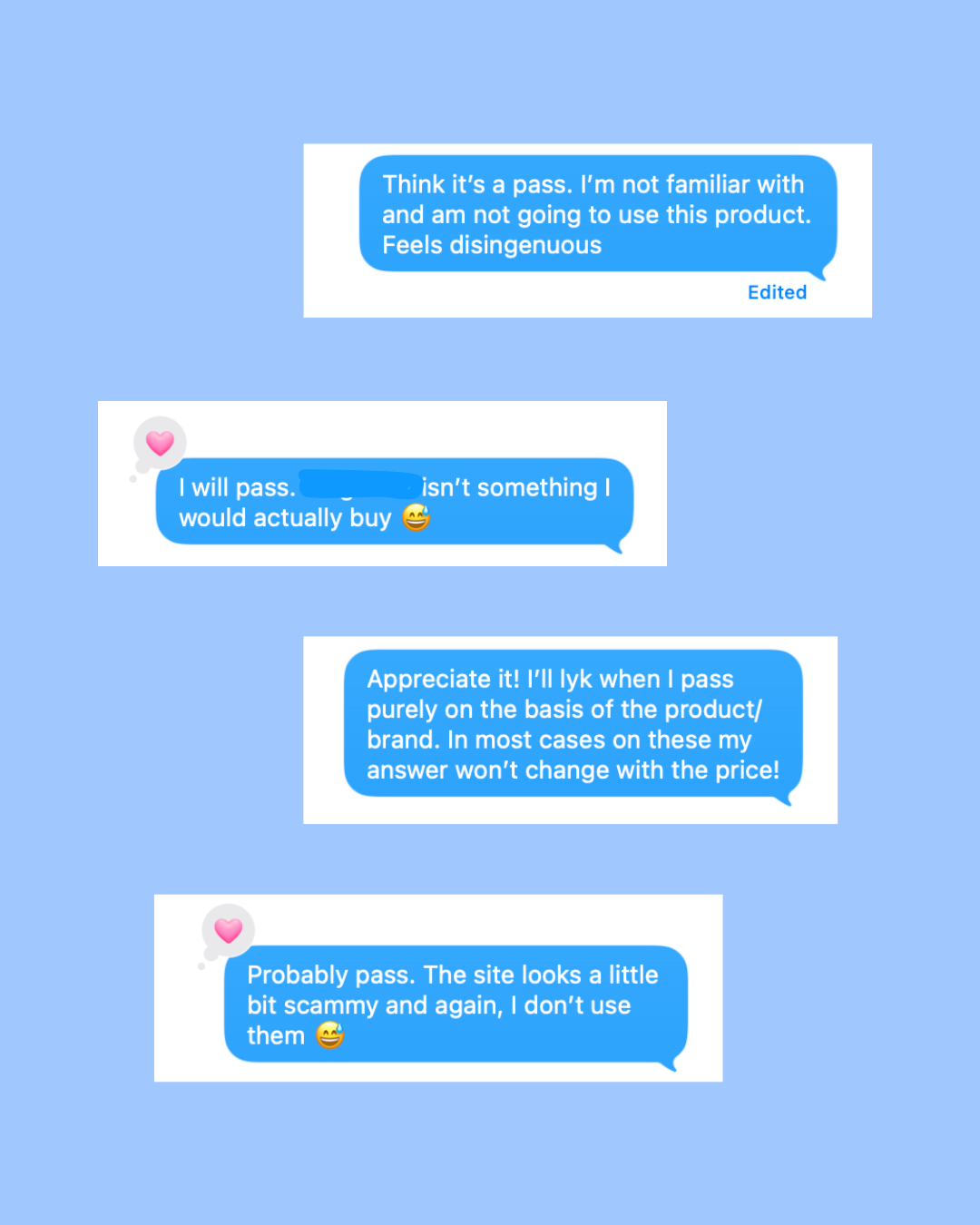
My current rules are something like:
I don’t promote tobacco, gambling, prediction markets, or predatory consumer products that directly profit from addiction, deception, or financial vulnerability.
I don’t make claims about a product that I don’t believe are true.
I try to understand how a product makes money, who benefits from it, and who bears risks I may not experience.
I don’t cheat or copy other people’s work, and I cite the people and research my ideas come from.
I correct factual errors and omissions, and reconsider endorsements when new information changes my view.
I try to disagree without publicly humiliating or attacking people.
These are not proof that I have solved morality or am more moral than another creator or entrepreneur. In fact, many might look at this and think my list is far too short.
And there will always be two stories for every decision:
Recently, I passed on an opportunity to advise and invest in a marketplace where people could trade on the future value of human talent because I wasn’t comfortable with the idea of turning people’s future careers into a speculative asset. But someone else might make a strong argument for why that product creates opportunity for those underserved by traditional capital raising.
I’ve certainly made mistakes in the past and taken money that I later regretted because I didn’t do sufficient due diligence.
Some rules are easy to follow because the answer is obvious to me. The more difficult decisions are the ones involving products that create real value and real harm at the same time, which describes most large companies and technologies today.
The questions I ask before I take the money now
I’m still figuring this out, but these are the questions I want to keep asking:
Is it strongly aligned with my mission of empowering smart people with nonlinear paths to build careers and businesses that make them rich and happy? Or do I have to make too many jumps to justify the connection?
Would I still make this claim if nobody were paying me, and what might I be incentivized not to notice?
Who benefits from this decision, and who bears costs I may not personally experience?
Could I explain my decision plainly to an informed person who disagrees with me and fully believe my own justification?
What evidence would make me change my mind?
Ambition makes your values more consequential
I don’t think my friend was right that I care more about money than people. (She’s a former friend now, in case you’re nosy and wondering 🍵)
She was responding to the version of me she sees through my work online, where I talk much more about building businesses, making money, and using AI than I do about politics or social issues. That version is not all of me, but it is still a version I chose to put into the world.
I’m glad we had the conversation. Someone can misunderstand you and still point to something worth examining.
That examination has not led me to stop working with AI companies.
I believe AI will be one of the defining technologies of our generation. I have concerns about its impact, but I’m also in a unique position to work with and advise some of the companies shaping it, where I’ve met some of the smartest, most curious, and most creative people I know.
These partnerships also create opportunities for me to grow my business and brand, and I won’t disguise self-interest as pure altruism.
And the last thing I want this essay to do is scare anyone away from building a business or talking honestly about money.
I believe more people with strong values should make money, build businesses, accumulate influence, and put their ideas into the world. Money creates security, freedom, jobs, and the ability to support the people and causes you care about.
Leaving all of that to people with fewer scruples would not make the world more moral.
Ambition does not inherently make someone a good or bad person. It makes their values more consequential.
The more money, influence, and visibility we accumulate, the more important it becomes to know what we believe, understand why we believe it, and be honest about what we are—and are not—willing to trade for success.
I still don’t have a neat answer, so part of writing this is to ask for yours:
How do you decide which compromises you can live with, and where do you draw the line?

A high-growth health-tech startup is looking for an exceptional senior content and brand operator to work closely with the founder to shape their long-term positioning and point of view, develop original ideas and narratives, and build a world-class content and media engine around them. This is a confidential search - fill out this form if you’re interested for more details

📣 Get your 5-9 Creator Starter Kit
Find me on: Instagram, Linkedin, Tiktok, Youtube

✋ NexusPoint — Not a tool, but this is the best resource I’ve used so far for hiring assistants and editors overseas (and I’ve tried a LOT) - they take care of everything up to the point of hiring and don’t charge until you onboard someone → Book a free discovery call
💬 ManyChat — The tool behind every “comment X and I’ll DM you the link.” It auto-sends resources to everyone who comments, so I’m not manually replying to hundreds of DMs → Try ManyChat
💬 Stanley — If you’ve been wanting to post more consistently on LinkedIn, this is the writing partner I use. You’ll get a 3-day free trial with my link → Try Stanley
🎙️ Wispr Flow — Voice-to-text that actually works. I dictate messages, prompts, and emails instead of typing, and it saves me hours every week talking to AI → Try Wispr Flow
👩🏻💻 Fiverr — My go-to for hiring freelancers for things like design, editing, one-off projects (I use Fiverr Pro to save time on vetting talent) → Try Fiverr
🧊 Othership — The sauna/cold plunge I go to! → Try Othership with my discount
🧾 Xero — The accounting software running the back end of my business. Bookkeeping and invoices without me having to think about it → Try Xero
This is a deeply nuanced take, which has been unfortunately missing from this conversation.
Really loved this exploration of morality in our current era and I couldn’t agree more with your perspective that more people with strong values should accumulate influence. Working hard to maintain those values while doing so is our modern crucible.